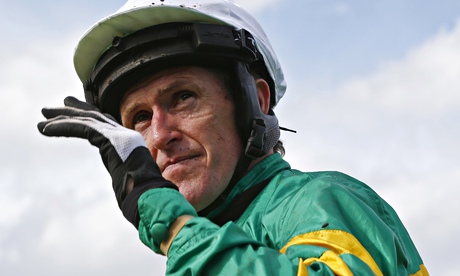
Speculation persists as to what Tony McCoy is going to do with the half-century that may remain to him and it seems the man himself has no definite plans but there is at least one thing one can confidently expect him to be doing for many years to come. The 20-times champion jump jockey has never needed prompting to show his support for those of his colleagues suffering from serious injury and it was like him to raise the subject once more as he made his farewells at Sandown on Saturday.
“I’ve seen the very tough side of this sport,” McCoy said, “with colleagues being fatally injured and very severely injured as well. I feel very lucky that I’ve been able to end my career in one piece. Those lads we have lost along the way, I will never forget. The lads that have been injured, you try and do your best for them.”
McCoy continues to be a vice-patron of the Injured Jockeys Fund and, in his first week as a free agent, will make a point of visiting two riders who have suffered more than most. Robbie McNamara remains in hospital after a shocking fall at Wexford on the day before the Grand National and is said to be remarkably positive as he tries to recover from a spinal injury. His cousin JT McNamara was paralysed by a fall at the Cheltenham Festival two years ago.
Spring and summer can be a particularly dangerous time for jockeys, as drying ground offers less of a cushion in the event of a tumble. Peter Toole, Brian Toomey and Isabel Tompsett all suffered serious head injuries at about this time in recent years, from which all three are said to be progressing well with their long-term recoveries. The point-to-point jockey Ed Barrett remains in a Plymouth hospital with a spinal injury sustained a fortnight ago.
It is to be hoped British racing is doing something right because it is almost 10 years since Tom Halliday’s death at Market Rasen, the last time that a jockey was killed on a racecourse here. A report at the time of Richard Davis’s death at Southwell in 1996 said that six other jockeys had been lost in the previous 15 years.
Racing remains a risk sport, as was seen in Australia last October, when two jockeys were killed in the same week. But the hope is that the advances made in medical treatment, safety procedures, racecourse preparation and jockey conditioning have all helped to improve everyone’s chances of going home safely.
At this point, it may be worth praising the work of Sandown’s clerk of the course, Andrew Cooper, whose watering campaign ensured safe ground for Saturday’s jump racing. Trainers of horses in need of fast ground were understandably irked but safety is generally recognised as the right priority these days.
The thought occurred, as Saturday’s crowd thronged Sandown to see off McCoy into retirement, that this would have been an excellent opportunity to promote the Injured Jockeys Fund to a receptive audience. There will not always be 18,300 in attendance but Sandown has made a success of its Jumps Finale card and apparently IJF officials will have a discussion with the course about possibly featuring the fund’s work on that day in the future.
It should be said that racecourses have a fine record of backing up the IJF. During its 50th anniversary celebrations last year every single British track offered it fundraising opportunities. And the fund’s excellent work includes the construction of Jack Berry House, a £3.5m project in Yorkshire to be opened in June, with McCoy expected to attend, which will offer northern jockeys the same rehabilitation facilities that have been available since 2009 in Lambourn at the fund’s Oaksey House.
But there is no single day’s racing in this country which is used to push the IJF and that seems like an omission that could usefully be corrected. The racing public’s sympathy for injured jockeys is in no danger of being exhausted. There is always more that racegoers can do to remember those who were unable to walk away from the sport in one piece.