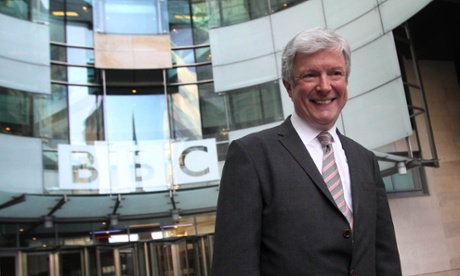
Tony Hall, director general of the BBC, will argue that a strong, pioneering corporation needs political and financial backing if it is to prosper in the digital age and offer more personalised services as part of a reinvention he dubs “myBBC revolution”.
In an important speech on the future of the corporation on Monday, Hall says the BBC is at a crossroads where it can either continue as a national standard bearer for the creative industries at home and abroad or “sleep-walk into decay”.
Not only is the speech Hall’s first dealing with the future scope and scale of the BBC – likely battlegrounds of charter renewal negotiations – it comes less than a week after an influential committee of MPs gave their verdict on the funding and governance of the BBC.
In a nod to criticism of the BBC’s financial and editorial management mentioned in the report, Hall will suggest that he has fixed some of the problems dogging the corporation since taking the top job two years ago – by making £1.5bn of cost savings and strengthening editorial processes – and now needs support for the BBC to become “pioneers again”.
“The internet gives the BBC the tools to make public service broadcasting better,” he will say at a speech at Broadcasting House. “To do this, we must reinvent the BBC once more.”
Commercial rivals are likely to see the speech as an aggressive statement of intent positioning the BBC as a sort of public-service Amazon, offering personalised services which allows viewers to pick their own follow-up programmes. Using Wolf Hall, the showcase drama based on Hilary Mantel’s award-winning novels that ended last week, Hall says fans should have been given the chance to watch “the best of BBC’s content about the Tudors or radio shows about historical novels... The potential is huge to let our audience become schedulers.”
“This is the start of a real transformation – the myBBC revolution. How to reinvent public service broadcasting through data. But we will always be doing it the BBC way – not telling you what customers like you bought, but what citizens like you would love to watch and need to know.”
Hall welcomed the MPs’ report, which argued that the license fee needed to reflect changing viewing habits and suggested a universal household levy as one alternative. “We’ve always said that the licence fee should be updated to reflect changing times. I welcome the Committee’s endorsement of our proposal to make people pay the licence fee even if they only watch catch-up television.”
Adapting the “licence fee for the internet age... is vital. Because I believe we need and we will need what the licence fee – in whatever form – makes happen more than ever.”
Given the fact that the current license fee settlement runs until the end of 2016, leaving just 18 months after the election for a new agreement to be reached, the speech offers politicians a vision of the future with the media dominated by foreign-owned global groups. Hall made no mention of the report’s other main recommendation – that the BBC Trust governing the corporation should be abolished – although in the past two years he has already appointed several senior non-executive directors to a sort of internal “unitary board” recommended by the report.
“The BBC is at a crossroads,” says Hall. “Down one path lies a BBC reduced in impact and reach in a world of global giants. Damaging the UK’s creative industries. A sleep-walk into decay for the BBC, punching below its weight abroad and Britain diminished as a result. Which means a UK dominated by global gatekeepers and American taste-makers.
“Down the other path is a strong BBC helping bind the country together at home and championing it abroad. A British creative beacon to the world. Providing a universal service for a universal fee. An internet-first BBC which belongs to everyone and where everyone belongs. A BBC celebrating its hundredth birthday but with its best days ahead of it.”
With those on the right wing often opposed to continued high levels of state funding for a media company, BBC bosses hope this appeal to nationalist sentiment will provide support. Last Tuesday, the day before the commons culture, media and sport committee launched its report on the future of the BBC, the prime minister talked about the value of impartial media abroad at the liaison committee.
“We have got to recognise one of the strengths we have got as a country – although we don’t always necessarily see it this way – is that we have a very strong and impartial media, we have a wonderful brand in the BBC knowns for its impartial views. We should be supporting the BBC to provide news services and news channels where people otherwise are getting a diet of Russian disinformation.”
Hall will say: “What we do is undeniably good for Britain and the British public. And will become even more so in the internet age.”
As part of the changes, Fran Unsworth, director of BBC World Service, is to join the BBC’s senior exectuive team.