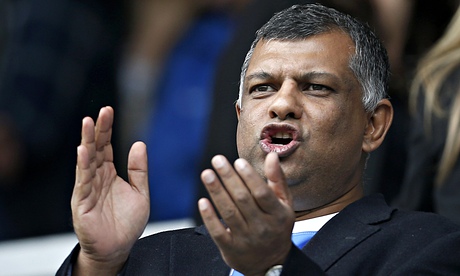
For clues as to how Queens Park Rangers have progressed since the Air Asia mogul Tony Fernandes walked through the door promising to polish up west London’s “rough diamond” and proceeded to go round in circles, it is worth taking a trip to their training ground.
Long-mooted plans for a new training complex at Warren Farm, initially rejected in the face of protests from residents and then resubmitted in January this year, will not bear fruit for at least two years. Meanwhile, an exciting vision for a new stadium at Old Oak Common remains in flux amid opposition from the landowner Car Giant and debate over the wider regeneration of the area.
So QPR carry on battling in their cramped, charming ground and are engaged in an uphill scrap against a second relegation from the top flight in three years at Chelsea’s cramped former training headquarters. For all the millions poured into the pockets of players and agents who did little to deserve it, for all the big talk and grand plans, QPR are arguably no further forward than when the likable Fernandes pitched up in 2011.
“What’s happened with the training ground isn’t too dissimilar to the situation with the first team, where we brought a lot of players in and it didn’t work – we got relegated,” admitted Fernandes in January.
Or as one poster on a QPR messageboard ruefully put it, Fernandes took over the team in the Premier League with debts of around £20m (following the madcap, chaotic Flavio Briatore era brilliantly captured on film in The Four Year Plan) and could this summer preside over one heading for the Championship with debts of more than £200m.
For all the business acumen of Fernandes in other fields (not to mention that of the billionaire steel magnate Lakshmi Mittal, who owns a 30% stake in the club), during his time at QPR the club has fallen foul of all the worst excesses of the modern game.
One of the puzzles of the Fernandes era has been how a man so feted elsewhere – and recently named by Time magazine as among the world’s 100 most influential people – could preside over such a chaotic rollercoaster ride at QPR.
As Neil Warnock was traded in for Mark Hughes and then Harry Redknapp, the club became first stop for agents looking to offload players past their prime and whose big wages have proved a drag on the balance sheet ever since.
Jermaine Jenas, a QPR player for 18 injury-hit months and now a pundit for the BBC, was the latest to confirm, on Football Focus last weekend, that work ethic were not always the first words that sprang to mind when he scanned the dressing room.
As Ed Thompson points out on his Financial Fair Play blog, it is instructive to note that the Derby team that outplayed QPR in last season’s play-off final before going down to a late Bobby Zamora goal had a wage bill of around £13m. We now know that QPR’s that season was £71.96m, just £1.3m less than their previous season in the Premier League.
On returning to the Premier League following that dramatic play-off victory, things were supposed to be different. The club bought more sensibly, showing signs of wanting to build a team rather than throwing together a collection of big-name recruits. But Redknapp’s QPR was a misfiring, oddly melancholy machine and the signing of a spent Rio Ferdinand a reminder of earlier regimes.
Under the director of football, Les Ferdinand, and the manager, Chris Ramsey, appointed in February after Redknapp departed complaining of a dodgy knee (he has since alluded darkly to mischief-making behind the scenes), it has been a case of one step forward followed by one back.
Ramsey, who has had no discussions over his future beyond the end of the season, insists the days of dressing-room discord are long gone. He talks up the spirit engendered by Joey Barton and Clint Hill, of the brilliance of Rob Green, about the willingness of Zamora (a doubt for this weekend) to play through injury, about Charlie Austin’s ability to shoulder the goalscoring burden.
Yet recent weeks have brought only frustration, with decent performances failing to yield precious points. At home to Chelsea they lost to a last-ditch Cesc Fàbregas goal and then Austin missed a penalty to forego victory against West Ham. The fine margins that assume even greater importance for clubs in dire straits are looming large for Ramsey before Saturday’sgame at Liverpool.
“The last thing you want to do is start moaning about who is injured and who isn’t and which referees decisions happened and which didn’t, but sometimes you do reflect on how these last few games have panned out because of these critical times,” he says.
When it is suggested that Brendan Rodgers may be under more pressure than him, Ramsey stops short of calling his inquisitor an ostrich. Not for him the passive aggressive posturing of the similarly under-pressure Nigel Pearson. But he makes his feelings plain nevertheless.
“I would really love to have that pressure that he’s got,” he says. “I don’t know how you guys work if I’m being honest. He’s at a big club, he’s done very, very well. You don’t become a bad manager overnight.
“The pressure is on us really because we don’t want to go out of the division. The implications of going out of the division are huge. So I think we actually have much, much more to lose than him.”
With QPR four points from safety with four to play, and at Leicester on the last day of the season, it will be an uphill battle.
“Every manager will feel the pressure,” Ramsey says. “Most of the pressure isn’t about yourself, it’s about the people around you. You want to do well for the fans, the owners and everyone who has put their effort and time into making the club what it is. How can you keep everyone in work? How can you keep the people that surround the club in work?”
And if the worst happens and QPR yo-yo back down again, the £50m mystery hanging over the club’s head will become a major concern.
Last month QPR released a terse statement saying that losses had been cut from £65.4m to £9.8m during their year in the Championship and noting that the club’s owners had written off £60m in loans; the implication being that QPR would thus avoid a hefty fine of up to £50m levied by the Football League for busting its FFP rules.
But the long-running issue is far from settled, with lawyers on both sides scrutinising the fine print over whether the £60m write off is legitimate under the rules and the threat of a fine still hanging over the club. Despite the controversial loan write-off, debts grew according to the most recent accounts to more than £205m.
They also reveal that £53.7m of that loan was waived by Tune QPR, the vehicle though which Fernandes and his partners (Kamarudin Meranun and Ruben Gnanalingam) own 69% of the club. Sea Dream, the company through which Mittal owns 30%, waived just £6.6m.
So Fernandes and his business partners continue to pour money into a club that they insisted would essentially run as a going concern, while granting interest-free loans that have helped swell the overall debt. The accounts to the end of May 2014 detail a lengthy list of interest-free loans totalling £115.3m from Tune QPR and £5.3m from Sea Dream that may have to be repaid if the club were sold.
Having alighted almost by default on Ferdinand and Ramsey, surely the best course of action would be to give them an opportunity to build from the bottom up. There has been upheaval at executive level too, with the recent departure of chief executive Philip Beard.
Fernandes claims to be learning all the time and in it for the long haul. But an increasingly jittery fanbase that initially warmed to the Malaysian over his Twitter accessibility is urgently looking for reassurances that he will not leave them back where they started nursing an altogether bigger debt burden.
“The key is a philosophy, and a philosophy can’t be built overnight,” said Fernandes when he arrived. “A philosophy takes years, and the culture of what you want to do.” Four years into another plan that has dissolved into a soap opera, that guiding philosophy is not much clearer.
For Ramsey, at least, the immediate task is plain: “We do believe we can stay up,” he insists. “But we know it’s going to be a very difficult task.”