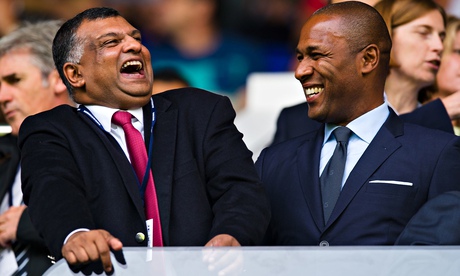
Is it really only three and a half years since Tony Fernandes sat alongside Neil Warnock in a packed, airless media suite in the South Africa Road stand and proclaimed football a “fantastic business if run well”? He pointed to his experience controlling costs and challenging the big boys in both the airline industry and in Formula One and vowed to do the same at Queens Park Rangers.
Plenty of red ink has passed under the bridge since then. Not to mention three managers, a small fortune squandered on ageing players amid abrupt U-turns in strategy, one relegation, one promotion and an ongoing stand-off with the Football League that could yet result in a fine of tens of millions of pounds.
QPR fans hoping the arrival of Fernandes, who bought a majority stake with long-term silent business partner Kamarudin bin Meranun for £35m, would signal an end to the comic turbulence of the Flavio Briatore/Bernie Ecclestone era have long since come to terms with their disappointment.
Fernandes was a West Ham fan who had failed in two aborted bids for the East End club before alighting upon QPR. Yet like others who have succeeded in other fields before investing in football, he seems at times to have struggled with the peculiarities of a business that is difficult to equate to any other. With lieutenants Philip Beard, who had a good reputation but scant football experience before arriving as chief executive, and Amit Bhatia, appointed chairman when his father-in-law Lakshmi Mittal took a 33% stake, he has too often appeared at the mercy of his managers and their retinues.
Another promise Fernandes made when he bought the club was to act with transparency. In one sense he has honoured that vow, acknowledging mistakes and spending plenty of time on Twitter. He was at it again on Wednesday in the wake of the departures of Harry Redknapp, Glenn Hoddle and Joe Jordan.
Accused of presiding over a “shambles” by a fan exercised by QPR’s failure to win a point away from home all season, Fernandes remained upbeat: “One of the few clubs who bounced back from Championship. 19 points. In the mix. Lots of mistakes but many clubs have made mistakes.”
Among those mistakes has been a willingness to waste big money on players who saw Loftus Road as a pleasant retirement home or who simply were not up to the job. QPR insiders insist the dressing room atmosphere is much-improved but even now they have the second oldest squad in the top flight.
Rangers were fortunate in many ways to bounce back via a last-minute Bobby Zamora play-off final goal to reach the Premier League promised land, with its attendant broadcasting riches.
While Fernandes happily engages on Twitter and the club’s PR staff have won awards for their social-media strategy, beneath the forced bonhomie big questions are lurking. It remains unclear just how much has been pumped into the club in loans by Fernandes and his fellow shareholders. A £27m loan from Barclays was last season secured on the stadium. QPR have not published any accounts since those for the 2012-13 season that resulted in relegation and revealed a £65m loss. The wage bill alone amounted to £78m in the year to May 2013.
Accounts for the following year have been lodged with the Football League, which is considering them with a view to an FFP fine, but not yet filed with Companies House. The League has said QPR could theoretically be exiled to the Conference if they go down and refuse to pay up.
Meanwhile, the patience of fans who initially warmed to Fernandes is starting to fray. The tendency to seek an equal and opposite reaction to what has gone before looks set to lead QPR to a progressive pairing of Les Ferdinand as director of football with one of Tim Sherwood, Paul Clement or Steve McClaren as manager.
It all points to a realisation that the common theme amid the malaise is a lack of long-term thinking. Yet in all this, there is nothing to suggest that Fernandes made decisions with anything but the club’s best interests at heart. He is delivering on promises to make progress on a new training complex and modern stadium that can better deliver revenues commensurate with breaking even. But neither has gone according to plan.
The training ground development has seen the club amend the plans and the path to Old Oak Common has also been less than smooth as QPR remain at odds with Cargiant, which owns 45 acres of the site and has rival plans for the area. “Of course it’s been tough – I never expected it to be easy. But I love it. It’s been a real challenge and we’ve learned a lot,” a defiantly glass-half-full Fernandes told the Guardian on Wednesday night after another day of breathless speculation.
“We’re still in the Premier League and we’re putting the wrong things right. The experience at [play-off final] Wembley was one of a kind. Not many people alive could have had that feeling.” His investment has so far bought him a once-in-a-lifetime buzz and a whole heap of trouble. If it ends in a second relegation in three seasons, things will get worse still.