Night time political summary
- Tony Abbott says there is no reason why any groups should feel alienated by the government’s national security crackdown. Though the citizenship changes had been flagged by him yesterday, the PM said he would not talk about them until later in the week. Instead he appointed the new counter-terrorism coordinator Greg Moriarty and gave justice minister Michael Keenan the job of overseeing deradicalisation programs.
- The immigration department have been expanding - or not - on the concepts of take backs and turn backs, documenting the return of 46 Vietnamese asylum seekers to their country of origin.
- Pistol and Boo, the Johnny Depp dogs, got a run in the senate estimates as Bill Heffernan and Labor’s Glenn Sterle wanted to know how the dogs got through the inspection, the lounge, customs and the airport to a pampered pooch parlour.
- Heffernan was also trying kill off the idea that Australia may allow US meat products into the country, through the Trans Pacific Partnership Agreement, currently being negotiated by trade minister Andrew Robb.
- Question time was dominated by Natsem research which found lower income families were hit harder by the budget. Labor did not release the full report, which blunted their attack in parliament and gave Joe Hockey the chance to have some fun.
- Several Liberals called for a free vote on same sex marriage, joining Tony Abbott’s sister. The idea of a referendum on the issue - like Ireland - was quietly put to bed.
So here, I will bid you farewell. Thanks to the ailing Mike Bowers for his lovely pics and the brains trust, Lenore Taylor and Daniel Hurst.
I told you that puppet on a string routine would come back to bite.
This man is Prime Minister of Australia. #auspol pic.twitter.com/6obGHEdRfb
— Tony Burke (@Tony_Burke) May 25, 2015
Good night.
Who signs off on the script of the telemovie?
Major general Andrew Bottrell says he gets to sign off but his staff work on it. The movie represents “actual events that have occurred”.
The telemovie will be screened in Iran, Iraq Afghanistan and Pakistan. It will have three major broadcasts and nine repeats.
The total anti-people-smuggling information campaign costs $70.7m.
(This does not represent a true depiction of the telemovie.)
@gabriellechan *EXCLUSIVE* first look at the Operation Sovereign Borders movie 'Girt By Leviathans'. #politicslive pic.twitter.com/V2tLVabx4h
— The Matt Hatter (@MattGlassDarkly) May 25, 2015
Updated
On to Nauru now. The department confirms there are 677 transferees in the Nauru processing centre.


Labor’s Kim Carr wants to know how many injuries and medical emergencies have occurred at Manus Island detention facility since 1 July, 2014.
The department is taking the questions on notice.
Bottrell says he cannot tell the senators that when the four asylum seekers who have agreed to move to Cambodia will be taken there. The program costs $40m.
Carr: Is it $10m per person, is that how it works?
No. Michael Pezzullo says the Australian government has committed to a whole program worth $40m.
Estimates also hears that the immigration department is spending $4.1m on a telemovie as part of its anti-people smuggling campaign.
The production house which was awarded the contract is Put It Out There Pictures, which is still in the casting phase.
Which fits quite nicely with the government’s Have A Go budget.
Take backs and turn backs
Major General Andrew Bottrell, head of Operation Sovereign Borders, is asked about the success of “turn backs and take backs”. Bottrell says he cannot talk about the policy settings but:
a combination of those factors really add to the OSB success.
Greens senator Sarah Hanson-Young is taking Bottrell back to the Vietnamese asylum seekers who were taken back to Vietnam in April by the Australian government officials.
The asylum seekers were intercepted on March 20 and returned to Vietnam in mid-April, though Andrew Bottrell could not confirm how much time they were held on own vessel and/or on a customs vessel.
The asylum seekers “were all screened out”. There were men, women and children on board, though no unaccompanied minors.
Hanson-Young wants to know what assurances were given by the Vietnamese government that there would be no retribution against the 46 people.
Bottrell says there was be a “level of comfort” promised by the Vietnamese government and there was “no retribution for their illegal departure from Vietnam”.
However he confirmed the Australian government did not “track people” once they are returned.
With a take back, overt engagement with a foreign country.
Hanson-Young wants more information on boats turned back but the immigration department says they cannot share such sensitive information.
Michael Pezzullo, immigration department head, explains the different between turn backs and take backs.
I am paraphrasing here but with take backs, there is a country-to-country engagement. Everyone knows how it is done. With turn backs, there is no country to country engagement. Immigration does not want to telegraph how it is done because people smugglers will adapt their methods.
Now we are over the immigration estimates. Michael Pezzullo, immigration department secretary is speaking about the people smuggling trade and their efficacy of “selling a dream”.
Earlier in the day, immigration officials confirmed that 46 Vietnamese asylum seekers were held on their boat for nearly a month for before it was turned back to Vietnam.
The hot seat.

I don’t give a rats who they are, they are going to cop it.
Bill Heffernan has gone to his corner and in the meantime, Twitter corro @MattGlassDarkly has sent this representation of #BistolandPoo being getting into Queensland.
@gabriellechan **How Pistol & Boo were smuggled into Qld. The pilot fooled officials by saying the flight was 'ruff". pic.twitter.com/bjlXNPlT3b
— The Matt Hatter (@MattGlassDarkly) May 25, 2015
The agriculture department tries to reassure estimates chair Bill Heffernan there is no plan for fresh beef to come into Australia.
Heffernan says there was a proposal and he has the email trail. There was pressure put on Australia under the TPP arrangements. Heffernan says some in the Liberal government are aligned with the TPP philosophically but:
I don’t give a rats who they are, they are going to cop it.
Tim Chapman of the agriculture department says before any fresh beef is allowed into Australia, the government would have to do a biosecurity assessment. Only beef from Vanuatu and NZ is currently allowed in.
Heffernan won’t be swayed. He is comparing his cache of documents to Edward Snowden’s.
Bill Heffernan is now moving onto biosecurity and processed meat. The nub of this issue is that Heffernan has been protesting the possible import of American beef through the Trans Pacific Partnership (TPP) and/or through the possible approval of processed American meat products. He has already flagged concerns about the potential of bovine spongiform encephalopathy (BSE) or mad cow disease coming into the country in US beef.
Food Standards Australia and New Zealand (FSANZ) is the regulatory body. Estimates hear that countries with BSE could get access to Australian markets if they had an assessment and approval by FSANZ.
FSANZ have been reviewing countries and no decision has been made on the United States.
Heffernan wants to know if the department understands the definition of processed meat because he checked with Tony Abbott’s office, and they did not know.
Updated
Labor senator Glenn Sterle wants to know what process has been changed since “Bistol and Poo” arrived. (Excellent slip of the tongue.)
Rona Mellor of the department says they are considering using security dogs to detect rogue dogs if they are suspected on any new vessel.
It’s a real dog fight here.
Labor WA senator Joe Bullock suggests perhaps agriculture minister Barnaby Joyce could be enlisted in the department’s biosecurity campaign.
He’s very effective at it.
Seriously though, officials are talking about balancing the need not to impede passengers and trade and the need to protect Australia’s biosecurity.
The event has been a pretty good advertisement for the requirements of the biosecurity system, says an official.
The floodgates are opening now. Estimates hears from various senators and agriculture officials that there have been other illegal imports:
- 24 containers of dirt
- honey bees
- two dogs, aka Pistol and Boo
- a small dog in a handbag on a commercial flight.
Did the small dog in the handbag go through the x-ray, asked Heffernan?
No. He woke up, says official.
Did it have toilet facilities in the handbag, asks Heffernan?
Don’t answer that.
The Pistol and Boo timeline.
- Dawgs arrive: 21 April
- The first media inquiry: 11 May
- Dawgs were kept at the Gold Coast property for that period of time. (Presumably apart from the pet salon.)
- Dawgs exported: 15 May
Heffernan speculates that if he were a “celebrity and a lair with plenty of money to throw around”, he would hide the dogs and get a staffer to take them off the plane.
Lucky Heff is not a celebrity and a lair.
Pistol and Boo are before the Senate estimates
Liberal senator Bill Heffernan wants to know how Pistol and Boo rode in on their jet with master Johnny Depp, aka Captain Sparrow.
Heffernan wants to know if the captain of the plane signed anything to declare the plane was terrier free.
The agriculture department spokesman says they have no evidence that “leads us to believe he had a declared animnal on board”.
Heffernan wants to know whether the captain signed a false affidavit.
Agriculture tells Heffernan that masters of vessels needs to declare prior to arrival whether they have animals on board.
Is it fair to say you know but don’t want to disturb the legal process?
So it appears from the answers that an inspector did board the plane before anyone got off but they don’t know whether the dogs were on the plane because they were not found. Heffernan wants to know the process.
Some people think they are too good for the system.
The dogs got off the plane, though the private lounge, through customs and they were discovered “in Australia”.
Not in the airport? Not in the airport, says the official.
Jesus! says Heffernan.
Updated
Hatching a plan.

Question time is over.
Tony Burke asks the speaker about the convention not to name staff members in the house after Joe Hockey named a Labor staffer today. Burke raises the point and reminds the government that “they know” the stories Labor has chosen not to run. Which sounds like a shot across the bow.
Speaker Bishop says it is not a question for her. And reminds Burke she has been kind enough to let him make the statement on indulgence.
Shorten to Abbott: Before the election, the PM promised not to make any adverse changes to superannuation. But since the election the PM has twice frozen the superannuation guarantee, and has increased superannuation taxes on low income earners, measures that will cost Australians over $900bn in retirement savings, $900bn over the next 40 years. Why is the PM cutting the superannuation of low around middle income Australians?
Abbott:
This government made a commitment prior to the election that there would be no adverse changes to superannuation in this term of parliament and that is exactly what we are keeping. That is the the commitment that we are keeping.
Which does not account for the government’s freeze in the superannuation guarantee.
Chris Bowen to Joe Hockey: Will the government be changing the draw down or preservation age rules governing superannuation?
We absolutely have no plans to change super, says Hockey.
Ruling in. Ruling out.
Social services minister Scott Morrison is asked by Jenny Macklin, did the government do any modelling of the impact of its cuts to families before the May 12 budget and when will you release that modelling?
Morrison does not answer whether modelling has been done but he extends Abbott’s lines around Labor being the party of welfare.
What those opposite want to see is the Shorten shuttle, the bus that goes from the school gate to the Centrelink office. That is what they want. The future that they see for Australia is more welfare and higher taxes. On this side of the house, Madam Speaker, we want to see welfare for those who really, really need it, not just those who think they’re entitled to it.
Just not sure about this line. It smacks of more language about rorters, fraudsters, leaners not lifters. Especially given the budget accepts 6.5% unemployment over the next four years. If you were desperately looking for a job, how would you feel?
Ryan Sheales, journalist at The Project, has kindly delivered a photo of Tony Abbott riding to the rescue for the Australian people.
@gabriellechan "Riding to the rescue..." pic.twitter.com/CzwRXWkTx7
— Ryan Sheales (@RyanSheales) May 25, 2015
Shorten to Abbott: Does the PM believe that people working in Australia should be paid Australian wages and conditions?
I think I know what this question is all about. It’s quite interesting their union master, tugging on the strings.
Abbott does a rendition of a puppet dancing.
(Can’t wait for the photos.)
Here’s one of Joe Hockey, in the meantime.

Shock horror, a skinny mocha.

Labor asks Abbott: Why does the PM’s unfair Budget slash the household budget of 10,000 families in the electorate of Page?
Abbott:
I will tell the member who asked the question what’s unfair. Starting the boats and putting the people smugglers back into business, that is unfair. And I will tell you what’s fair. Stopping theboats an saving all those livesat sea.
Madame speaker, there’s got to be something relevant to the question, says Tony Burke.
The prime minister continues on, “riding to the rescue” of the Australian people.
(There must be some pictures I can use here.)
Joe Hockey is demolishing the Natsem modelling. He is using the document sent out to journalists. The treasurer names Ryan Liddell, Labor staffer, as the owner of the document according to the data.
This has come about because Labor did not release the whole of the Natsem research, just excerpts. Which was passing strange. For the record, yesterday I requested the whole report, but it was not supplied.
Bruce Billson, small biz minister, has met some of Tony’s tradies.
There was Steve and his son. They’re painters and they said because of this budget they will invest in new tools an new kit to grow their business. He said, ‘As a result of these budget measures it will give mean opportunity to expand the business and therefore employ more people.’ Isn’t that great? Everywhere we’re going we’re seeing a positive and optimistic response to this budget.
Labor asks Abbott: How can the PM describe his Budget as a jobs Budget when, according to his own budget papers, unemployment is rising to 6.5%and is at a 14-year high?
Jobs growth is three times now what it was in the last year of members opposite and jobs growth should accelerate in a the months ahead because this is a budget for confidence, says Abbott.
You heard it here first.
Stop the boats. End the waste. Release the data.
"Release the data" PM Tony Abbott and treasurer Hockey taunt the opposition @GuardianAus @gabriellechan #politicslive pic.twitter.com/xfeNh1XeKz
— Mike Bowers (@mpbowers) May 25, 2015
Greens MP Adam Bandt asks about the loss of funding for the only community not-for-profit pharmacy in his electorate.
Health minister Sussan Ley says the community pharmacy, which operates on subscriptions from the local community, is the only one of its type in Australia. The budget changes means the pharmacy will transition to the Pharmaceutical Benefits Scheme.
We’ve given Co-health, I understand, 6-month notice and an understanding to work with them to transition them to the PBS.
Tony Abbott again repeats the line about Labor preferring people trapped in welfare but takes it further.
Government should be there to help, government should never be the master of the people. It never ever should be the master of the people and the trouble with members opposite is they are no longer a working class party. They’re a welfare class party, that is the problem. That is the measure of the decline of the once great Labor Party, they would rather see people stuck in the welfare system than helped by government to get the jobs that will liberate them for the rest of their life.
Labor to Abbott: NATSEM modelling shows nine out of 10 of the lowest income families lose under the PM’s budget. So why did the PM say that this Budget would be “good for families”?
Abbott:
I do recall saying what I said and if members opposite want to vindicate ...vindicate the work of NATSEM, release it.
Tony Abbott is asked again on the Natsem modelling, which Labor has yet to fully release.
It absolutely must be released and every moment that the modelling is kept hidden by members opposite demonstrates that even they fear that it can’t all be taken seriously, even they fear that this particular modelling is cannot withstand serious scrutiny.
Abbott says the Natsem modelling does not take into account the impact of people moving from welfare to work. Though given it has yet to be released, it is unclear how he knows that.
Unfortunately Madam Speaker members opposite rejoice when people are trapped in welfare.
Labor frontbencher, Mark Dreyfus yells out:
You’re not fit to be prime minister.
Speaker Bishop throws Dreyfus out for an hour.
Abbott’s government question is on small business instant asset write-offs. He mentions the good coffee at a business yesterday, to which Labor mocks him for his choice of a skinny mocha.
What’s wrong with skinny mocha, come on!
Speaker Bishop urges the house to calm down.
Enough hilarity. Enough. The PM has the call.
Abbott tells the house he is a man of many shades. Not in so many words.
There is a time for shandy of lite as well as there is a time to skoll a full strength beer at the Double Bay Oak.
Updated
First question from Bill Shorten to Tony Abbott on the Natsem advice which shows the budget hits lower income families hardest.
Abbott missteps by calling Shorten prime minister.
Then onwards and upwards.
It does seem from what we can make of the Natsem modelling so far that the Natsem modelling does not take into account the impact of people moving from welfare into work. And that’s exactly what we want to encourage. Unlike members opposite who want to trap people in welfare, we want to encourage people to move into work.
A six flag announcement.


Three blokes.

Readers asked me to track down the disability announcement from foreign minister Julie Bishop.
With five minutes to go before question time, here t’is:
It was part of a new strategy within the foreign aid program to strengthen the inclusion of people with disabilities in developing countries.
The strategy recognises that everyone is affected if the most disadvantaged people are left behind, and acknowledges that people with disabilities make up one of the largest and most disadvantaged minorities in the world.
Development for All 2015-2020: Strategy for strengthening disability-inclusive development in Australia’s aid program will support people with disabilities in developing countries to find pathways out of poverty and realise their potential.
Abbott is asked about military strategist David Kilcullen’s view that the west should acknowledge that Isis is acting like a state. Here is an excerpt from Kilcullen’s analysis in The Australian:
What is clear is that we need to start treating Islamic State as what it is — more than just a terrorist group or an extremist death cult but, rather, something that looks increasingly like what it claims to be: a state.
Islamic State controls territory and population, governs cities, levies taxes, disposes of substantial economic and military resources, and is in the process of redrawing the map of the entire Middle East through aggressive (largely conventional) military conquest.
It does have an international terrorist network as well, and its reach on social media — along with its ability to radicalise people in the West and draw recruits from across the world — is dangerous.
But its most threatening aspect of its state-like nature, which has turned a longstanding Sunni-Shia cold war into a hot conflict that is dragging in regional and global powers such as Iran, Turkey, Israel, the Gulf states, Saudi Arabia, Russia and, of course, the US and allies including Australia, New Zealand, Canada and Britain, along with several European countries. At least five of these states are present or threshold nuclear powers, so that — in a worst-case scenario — the escalating regional conflagration centred on Iraq and Syria even carries the ultimate risk of a nuclear exchange.
The PM hones in on the terminology.
I am not going to dignify a death cult. If some entity was to start killing people and call itself “ the true Vatican”, I would not use that terminology...
Now plainly they they have a high level of control secured through terror over millions of people, and vast areas of land and this is why it’s absolutely important that we do everything we reasonably can to enable the legitimate government of Iraq - the democratically-elected government of Iraq - to recapture the territory that is rightly it. And without wanting to say that everything that the current Iraqi Government does is perfect, by the standards of democratic legitimacy, it’s pretty good in that part of the world.
Tony Abbott is asked about the “debacle of Ramadi”, with the withdrawal of Iraqi troops, who greatly outnumbered Isis. Abbott again says the war is “reaching out to us” and then gives Australian-trained forces a pat on the back.
The one Iraqi security force element that most stuck to its post and withdrew from Ramadi as a formed unit as opposed to a disorganised group was the unit, the counter-terrorism service of the Iraqi security forces that we have been advising and assisting in our initial placement at Baghdad International Airport.
Tony Abbott is not going to announce citizenship details today: “We’ll have more to say later in the week”. He goes for more of the general vibe today:
We were intending to extend to people who had participated in terrorist activity against Australia the same sanctions that have long existed under the Citizenship Act for people who have served with the military of a country at war with Australia. So effectively what we are doing is acknowledging that in the modern world it’s not just people who are serving with an enemy army who are in a sense at odds with the whole nature of citizenship , but people who are working with terrorist organisations that hate our country, hate our way of life, hate our values.
Brandis says Greg Moriarty was needed because the many different security agencies are located in various departments.
Moriarty, a former ambassador to Indonesia, has seen the benefits of coordinated agencies through Operation Sovereign Borders.
I have seen the benefits to the government of tightly coordinated interagency work. In Jakarta where I worked with multi-agencies to tackle challenges relating to counter-terrorism, in Indonesia and South East Asia, but also the very enormous amount of interagency work we did in support of Operation Sovereign Borders and I think our agencies have enormous depths of talent and enormously hard-working people.
George Brandis wants to elevate the Countering Violent Extremism (CVE) programs
Increasingly, we know that stopping this problem at source, anticipating it before it metastacizes into an irretrievable problem, is an essential element of meeting the terrorist challenge and that’s particularly acute now that we see this very alarming trend that younger and younger people now people of 14 and 15 years old are being radicalised.
It made sense to appoint Keenan, as the junior minister, Brandis says.
Abbott announces as expected, Greg Moriarty as counter-terrorism coordinator and Michael Keenan assisting the prime minister on counter-terrorism.
Keenan will take responsibility within the attorney-general’s department, for countering violent extremism programs.
George Brandis is speaking on the changes.
When we receive the departmental review and the Martin Place siege review to which the PM has referred, we examined those reviews closely and asked ourselves the question - is there anything more that could be done to make the preexisting arrangements even stronger?
Tony Abbott is now speaking on national security.
There’s now at least 100, the number of Australians, actively supporting the death cult and other terrorist groups in the Middle East. Here at home is going up all the time, there’s now at least 150.
Morrison favours a conscience vote on same sex marriage. Or does he?
While we wait for the prime minister, here is a little snippet from an Ray Hadley interview with Scott Morrison on same sex marriage.
Hadley: More Australian politicians say they are now supporting gay marriage which of course doesn’t require referendum here, where do you think we are headed with this one?
Scott Morrison:
It will be considered by the parliament I assume at some point. My position has never changed on this and it isn’t going to. That is a matter of conscience for me and I respect the conscience of other members. But it is a change to the Marriage Act it is not a change to the constitution which is the point the prime minister was making. So that is not the mechanism to change this in this country. But look everyone in Australia has a view about this and that is fair enough and I think we should all treat each other with respect about the different views that we have. I have my view, I don’t support the change, I don’t go around ramming that down others’ throats but that is my view and I intend to stick to it.
Which sounds like the member for Cook is in favour of a conscience vote.
Lunchtime political summary
- As the inquest into the Martin Place Lindt cafe siege continues, the government is bringing on changes which are expected to strip dual nationals of Australian citizenship. The PM will elaborate at 1pm.
- A number of Liberals have called for a conscience vote on same sex marriage.
- Labor’s Melissa Parke and Liberal father of the house, Philip Ruddock, joined to condemn the death penalty and call on all members to work to end the use of the death penalty around the world.
- The government has offered to help families to repatriate remains of Australian soldiers killed in the Vietnam war.
- The Greens have completed a minor reshuffle, seeing Adam Bandt as treasury spokesman, Scott Ludlam on foreign affairs and Janet Rice on LGBTI and marriage equality.
The prime minister will hold a press conference at 1pm. Citizens alert!
In the appropriation debate, Tanya Plibersek has talked about budget cuts, many of them around health. She says the budget fails the fairness test and the economic test, set by the government.
This budget, as last year, is unfair. The devil is in the detail.
Just back to the Greens briefly. We have been told Sarah Hanson-Young offered LGBTI to Janet Rice. Rice is the only federal Greens senator in an LGBTI relationship. Hanson-Young gained youth from Richard Di Natale.
Updated
Budget debate is commencing with Tanya Plibersek first up.
Guess who?

Foreign minister on the move, via Mike Bowers.

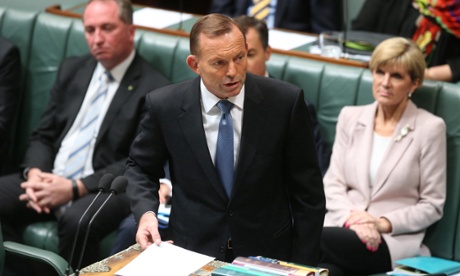
The view from the Greens party room is that the reshuffle was minimalist so that the party is a ready for an election at any mo.
The former leader Christine Milne had been responsible for treasury and foreign affairs. The new leader (and medical practitioner) Richard Di Natale is keeping health and multiculturalism and his office will move to his home state of Melbourne from Sydney, causing a changeover of a number of staff.
In new moves, co-deputy Scott Ludlam takes foreign affairs and Adam Bandt takes treasury. The afore-mentioned Hanson Young loses LGBTI and same sex marriage and water.
This partyroom briefing mimics Labor and Liberal briefings which are done with the proviso that the party spokesman is not named. Such briefings are designed to advise the media of main stances on policy.
Thanks to Daniel Hurst, we now know that the Greens will oppose the SBS advertising bill and would not change their stance on fuel excise unless the government shifted ground.
(The SBS bill allows SBS to show up to 10 minutes of advertising an hour – double what it presently shows – but no more than 120 minutes a day. The fuel excise reintroduces indexation to fuel excise - which the Greens opposed, notwithstanding their opposition to fossil fuels. Their reason was that the money raised was being put towards more roads.)
On welfare and pensions budget changes, the Greens plan to use the senate estimates fortnight to extract further details. On the citizenship changes, the Greens, like Labor, will wait to see the detailed legislation.
Father of the house, Philip Ruddock has said the government should seek to influence the United States, where the death penalty is still carried out. Ruddock says if such a player as the US changes, it may persuade other countries.
There is a very very important role with colleagues can play.
He is followed by Labor’s Chris Hayes. Parke, Ruddock and Hayes are all members of a cross-party group of parliamentarians against the death penalty. I will endeavour to bring you part of Parke’s speech shortly.
Parke and Ruddock join forces to condemn the death penalty
Labor’s Melissa Parke is moving a private members motion on the death penalty following the executions of Andrew Chan and Myuran Sukumaran. It seconded by Liberal Philip Ruddock, who thanks Parke for her campaigning against the death penalty and offers his condolences to Chan and Sukumaran’s families.
The motion notes:
(a) the execution in Indonesia by firing squad on 29 April 2015 of Andrew Chan and Myuran Sukumaran, along with their fellow prisoners, Rodrigo Gularte, Silvester Nwolise, Okwuduli Oyatanze, Raheem Salami, Martin Anderson and Zainal Abidin, and expresses condolences to their families;
(b) the bipartisan commitment in Australia to see an end to the death penalty worldwide;
(c) that the evidence overwhelmingly shows that the death penalty is not a more effective deterrent than long term imprisonment;
(d) that the international trend is clearly away from the practice of the death penalty—in 1977 only 16 countries had abolished the death penalty, now 140 nations have banned the practice; and
(e) that Australia has the opportunity to influence further progress towards the worldwide abolition of the death penalty in its relationship with key regional and global partners; and
(2) calls on the Government to:
(a) strengthen its efforts to advocate for an end to the death penalty wherever it still occurs; and
(b) ensure that Australia’s international cooperation is structured to avoid to the extent possible, the potential that such cooperation could lead to a person receiving the death penalty.
Updated
Already, the analysis of the Greens reshuffle is occurring. Here’s Ben Raue of @thetallyroom and Get Up, on Sarah Hanson-Young’s loss of LGBTI and marriage equality to Janet Rice.
@danielhurstbne @gabriellechan SHY losing LGBTI is a bit of a thing.
— Ben Raue (@benraue) May 25, 2015
Cate Faehrmann - of Sea Shepherd & former NSW upper house MP - named as new Greens leader Richard Di Natale's chief of staff. @gabriellechan
— Daniel Hurst (@danielhurstbne) May 25, 2015
From the Greens briefing, the winners are...
Minor reshuffle of portfolios in Greens. Bandt takes on Treasury; Di Natale keeps Health. / @gabriellechan pic.twitter.com/S3r7A7MpgJ
— Daniel Hurst (@danielhurstbne) May 25, 2015
The budget appropriation bills are up on the parliamentary program. As we await the details, Ken Coghill, associate professor at Monash University, has done an interesting piece on The Conversation relating to the Stronger Communities fund in the budget. It is not a huge amount of money at $45m but it essentially delivers a fund to each member for community projects. The politician gets to advise where the money goes. Coghill writes:
The allocation of $150,000 a year to every MP’s electorate risks seducing and trapping MPs into unethical behaviour that conflicts with new benchmarks for parliamentary codes of conduct.
The history of political corruption around the world confirms that sooner or later, some MPs will succumb to the temptation to rort the “Stronger Communities” slush fund. MPs will advise on and are likely to have influence in the selection of projects in their electorates. The temptation to misuse public money to win votes is particularly strong in marginal seats.
Liberals call for a free vote on same sex marriage by year's end
From Daniel Hurst:
Liberal parliamentarians pushing for a free vote on same-sex marriage have called for the issue to be debated before the end of this year.
Supporters are seeking to build fresh momentum for action in Australia after Ireland became the latest country to grant same-sex couples the right to marry in a referendum on Friday.
The assistant education minister, Simon Birmingham, a long-time advocate of a conscience vote, told ABC Radio National Breakfast that he had been heartened by the number of colleagues who had indicated a change in position over the past five years.
“A number of others are privately indicating to me that they support a conscience vote, that they’re open to seeing change to the legislation around marriage and I think that’s really positive,” he said.
Birmingham said parliament should debate the issue again before the end of 2015 - which would be about three years after both houses rejected similar bills in 2012.
“I don’t think it should be done probably in an election year. So I think at some point this year when it’s appropriate - the government has a lot on its plate at present delivering a budget focused on small business, delivering national security reforms [but] of course we can always walk and chew gum - I’m sure that at the right time when there’s a window during the course of this year it will be raised, it will be debated and I hope we will see the right and positive outcome.”
North Queensland-based Liberal MP Warren Entsch, a former party whip, also called for the issue to be decided by parliament in the second half of 2015.
Entsch said it was hard to know whether a fresh bill would pass parliament, but it was time to put it to the test.
Ireland passed same-sex marriage in a nation-wide referendum on Friday, but in Australia the federal parliament would have the power to make the change without a public vote. Referenda in Australia are reserved for changes to the constitution.
The prime minister, Tony Abbott, continues to oppose same-sex marriage, but has left the door open to allowing a conscience vote.
On Sunday Abbott said it was “a very serious issue” and decent people could disagree on the issue. Abbott’s sister, Christine Forster, called for a free vote.
Abbott said: “There are a range of views inside the parliament. There are a range of views inside my party room. Frankly, there’s a range of views inside my family – inside the Abbott family – [and] I am probably the last hold-out for the traditional position. So, look, it is a serious issue.
“I don’t know if and when it’s going to come before our parliament again. It came before our parliament in the last term and was dealt with fairly decisively. If it comes before our parliament again, our party room will deal with it, our party room will decide whether our existing policy continues or not and then we will have a good debate.”
Updated
The Greens are announcing their cabinet reshuffle at 11am at a briefing. This follows the ascension of new leader Richard di Natale.
Bill Shorten is now speaking on the repatriation offer.
Both leaders have noted the controversial nature of the Vietnam war and Shorten elaborates on the isolation suffered by the veterans.
Offer of repatriation for families of Vietnam war dead
Tony Abbott is making a (prime) ministerial statement on the repatriation of 25 Australian soldiers’ remains from Vietnam. The commonwealth government will offer the families of Australian servicemen killed during the Vietnam War and buried overseas the opportunity to repatriate their remains. Australia deployed more than 60,000 servicemen and women to the conflict in Vietnam between 1962 and 1973, with 521 Australians names listed on the Australian War Memorial’s roll of honour. Twenty five of Australia’s war dead from Vietnam were not brought home. One lies in the Kranji War Cemetery in Singapore and 24 in the Terendak Military Cemetery in Malaysia.
With the agreement of their families, the commonwealth government will bring them home.
Liberal senator Bill Heffernan is downplaying the Hansard changes made by Barnaby Joyce, mentioned earlier. He says there were changes in a few figures - no biggie - certainly not punishable offences. Mumbles...mortal sin, decapitation...
It certainly doesn’t sound like a mortal sin to me.
More weighty matters from estimates.
The Senate’s Finance and Public Administration Committee has turned briefly to weighty matters: the Magna Carta. The clerk of the Senate, Rosemary Laing, held up a copy of a Magna Carta book that is available in parliament and then made a quip about procedure:
I know it’s highly disorderly [to hold up a prop] but I’m not a senator and I’m assisting the committee.
Senate estimates are going on today and for the rest of the week. This is where senators get to question public servants and ministers.
Labor’s Doug Cameron has been chasing down the agriculture department on the sacking of secretary Paul Grimes due to lack of mutual confidence between Grimes and his minister, Barnaby Joyce.
The events occurred after a controversy involving changes to Hansard. Joyce blamed staff for corrections to the Hansard record of an incorrect answer he gave regarding drought support loans on 20 October last year. Joyce said he was unaware of the change and that he had asked for the changes to be reversed when he became aware that they had been made.
The Land’s Colin Bettles is tweeting from the committee.
Senate budget estimates - Agriculture Department felt matter of hansard changes were dealt with but former Secretary Grimes was concerned
— Colin James Bettles (@ColinJBettles) May 24, 2015
Department - former Secretary Grimes was 'quite concerned' about hansard changes and that 'elevated' our concerns
— Colin James Bettles (@ColinJBettles) May 24, 2015
Sen Edwards on Q's about @Barnaby_Joyce hansard changes last year "we are chasing a rabbit down a hole here - we are mere mortals after-all"
— Colin James Bettles (@ColinJBettles) May 24, 2015
Updated
The cross-party working group in opposition to the trans Pacific partnership agreement will launch today at 12.30pm.
The Australian parliamentary working group, founded by Labor’s Melissa Parke, Greens senator Peter Whish-Wilson and independent senator Nick Xenophon, will raise concerns about the secrecy around the agreement.
There are serious concerns around some of the clauses which are said to be contained within. But who would know, given the voters in the 12 countries involved are not allowed to see the deets until after the drafts are signed. (Process warning!)
One of the major worries is around the investor-state dispute settlement provision (ISDS), which gives foreign companies the right to sue the government under international law. As prime minister, John Howard refused to include it in trade agreements, with good reason. This is the clause, contained in an obscure Hong Kong treaty, that allowed the tobacco company Philip Morris to sue Australia over plain packaging laws.
Though it’s a little aged now, here is an explainer of the main issues which – as far as we know – still stand.
Updated
A quick shout out to the secret squirrels who run the house and Senate Twitter accounts. They are totally on the ball. Here, they have released the sitting schedules.
The House sits again today at 10am. Here's the Order of Business for the week http://t.co/jhEcH22kiK
— About the House (@AboutTheHouse) May 24, 2015
Updated
We are all a little bit Irish this week after the republic voted overwhelming voted in favour of marriage equality. Here is a cartoon from the West Australian via our neighbour Andrew Probyn.
Tremendous @DeanAlston cartoon on rainbow dynamics in Chez Abbott pic.twitter.com/4o5HpT02mx
— Andrew Probyn (@andrewprobyn) May 24, 2015
Tony Abbott conceded he was on his lonesome when it came to same-sex marriage.
Inside the Abbott family I’m probably the last holdout for the traditional position, so look, it is a serious issue.
His sister, Christine Forster, urged him to bring on a vote in parliament. She used the example of the British prime minister, David Cameron, who brought on a vote despite significant opposition from his own MPs. Forster put it like this on Sky:
His personal position is well known. I would like nothing more than for the current prime minister – who happens to be my brother – to take the same position David Cameron took. We need to move forward on a free vote.
The ground is shifting in Labor as well. The right faction member and manager of opposition business, Tony Burke, has changed his view. He believes the Irish vote showed that change was inevitable. You can check where you member stands on the issue at the Australian Marriage Equality website. (Change your states down at the bottom of the page.)
Updated
Government offers to help families repatriate remains of Vietnam veterans
Tony Abbott is expected in the chamber this morning to announce the government will offer the families of Australian servicemen killed during the Vietnam war the opportunity to repatriate their remains.
Updated
After Barnaby Joyce rightly (in my view) called out Johnny Depp for sneaking his dawgs into Australia, the #waronterriers began for two highly emotive days. Twitter corro Pete from Hay reckons they might be the thin end of the wedge.
@gabriellechan If an actor can smuggle two Yorky terriers into Australia, what stops a terrorist smuggling two Yorky terrier sized bombs
— Peter Oataway (@PetefromHayNSW) May 24, 2015
Tony Abbott was out yesterday, campaigning for his small business measures. He was tasting some treats at the Greek Paniyiri festival in Brisbane where he urged the Senate and Labor to have a go and pass the budget.
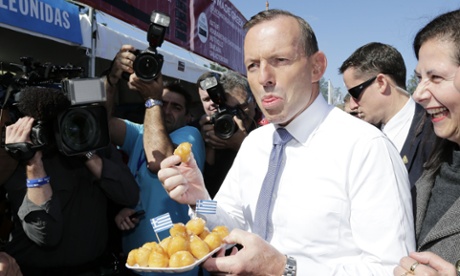
What may stick in his craw is the opposition to the his family tax benefit changes in the Senate. The FTB changes, announced in last year’s budget, removed benefits from families once a child turned six. The savings FTB reaped were to be subsequently re-engineered to pay for the newly promised childcare benefit package in the 2015 budget. This is the package that simplifies childcare payments and increases them for working parents. So while the government is giving with one hand on childcare, it seeks to take away from some families with the other. We will be watching that debate closely.
You will remember that after the 2014 budget went down like a lead balloon, this year’s budget was supposed to correct the view that the Coalition was favouring wealthier Australians. It’s fair to say that the word “fair” was fairly overused during budget week.
But analysis last night from the respected University of Canberra’s National Centre for Social and Economic Modelling (Natsem) showed low-income families would be the biggest losers from the latest budget.
The research was commissioned by the Labor party and found the lowest-income families could lose up to 7.1% of their total disposable income by 2018-19 as a result of budget changes.
According to Natsem, low-income families could lose $3,734 a year in 2015-16, equating to more than $70 a week, under the budget measures which include family tax benefit cuts as well as the boost to childcare benefits. The cuts increased to $6,165 a year by 2018-19, equating to a loss of $118.50 a week.
Yet the report showed families on incomes of more than $120,000 (approximately the top 30% of families) were marginally better off than those on lower incomes, with a 0.2% increase in their disposable income.
The principal research fellow, Ben Phillips, said the skewing happened partly because childcare benefits tend to go more towards middle- to high-income families.
You can read the full report here.
Updated
The citizens and their budget: parliament returns
Greetings citizens.
Today parliament returns and Tony Abbott will reveal his government’s plans to deal with foreign fighters and their citizenship. Expectations are that dual nationals will have their Australian citizenship stripped. The definitions and evidentiary requirements around the definitions of terrorism will be the key sticking point.
The prime minister will also announce Greg Moriarty, a former ambassador to Iran and Indonesia, as the new national counter-terrorism coordinator.
Moriarty will lead a counter-terrorism coordination office within the Department of Prime Minister and Cabinet. Michael Keenan is expected to get a new ministerial role in addition to his justice ministry to assist the prime minister on counter-terrorism.
Kieran Gilbert on Sky News asks the foreign affairs minister, Julie Bishop, “Is this not window dressing?”
Bishop says the government can take no chances and must ensure all agencies are completely coordinated. She makes the point that if a terrorist event occurred the government would not be “thanked” if the agency structures and coordination were found wanting.
Bishop says measures are needed to deal with Australian citizens who are essentially at war with their own country. She put it like this:
If you take arms with Daesh, this is an organisation that threatens the security of Australians. This is an organisation that is encouraging people to carry out terrorist attacks in Australia and elsewhere. So we have to ensure that people understand you are at war with Australia if you do that and that means you should not have the rights of Australians.
Q: Don’t we export the problem if we make these individuals stateless when they were born here?
This is a challenge that a number of countries are facing. The United Kingdom has already implemented this citizenship law and on about 20 occasions they have stripped citizens of their citizenship. It’s an issue we are dealing with globally and the kind of matter we will be discussing at a countering violent extremism summit that George Brandis will be hosting in Sydney shortly.
The introduction of these laws and their public debate occurs as the inquest into the Lindt Cafe siege in Martin Place resumes and runs for the next fortnight – in conjunction with parliament. The inquest is due to drill down into the background of Man Haron Monis, the Iranian-born Australian who took hostages in the siege which left two people, Tori Johnson and Katrina Dawson dead. The inquest will hear from hostages as well as evidence regarding Monis’s background. This evidence will form the backdrop for the parliamentary debate.
Coordination is the key.
There is also the first of the budget bills expected to come up and the same sex marriage debate after that thumping win for equality in Ireland at the weekend.
It will be a long week so stay with me @gabriellechan and @mpbowers.
Updated