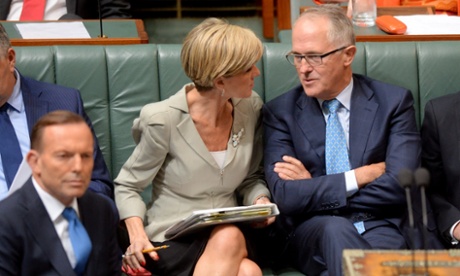
Tony Abbott is on the precipice of being dismissed as Australia’s prime minister after weeks of speculation culminating in the announcement on Friday that a “spill” would be moved at a party meeting in four days’ time.
Should the motion, which was moved by West Australian backbencher Luke Simpkins, succeed, the positions of Abbott and his deputy, Julie Bishop, would be immediately vacated (“spilled”) and opened to a vote of the parliamentary caucus.
The spill has become a regular fixture of politics in this country, which despite its relative prosperity and stable economy has seen the top job change hands four times in the past eight years.
Internal discontent with the direction of the Abbott government had festered over the Australian summer break, but the prime minister’s bizarre decision to knight Prince Philip broke it open.
Days of leaks and rumours reached a climax on Friday afternoon, local time, when Simpkins emailed his colleagues asking for “a motion to spill the leadership positions of the federal parliamentary Liberal party”.
He claimed to have been inundated with criticism of Abbott’s leadership by “firm supporters” of the party. “The knighthood issue was for many the final proof of a disconnection with the people,” he wrote.
Whether Simpkins is working on behalf of an Abbott rival remains unclear, but backbenchers often play a key role in the dark arts of a leadership spill.
Spoiler candidates, sometimes called “suicide bombers”, can be enlisted to make runs for the leadership that can’t possibly succeed. A Queensland MP, Mal Brough, was reportedly mulling such a role days ago.
The spoiler’s intention is to bring a leadership crisis to a head and smoke out opposition to a prime minister. They sow chaos and spook wavering MPs, allowing another, more credible candidate to offer themselves up as a consensus choice.
Abbott’s deputy, Bishop, has been touted as a serious contender. The foreign minister from Western Australian has been second-in-command to the past three Liberal leaders.
But she appears to have pledged not to vote for the spill motion in a carefully worded statement which does not mention what she would do if the motion was passed. So should Abbott lose the vote to force a spill, she would be free to stand for his job.
That leaves Malcolm Turnbull, a raffish former barrister and investment banker, and darling of the country’s so-called “latte left”.
Turnbull was the leader Abbott replaced when he became party leader in 2009, after Turnbull’s full-throated embrace of a carbon-emissions reduction scheme upset the climate sceptics in the party.
Urbane and witty, a mellifluous speaker, and among the country’s most prominent republicans and supporters of marriage equality, Turnbull belongs to the leftmost wing of the party, a far cry from the man he could replace.
Conservative members of the governing Coalition have already asked Turnbull to pledge he won’t push for gay marriage or serious action on climate change if elected.
However the spill turns out, the troubles of the Liberal-National Coalition government are unlikely to go away.
Abbott was elected in large part because he promised a return to “grown up, adult government”, after a tumultuous six years of Labor rule marked by the leadership rivalry of Julia Gillard and Kevin Rudd.
Facing a press conference on Friday after news of the spill motion broke, Abbott looked incensed. “We are not the Labor party. And we are not going to repeat the chaos and instability of the Labor years,” he said.
It is too late for that. Chaos rules once more.
• This article was amended on 13 February 2015 to correct a reference to a crescendo, rather than a climax, in contravention of the Style guide.