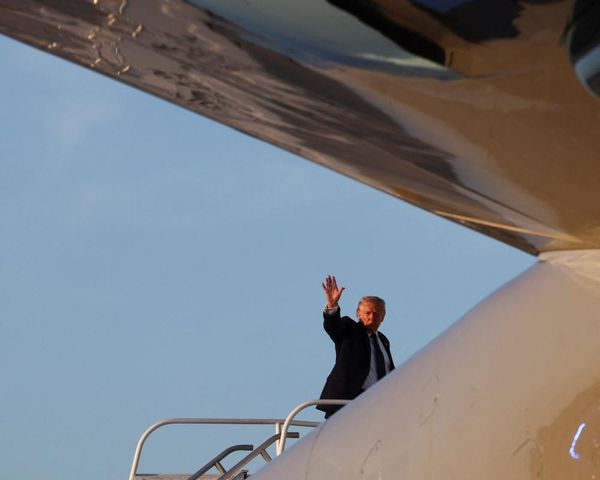
Tony Abbott appears to have backed away from a government-supported inquiry into the iron ore market after a backlash from mining giants and some cabinet colleagues.
Last Friday the prime minister said “I think we do need an inquiry,” and on Monday he said: “I think it is important to get to the facts and an inquiry may well be a very good way of doing that.”
But in the wake of a lobbying effort by BHP Billiton and Rio Tinto the prime minister said on Tuesday: “We certainly haven’t made any decision to have an inquiry … the last thing this government would ever want to do is interfere in a free market like the iron ore market.”
Distancing himself from the proposal, Abbott emphasised that the independent senator Nick Xenophon was the one who suggested an inquiry.
The government was considering backing an inquiry headed by a government member as an alternative to Xenophon’s original proposal, but the idea triggered cabinet divisions.
The industry minister, Ian Macfarlane, who opposes the idea, said six times during an interview on Tuesday morning that a decision had not been made.
Macfarlane said the government did not want to regulate the iron ore market and that it was the job of the Australian Competition and Consumer Commission to examine claims.
“I’ve spoken pretty regularly with the prime minister in the last two days and I can tell you no decision has been made to have an inquiry,” he told the ABC’s AM program on Tuesday.
But the environment minister, Greg Hunt, pointed to the collapse in iron ore prices and suggested it was worthwhile to examine actions “in the policy space to remove regulatory barriers which may be prohibiting or preventing efficiencies”.
“A parliamentary inquiry also allows us to look at long-term government policy settings,” Hunt told ABC Radio National on Monday.
“Clearly the prime minister has indicated a desire to head down that path, so you would presume that’s precisely where we are heading and there’s very broad support for that. The details need to be worked through.”
The inquiry push was championed by the chairman of Fortescue Metals Group, Andrew Forrest, who has accused Rio Tinto and BHP Billiton of increasing iron ore production to reduce prices and damage smaller competitors.
Rio Tinto and BHP have rejected this criticism and have been lobbying all parties against backing the inquiry, arguing such a review would send a bad signal to Australia’s trading partners about potential government intervention in the market.
On Tuesday, Abbott sounded cooler on the idea of an inquiry than he had in other media appearances over the past few days. The prime minister said while it was important to gather facts, the government would not interfere in the market.
“Obviously we believe in the free market,” the prime minister said.
“We certainly haven’t made any decision to have an inquiry. This was something that Nick Xenophon was talking about last week.
“The last thing we would want is a one-sided inquiry which degenerates into a witch-hunt against some of our best companies ... The last thing this government would ever want to do is interfere with a free market like the iron ore market.”
Abbott praised BHP, Rio and Fortescue as “terrific Australian businesses” that had flourished in a competitive free market “and long may that be the case”.
The opposition leader, Bill Shorten, said the government was “in a world of pain on this iron ore inquiry because they’re sending out mixed messages” and had “let this debate run on far too long”.
The chief of BHP Billiton, Andrew Mackenzie, said an inquiry “would be an amazing gift to our major competitor Brazil”, which was currently hosting a visit from the Chinese premier, Li Keqiang. China could be persuaded to increase investments in Brazil at the expense of Australia, he said.
“Not all inquiries are bad because they can draw people onto the same page, create transparency and trust, but this is a ridiculous waste of taxpayers’ money on providing a basic economics course on supply and demand,” Mackenzie told RN Breakfast on Tuesday.
“It is something that will be an additional burden on the backs of business, distract us from growing profitability and paying more tax. It’s red tape pure and simple.
“It comes at a very bad moment, it sends a terrible signal to our customers and it flies in the face of the commitments that we have made at the highest level in places like China, Japan and Korea that they can count on secure supply from us at fair prices.”
In arguing for an inquiry, Forrest said it was no longer a free market but a distorted market.
To support his argument that the big miners were flooding the market, Forrest pointed to a comment by the BHP Billiton iron ore division chief executive Jimmy Wilson in October 2014 that “demand side in this business still remains good but what we’re doing is we’re oversupplying at the moment and we’ll oversupply in the medium term”.
But Mackenzie said Wilson “was not commenting on us” but was “commenting on the whole market” and was repeating a point made about four years ago.
“Since 2006 we have not increased our market share. It still sits globally at 17%,” Mackenzie said.
“Most of those other small suppliers have substantially increased their market share – good on them – because they were able to do that at higher prices but they were the sorts of investments that our company and our shareholders would never have made because we knew they weren’t sustainable in the long term. There was a once-in-a-generation spike in price caused by the massive urbanisation of China that was always going to peter out.”
The treasurer, Joe Hockey, who spoke to Xenophon last week and persuaded him to delay his attempt to launch an inquiry, said the Xenophon-initiated probe “was going to turn into some kind of star chamber by [Labor senator] Sam Dastyari”.
“From our perspective, we’ll speak to the relevant parties,” Hockey told ABC Radio in Adelaide on Tuesday. “We haven’t made any final decision.”
Asked what would be the point of an inquiry if it did not lead to action at the end, Hockey said it was “not an unreasonable point” and the government was “consulting with all the parties”.
On Adelaide radio station FiveAA, Hockey said his priority was the budget, describing the iron ore issue as “not the main game”.
“I’d love to have iron ore prices higher but the market’s the market,” he said, referring to the flow-on impacts of a low price on government revenue.
.jpg?w=600)