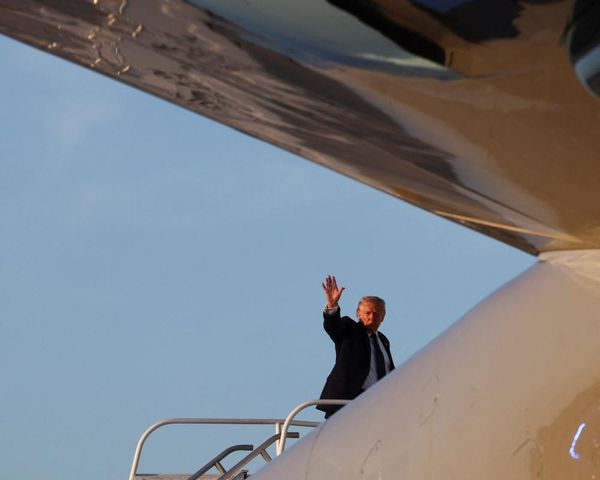
Tony Abbott has called for the government to give employers greater clarity about requiring staff to be vaccinated, rejecting Scott Morrison’s plan to leave mandates to business and the courts.
Abbott made the comments on his new Australia’s Heartland podcast with the Institute of Public Affairs, in which he also called for an inquiry into the handling of the pandemic and backed Gladys Berejiklian’s suggestion some restrictions in greater Sydney could be eased once vaccination rates reach 50%.
Morrison has ruled out further public health orders expanding the instances in which employers can require their staff to get a Covid-19 vaccine, labelling them a vaccine mandate “by stealth”.
In doing so, Morrison has sided with Coalition MPs concerned that requiring vaccines harms individual liberty over the business community, which had called for greater clarity.
The Fair Work Ombudsman has released fresh advice about when employers may be able to require vaccines – but it will be up to them to seek their own advice and defend the legality and reasonableness of their directions to staff in court.
In the podcast, released on Thursday, Abbott said: “To be honest, I think too much is decided in courts these days by unaccountable and unelected judges. I’d probably prefer to see more being decided in our parliaments, by people who are elected and are accountable and will face the judgment of the people every three or four years.
“So my instinct would be to have more clarity from government, and less that ends up in the hands of a disparate group of judges and officials.”
On Thursday the ombudsman advised that “in some cases, employers may be able to require their employees to be vaccinated against Covid-19”.
The FWO declared it was “more likely” to be reasonable to require vaccination for tier 1 work, where staff are in contact with people at risk from coronavirus, such as airline workers, or in tier 2, where they work with vulnerable people, such as aged care.
Tier 3 work, where there is interaction with the public, may allow employers to require vaccination, but this is more likely if there is community transmission.
On Friday the Australian Council of Trade Unions and Business Council of Australia issued a joint statement that for the “overwhelming majority of Australians [their] work or workplace should not fundamentally alter the voluntary nature of vaccination”.
They said for the “small number of high-risk workplaces” where universal vaccination is required, this decision “should not be left to individual employers and should only be made following public health advice based on risk and medical evidence”. They called on national cabinet to determine nationally consistent public health orders.
Earlier, ACTU secretary, Sally McManus, told ABC News Breakfast the FWO advice meant only employers covered by public health orders should require vaccines and for everyone else there was “no clear right” to do so.
Innes Willox, the chief executive of the Australian Industry Group, rejected that view, noting that the ombudsman had recognised that even where there are no public health orders, employers may have a “common law right to issue a ‘lawful and reasonable direction’ to employees”.
“Naturally, the FWO advises that before an employer issues a direction to an employee to be vaccinated, the employer needs to consider whether the direction would be ‘lawful and reasonable’ in the context of the specific business, the employee and the risk of Covid-19 infections,” he said.
“The ACTU’s creative claim … is complete nonsense. What employers and employees need now is clear information and advice.”
Since losing his seat at the 2019 election, Abbott has worked as a trade adviser to the UK and Australia and has become a “distinguished fellow” of the IPA.
In January Abbott blasted “virus hysteria and health despotism” in an IPA video claiming coronavirus is “dominating” people’s lives.
In the Australia’s Heartland podcast, Abbott said that he hoped for a national inquiry into the pandemic response.
He said there should be “a serious inquiry, a royal commission if you like, at the national level to look long and hard at what we did right and what we could have done better and compare the responses of different states and indeed the responses of different countries, because there will be another pandemic”.
Ahead of national cabinet meeting on Friday, Abbott also weighed in to the thorny topic of the vaccination thresholds required to reduce coronavirus restrictions.
Although state and territory leaders have agreed that lockdowns should no longer be used except in exceptional circumstances once vaccination rates reach 80%, Berejiklian has suggested some restrictions could ease at 50%.
Labor premiers are expected to confront Berejiklian about the plan, warning that she must first consult national cabinet before easing restrictions that may help contribute to coronavirus spread interstate.
Abbott said he was “certainly rather attracted to the idea of New South Wales premier Gladys Berejiklian, that we might be able to start to open up sooner when vaccination rates get up to about 50%”.
In fact, Berejiklian has already clarified the greater Sydney lockdown will remain in place until the agreed threshold is reached.
Abbott criticised the fact that political leaders had rarely released health advice underpinning their decisions, which he said was a “little irksome” given “so much that is so out of character has been asked of us on the basis of health advice, in inverted commas”.
“Over the course of this whole pandemic, the science, in inverted commas, has shifted from day to day, and it’s been different from state to state, and that’s why it would have been better for all of us, I think if there had been more transparency and if more of it had been published at the time.”
.jpg?w=600)