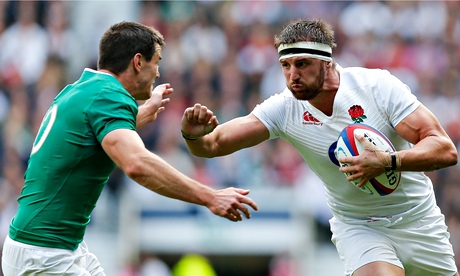
The next time England run out at Twickenham it will be for real. No more dress rehearsals, no more learning curves, no more hopeful experiments. Encouragingly they have completed their phoney-war period with no significant injuries and morale-raising home wins over France and Ireland. They would have settled for that springboard at the start of August.
Even if they do not yet look like guaranteed world-beaters they cannot be entirely discounted either, particularly if last month’s sub-standard performance in Paris is overlooked. Given their big games will all be staged on home ground, their away form matters less than it would in a Six Nations campaign. The tournament hosts are now unbeaten in their past seven Tests at Twickenham, including all five of their games in 2015, and seem significantly more at ease in south-west London than they looked at the Stade de France during that defeat.
Scroll back, in fact, and just one side have beaten England at Twickenham by more than a score during Stuart Lancaster’s tenure.
Even New Zealand, 30-22 winners in 2013, were trailing early in the final quarter. Maybe it is becoming more a question of how the venue affects England’s opponents, regardless of which dressing-room they occupy.
Lancaster’s side remain prone to inconsistency but they mostly get the job done in their own backyard.
That trend alone will cause all their opponents some concern. “Playing at home is a huge advantage that we really need to hammer home,” said Tom Wood, England’s man of the match on Saturday. “You have to harness that full energy of the crowd.”
Just as crucially there are signs that the intense preparation is paying off in some important areas. Ireland’s ability to win the aerial contests was the hallmark of their Six Nations victory in Dublin; here England ruled the skies. Against a side like Australia, whose full-back, Israel Folau, is as good in mid-air as anyone, the ability of Mike Brown and Anthony Watson to gather balls above their head will be equally vital.
There was also plenty of evidence to suggest that England are thinking straighter, with the return of Geoff Parling, Ben Morgan and Wood – described as England’s “fittest forward” by Lancaster – banishing the ill discipline of Paris.
Lancaster, for one, appreciated the difference and will probably conclude he has found his best starting lineup in readiness for the opening night against Fiji. “There’s a lesson in there about intelligent rugby players and getting them on the field,” said the head coach.
There was certainly more of a welcome snarl to the first half-hour than was the case in Paris. Rather than restarts being hoisted long and allowing Ireland time to clear they went shorter and straighter and caused infinitely more problems. The goal-kicking was sure and almost all the bench arrivals made a decent impression. No wonder Lancaster exhibited the quiet relief of a golfer whose ball has just cleared a number of lurking hazards and ended up pin high.
In the shape of Wood and Jonny May, he also has players raising their games at the perfect moment. Wood was as prominent as he has been all year while May is currently a man possessed. The way he simply powered through a startled Tommy Bowe to score was testament to his summer training efforts and he would have had a second try if a forward pass by the industrious Tom Youngs had not been belatedly spotted by the television match official.
The Gloucester wing later admitted a package of pre-match highlights, showcasing the best bits of every England player from 1 to 23 and aired in the dressing room before kick-off, had revved him up.
Watson, too, is looking sharp and the sight of him soaring above a startled Simon Zebo for his try was another illustration of England’s improvement. There remains work to be done on the accuracy of their approach work, however, with Owen Farrell guilty of one horrible loose pass which could have easily yielded a try. If the same happens against Wales or Australia it will prove more costly and George Ford’s prospects of starting against Fiji may well have been enhanced.
Then again it is not so long ago we were all lauding Ireland for their efficiency and narrow-eyed ruthlessness, none of which was discernible on Saturday. Unless Joe Schmidt is pulling a sheep station’s worth of wool over everyone’s eyes they badly need Cian Healy, the concussed Conor Murray and Rob Kearney to return and must urgently seek to revitalise Bowe, currently a shadow of his former ebullient self.
If not, on the evidence of the past eight days, their chances of beating France, finishing top of Pool D and shouldering their way into a semi-final back at Twickenham are receding sharply. Even Johnny Sexton is looking strangely out of sorts, possibly because of the fitful handling around him. Ireland do have the luxury of playing Canada, Romania and Italy in their first three pool games but any sense of complacency has now disappeared.
In contrast it has been a rather happier few weeks for the tournament organisers. Improvements to Twickenham station and the provision of more shuttle buses have massaged the post-match transport crush and closing the A316 has encouraged a less frenetic match-day experience around the stadium itself. The ultimate test will come on Friday week but there are more reasons for optimism than a month ago. The same applies to Lancaster’s England.
England Brown; Watson, Joseph, Barritt (Burgess, 59), May; Ford (Farrell, 59), B Youngs (Wigglesworth, 59); Marler (M Vunipola, 56), T Youngs (George, 59), Cole (Brookes, 62), Parling (Launchbury, 45), Lawes, Wood, Robshaw (capt), Morgan (B Vunipola, 56).
Tries May, Watson. Con Ford. Pens Ford, Farrell 2.
Ireland Zebo (Furlong, 69); Bowe, Payne, Henshaw (Madigan, 59), D Kearney (Cave, 65); Sexton, Murray (Reddan, 17); McGrath (Ross, 74), Best (Strauss, 61), Ross (White, 59), Toner, O’Connell (capt; Ryan, 65), O’Mahony, O’Brien (Henry, 61), Heaslip.
Try O’Connell. Con Sexton. Pens Sexton 2.
Referee N Owens (Wales). Attendance 80,138.