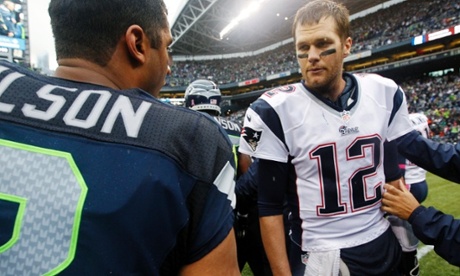
Tom Brady can write his name into NFL history on Sunday by emulating a childhood idol. Victory over Seattle would give the New England quarterback his fourth Super Bowl title – as many as Joe Montana earned with the San Francisco 49ers. Only one other player at their position, Terry Bradshaw, ever won as many as a starter.
To reach his goal, Brady must overcome an opponent who grew up watching him on TV. Russell Wilson was just 13 years old when the Patriots quarterback won his first Super Bowl in February 2002. He had started only a handful of high school games by the time Brady claimed his third title three years later.
And yet, Wilson, too, stands on the cusp of a landmark achievement. Beat New England in Arizona, and he will become the youngest starting quarterback ever to win two Super Bowls. Wilson would be halfway to catching Montana and Bradshaw, barely three years into his NFL career.
Few people outside of Seattle could have envisaged such a scenario. Wilson was not considered an elite talent coming out of college, selected by the Seahawks in the third round of the NFL Draft. It is something he has in common with Brady, who fell even further – to the sixth round – before being scooped up by New England in 2000.
On the surface, they look like two very different players. Brady, standing 6ft 4in tall, fits the classic mould for an NFL quarterback, doing his best work in the pocket behind his offensive linemen, picking out passes downfield. Wilson, by contrast, is not quite 5ft 11in, and sometimes struggles to see over the melee in front of him. Instead he uses his speed and mobility to create more varied angles of attack.
If the trajectory of their passes are different, then the start to each man’s professional career followed a similar arc. Both won their first Super Bowl in their second season, but neither was considered as the key contributor to that triumph.
It is easy to forget now that Brady was widely belittled after his first Super Bowl success as a “game manager” who had benefitted from playing on a New England team whose defense restricted opponents to 17 points per outing. Likewise, Wilson’s contribution became an afterthought as Seattle’s defenders held Denver’s record-breaking offense to eight points in last season’s title game.
Turn the clock forward to today, and Brady is considered to be one of the greatest ever to play his position. Wilson has a long way to go yet to achieve that kind of recognition, but it is certainly his aim. “Why can’t I be the best quarterback to ever play the game one day?” he asked reporters back in April. “I’m not right now. I’ve got a long way to go. But one day, you know?”
It is not an idle thought. Wilson talks often of the importance of visualising success, of making it an expectation rather than a hope. He credits that mindset to both his parents but especially his father, who would conduct mock interviews with him as a teenager, asking him about his preparations for an imaginary Super Bowl.
Speaking to the Observer this week, Seattle’s quarterback coach Carl Smith recalled coming away from their first telephone conversation after the player was drafted feeling a little overwhelmed.
“It was like ‘boom’, just a barrage of words and questions,” said Smith. “He’s driven to be great, plans on being great, and expects to be great, so he wanted to go to work immediately. He wanted to know about the snap count we use, he wanted to know about our plays. And I was like, ‘well, wait until you take the flight over’.”
Smith, like many others, had reservations about Wilson’s capacity to succeed in the NFL. Never before had a sub-6ft quarterback won a Super Bowl. The coach watched tape of Wilson making plays outside the pocket in college but worried that such an approach would not be viable in the pros.
Those fears melted away once he had the opportunity to work with Wilson in person. “He’s an outlier,” said Smith. “It’s not just your stature, or your drive, it’s something you can’t bottle up. There are a lot of guards in the NBA, but there’s only one Tony Parker. There’s only one Derek Jeter in Major League Baseball, where he is Mr Yankee, absolutely the man. I put Russell in their category, with Derek Jeter and Tony Parker. Put all his gifts together, he’s a very special player.”
Instead of Wilson’s size becoming a liability in the NFL, his unconventional playing style has been a tremendous asset. He rushed for 849 yards this season – more than was managed by half of the league’s starting running backs. By obliging defenses to account for this threat, he has also opened up opportunities for team-mates.
It is not a new formula. Many times over the past two decades, athletic quarterbacks have been hailed as the forebears of a new era – one in which the pocket passer will become extinct. More often than not, such players have failed to make good on their promise, either because of injuries sustained while running the ball or because they lacked the passing skills to give balance to their game.
The difference with Wilson is that he remains a quarterback first and a runner second – using his legs as a weapon to deploy when the defense is vulnerable rather than a default option to fall back on when he cannot see a pass downfield.
“He’ll run when he has to, but he understands how to utilise it,” said head coach Pete Carroll this week. “He’s a master at reading it. He’s phenomenal at doing it at the times when he’s not going to get hit, which is the only reason we keep doing it. If he was getting hit all the time we wouldn’t do it.”
Brady has rushed for fewer yards in his entire career than Wilson did in 2014, but that will not make him any less dangerous on Sunday. The Patriots quarterback threw for 13 more touchdowns than his opponent during the regular season. At 37 years old, he will be well aware that his window of opportunity to match Montana cannot stay open forever.
With his greatest rival, Peyton Manning, wavering over whether to return to the league next season, Brady has heard those voices which say a changing-of-the-guard is underway within the NFL’s quarterbacking fraternity. But his career to date, just like Wilson’s, speaks eloquently to his capacity for defying other people’s expectations.