Efforts are under way to ensure a clean Tokyo Bay for the events of the 2020 Tokyo Olympic and Paralympic Games.
After heavy rains, untreated sewage often flows into the bay from waterways across the city. Last summer, E. coli bacteria and other microbes, the number of which greatly exceeded the International Sports Federation's safety standards for water quality (see below), were found in the bay.
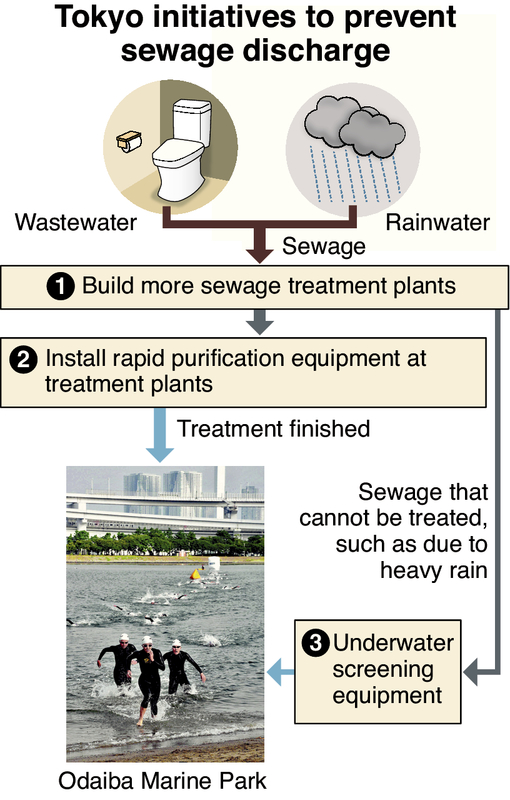
The metropolitan government is improving its sewage treatment facilities to double its current purification capacity.
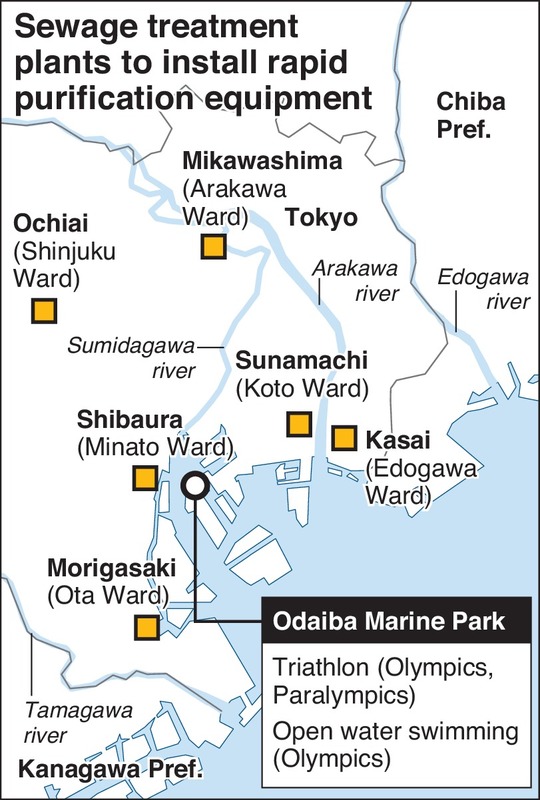
Odaiba Marine Park in Minato Ward is to host the triathlon for the Olympics and the Paralympics, as well as the open-water swimming for the Olympics. The organizing committee and the metropolitan government tested water quality there from July to September last year, as the 2020 Games is to be held in the same period. On 20 days of the total 26 days that the tests were conducted, the amount of E. coli exceeded the accepted limit for the triathlon, at times by up to more than 20 times. For open-water swimming, the number was as much as over seven times higher than the accepted limit.
The poor water quality was caused by 21 straight days of rain, the second longest on record, last August. In the 23 wards of Tokyo, 80 percent of the sewer system is a "combined type," which treats wastewater and rainwater together. In the event of heavy rains or long spells of rainy weather, plants treat large amounts of rainwater as well as wastewater. If a plant's treatment capacity is exceeded, untreated wastewater and rainwater are released into the ocean or rivers.
Water quality at event venues usually clears safety standards, but because a typhoon or heavy rain may occur during the Olympics, the metropolitan government decided it needed to stabilize water quality before the Games.
Of the 13 treatment plants in the 23 wards, rapid purification devices are to be installed at six plants in Minato, Ota and other wards located near Tokyo Bay, which are considered to have a major impact on the bay's contaminant levels.
The new devices will be able to remove about twice as many contaminants as the current devices. The metropolitan government plans to operate them before the Games begin.
Tokyo is also eagerly building underwater storage to hold sewage before it can be treated during heavy rains.
Space to hold 1.7 million cubic meters is thought to be necessary for a heavy rainfall. As of the end of fiscal 2015, tanks for 1.14 million cubic meters had been built. The metropolitan government wants to build an additional 260,000 cubic meters by the beginning of the Olympics. It hopes that these measures, as well as installment of the rapid purification devices, should be able to significantly reduce the amount of untreated discharge.
In addition, to prevent contaminated water from getting into event venues, Tokyo government is pushing for use of an "underwater screen," which would surround event areas.
"Water quality during summer is a source of concern, but we hope that by the Olympics we will have achieved a stable water quality. We want the Olympics to be an opportunity to enjoy outdoor water sports and swimming in Tokyo Bay," the official in charge of the matter at the Japan Triathlon Union said.
--Safety standards for water quality
Water quality standards of the International Triathlon Union stipulate that the number of E. coli bacteria in a race area's water must be 250 or less per 100 milliliters and enterococci 100 or less. According to the International Swimming Federation's standards, the number of fecal coliforms must be 1,000 or less per 100 milliliters and oil must not be present on the surface of the water for extended periods. These criteria are used to determine whether competitions can be held.
Read more from The Japan News at https://japannews.yomiuri.co.jp/