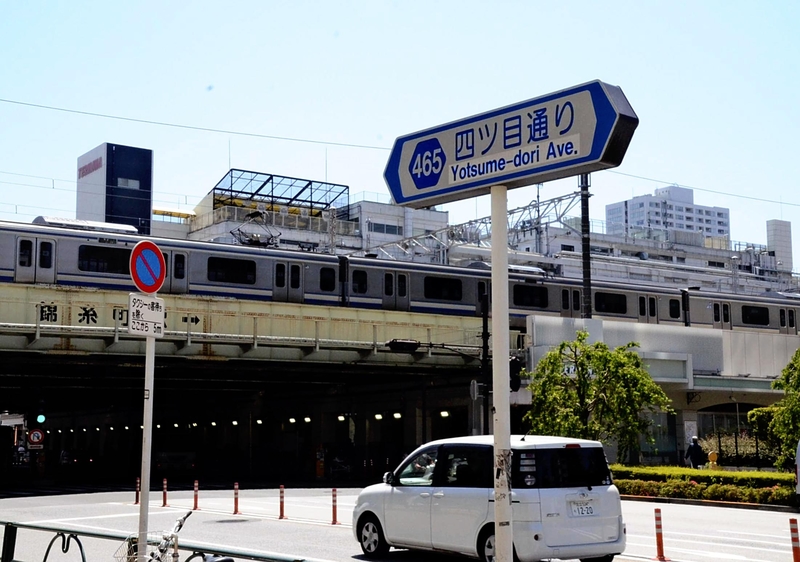
From the observation deck of Tokyo Skytree in Sumida Ward, Tokyo, I can see a wide street stretching directly south from where I stand.
The street's name is Yotsume-dori. Yotsume means four eyes. Every time I go along the street, I cannot help but picture a monster with four eyes in my head, which disturbs me. Why was this strange name given to the street?
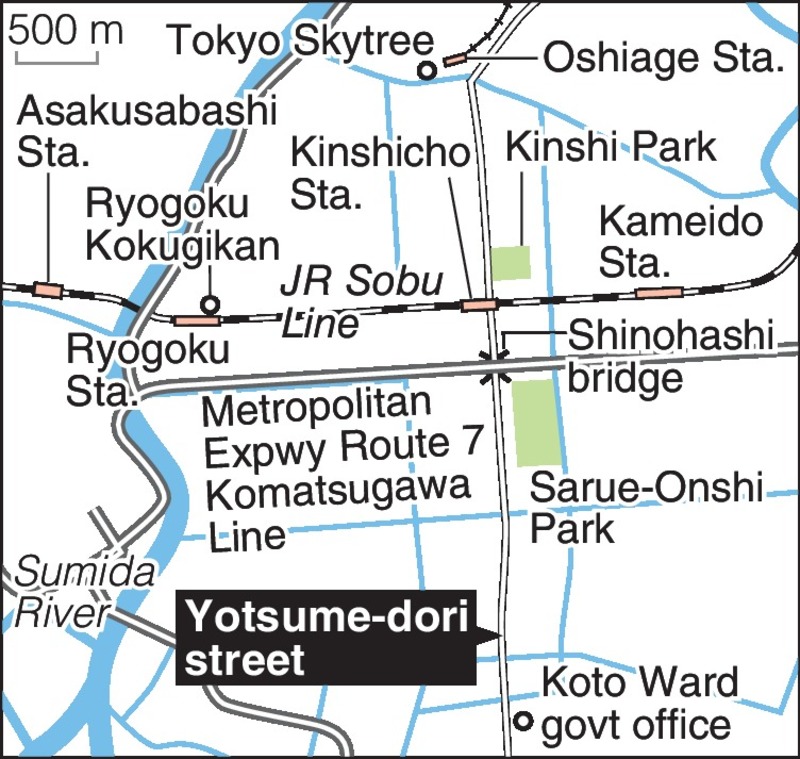
Yotsume-dori runs about 5.4 kilometers from Sumida Ward's Kyojima area to Koto Ward's Toyo area, according to the Tokyo metropolitan government's Road and Street Administration Division. The road is officially called the Fukagawa-Azumacho Line.
Just before the 1964 Tokyo Olympics, the metropolitan government gave 69 major roads popular names, such as Koshu-kaido road and Yasukuni-dori street to make them sound familiar to tourists from Japan and abroad, and Yotsume-dori is one of them. However, the origin of the name cannot be confirmed from records kept by the metropolitan government.
Thus, I visited Takeo Hisazome, 63, an expert on local history. Hisazome had worked for many years at the Nakagawa Funabansho Barge Museum and the Fukagawa Edo Museum, both in Koto Ward, giving lectures on history and tours of historic sites.
"The name 'Yotsume' is said to be derived from 'the fourth bridge,' which was built over the Tate River," he said. A Japanese word for "Fourth" is pronounced "Yottsume."
The Tate River is a canal that was excavated east of the Sumida River after Edo -- now Tokyo -- was burnt to the ground by the Great Fire of Meireki in 1657. Six bridges were built over the Tate River and called the Ichinohashi, Ninohashi, Sannohashi, Shinohashi (Numbers one to four in Japanese followed by the word bridge) and so on with the Ichinohashi being closest to Edo Castle, according to archives compiled in the Edo period (1603-1867).
The river was used as a waterway for transporting lumber and food and played an important role in the cultivation of the Honjo (now in Sumida Ward) district, which extended the urban area of Edo to the east bank of the Sumida River.
The Honjo area is filled with waterways and roads in the form of a grid, and the map compiled at the end of the Edo period contains descriptions of "Yottsume-no-hashi" as well as "Yottsume-dori" on the north-south road that passes over the bridge.
On the west side of the street were the residences of daimyo feudal lords and hatamoto (direct retainers of a shogun), while rice paddies and farms made up the east side. The surroundings of this street seem to have been the boundary between a town and a farming village back then.
There was a vegetable market near the bridge, according to a topographical archive called "Gofunaibiko" that describes the scenes of Edo.
"The street must have been bustling with people living in the residences who came to shop and people who delivered crops from the villages," Hisazome said.
In the Meiji era (1868-1912), a series of factories were built around the street. In 1894, the then Sobu railway's Honjo station (now JR Kinshicho Station) opened. The area was renovated in the wake of the reconstruction project enacted after the 1923 Great Kanto Earthquake, and streetcars ran on the street heading to Tokyo Station and the Tsukiji market district.
Noboru Yamada, 71, runs a ningyo-yaki doll-shaped cake shop called Yamada-ya that sits on Yotsume-dori near Kinshicho Station. The shop has been there for about 70 years, since his father's time. He said since his childhood shops have lined the street around his bakery, and the street was always crowded with streetcar commuters on weekdays and moviegoers on holidays.
Today, the Metropolitan Expressway Route 7 Komatsugawa Line runs above the Tate River, and part of the river has been reclaimed to become a park and a bicycle parking area. However, the Shinohashi bridge is still located near Yamada-ya.
"The cityscape has changed over the past few centuries, but names like 'Shinohashi' and 'Yotsume' have remained. I hope those names will continue to be cherished in the future," Yamada said with a smile.
Read more from The Japan News at https://japannews.yomiuri.co.jp/