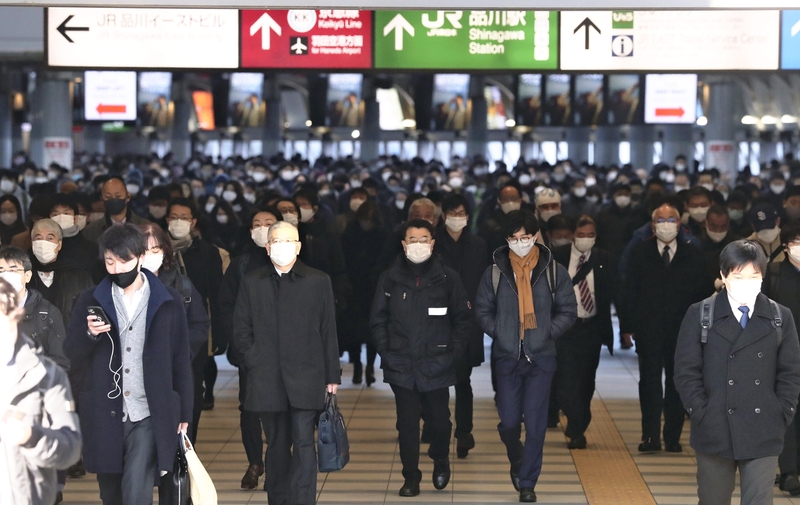
Major stations in Tokyo, Saitama, Chiba and Kanagawa prefectures were crowded with commuters on Friday morning, the day after the government declared a state of emergency in the area to tackle a recent surge in coronavirus infections.
The government is promoting teleworking with the aim of a 70% reduction in the number of people who commute to the office. However, there was no apparent drop in the number of commuters at major stations.
Tokyo and the three surrounding prefectures will remain under the state of emergency through Feb. 7. Based on the special measures law to cope with new strains of influenza, restaurants, karaoke bars and other establishments were asked to shorten their business hours and close by 8 p.m. Residents were also asked to refrain from nonessential and nonurgent outings particularly after 8 p.m.
At JR Shinagawa Station in Minato Ward, Tokyo, there was a constant flow of commuters wearing masks coming out of the ticket gates between 7 a.m. and 9 a.m.
"The train was crowded, as usual, with all the seats occupied," said a 58-year-old company employee from Suginami Ward. "The number of infection cases is increasing so much, but the nature of my job doesn't allow me to work from home, so my family is worried. I wonder if the situation will be brought under control only with a monthlong state of emergency."
Many commuters were also seen at major stations in Yokohama, Chiba and Saitama. According to East Japan Railway Co., when the previous state of emergency was declared, the number of passengers using Shinkansen and other limited express trains on conventional lines dropped by up to 90% in April and May compared to the same period last year. JR East officials said such a sharp drop would be unlikely this time as some restrictions are not in place, such as school closures.
At Ref Omiya by Vessel Hotels, a hotel in front of JR Omiya Station in Saitama, guests who planned to telework turned up at the facility that morning. Since its opening in September last year, the hotel has offered a telework plan that allows guests to use their rooms for about four to 10 hours. Previously, only a few customers used the telework plan each day, but the hotel received more than 30 reservations for Wednesday to Friday this week.
"The plan seems to be mainly used by clients who have children at home," said Yusuke Habara, 36, the manager of the hotel. "We intend to thoroughly disinfect and ventilate [our facilities] so that our guests can work here free from anxiety."
According to a survey by the Tokyo Chamber of Commerce and Industry of member companies in September and October last year, 53.1% of respondents said their employees were teleworking, a 14.2% drop from the previous survey in May and June. Waning productivity and concerns over security were raised as reasons for putting a halt to teleworking, according to the survey.
Read more from The Japan News at https://japannews.yomiuri.co.jp/