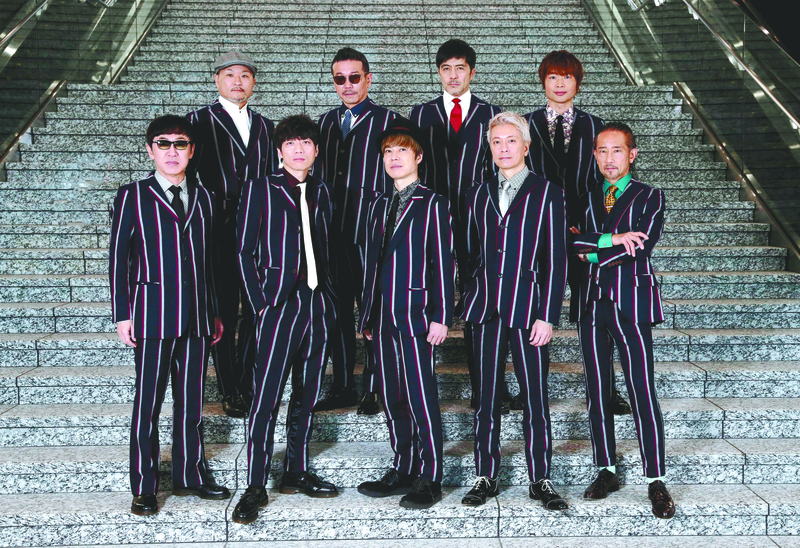
A cheerful Jamaican beat and men with a cool demeanor wearing matching suits -- for 30 years, Tokyo Ska Paradise Orchestra has stuck to one style in both its music and the appearance of its members. They also have a generous musical spirit of collaborating with other genres such as rock, jazz and pop.
The band, nicknamed Skapara, made its album debut in 1989, with the Jamaica-born music of ska at the core of its sound. With instrumental music as its main strength, the band started venturing into vocals in 2001, inviting guest singers to perform with them. "Stompin' On Down Beat Alley" (2002) was ranked No. 1 on the weekly Oricon music chart and sold about 500,000 copies. The band has also performed in about 30 countries across the globe.
For the past decade, the band has retained its nine-member format. It has had to overcome the departures of original leader Asa-Chang, Tatsuyuki Hiyamuta and other members as well as the deaths of Cleanhead Gimura and Tatsuyuki Aoki.
The members of this band that "lives together and prospers together" discussed how they rode out the waves of transformation and diversity in the music scene in an interview with The Yomiuri Shimbun.
The Yomiuri Shimbun: Your 30th anniversary original album, which was released last November, has a title that symbolizes Skapara: "Tsugihagi Colorful" (Patchwork colorful). It feels like you have grafted onto it what you've maintained from the early days.
Atsushi Yanaka: I'm glad to hear that.
Takashi Kato: Suits have been synonymous with Skapara since our debut. Do we have like 100 of them?
Yanaka: I was annoyed that construction work in Shibuya was never going to end. Then I realized we were patchworks, too, and I'm still under construction myself.
Q: I heard you all immerse yourselves in practice.
Yanaka: I started playing my instrument after joining the band, so I always have an inferiority complex.
Masahiko Kitahara: When I joined, I was already a pro and [I thought] no one was up to scratch, but they had this one weighty punch when it mattered. It reminded me of how I started out.
Nargo: I was a student when I joined so [upon meeting the band members] I thought there must be all kinds of different people in society. But then I realized the only interesting people were here.
Q: There have been some sad farewells in your history.
Gamo: We lost two members. Some members quit. They all showed us the way. Every time we had a member change, I was a bit concerned and felt a bit odd. Looking back now, I think we achieved rejuvenation each time.
Hajime Omori: The predecessor of my part was the founder Asa-Chang, so I was under a lot of pressure. But the other members accepted my own musical personality.
Q: When Mr. Tatsuyuki Aoki died suddenly, he was temporarily replaced by Mr. Tatsuya Nakamura, who was a member of Blankey Jet City. Mr. Motegi, you succeeded him while you were the drummer for Fishmans.
Kinichi Motegi: First of all, when Aoki-san died, I was surprised that [Skapara] continued the tour because I thought it would be canceled. It seemed to me the band didn't stop no matter what because they believed their existence was essential to the music scene and to people going about their lives.
Yuichi Oki: You know audiences raved and danced for the band even before our [album] debut.
Motegi: When Tatsuya-san joined the band, it became completely different and I was staggered. I thought it was impossible to replace him [Nakamura]. I had to be a daredevil.
Tsuyoshi Kawakami: Now there's no Skapara without Kin-chan [Motegi]. You are the cornerstone of the band.
Nargo: I think Aoki-san in heaven is glad. When we and Fishmans played back-to-back, Aoki-san pulled my arm and told me, "That's a great band. Watch them." He was always saying, "Kin-chan is cool."
Q: Any memorable moments from live performances?
Omori: When we did three concerts in two countries in 24 hours. We did the first concert in the Netherlands in the afternoon then traveled to Belgium and gave a concert that evening. When we performed a third concert before noon the following day, I was only half awake on stage.
Kato: We pulled in by the stage door on the bus we'd slept in and went right in to play.
Kawakami: When we appeared at Coachella [Valley Music and Arts] Festival, we also took on a recording session because our contract said we weren't supposed to give other concerts within the state for one week.
Kato: We didn't have to go as far as making an album though. We tend to put a burden on ourselves.
Kitahara: The concert in Mexico immediately after the Great East Japan Earthquake was impressive, too. Everyone was concerned about Japan and raised Japanese flags.
Kawakami: That's because Mexico City has suffered huge earthquakes as well. Back in Japan the overall atmosphere was that of voluntary restraint from everything.
Kato: Mexico had wanted us to come over for a long time. When Yanaka-san said in Spanish, "Please pray for Japan," the audience responded with huge applause.
Gamo: In our very early days, we gave a concert in the French city of Nimes. All the bands played on a stage that looked like a festival float on the back of a truck. We were all judged inside a bull ring. The band that played before us was booed, and we were applauded!
Nargo: Apparently, we were selected for some performance award, but we couldn't attend the award ceremony.
Motegi: At the Rising Sun Rock Festival in 2018, we performed last among the 10 headliners. Many people sang with us right before a really clear dawn sky. It's hard to forget that.
Kawakami: It was like the earth was shaking.
Q: The best-of album "Tokyo Ska Treasures: Best of Tokyo Ska Paradise Orchestra" features a new song, "Good Morning -- Blue Daisy feat. aiko," another track to add to the band's various collaboration songs with illustrious artists.
Kato: Since we don't have a fixed vocalist, our best-of album released on March 18 contains collaborations only Skapara can do, I think. We invited our favorite artists to join us. This time we asked aiko-san, whose music has its roots in jazz. That's why I thought we'd have good chemistry.
Q: Mr. Oki composed the music, and Mr. Yanaka wrote the lyrics.
Oki: That one song came out of nearly 10 candidate songs. I put the sense of melody that aiko has nurtured [in her repertoire] and the happy nature of Skapara into the song.
Yanaka: The song is about opening a curtain in the morning. It can be interpreted as a curtain call on stage or raising the curtain for the next thing to come. Skapara's 30th anniversary year will end soon, but it's also a new beginning.
Read more from The Japan News at https://japannews.yomiuri.co.jp/