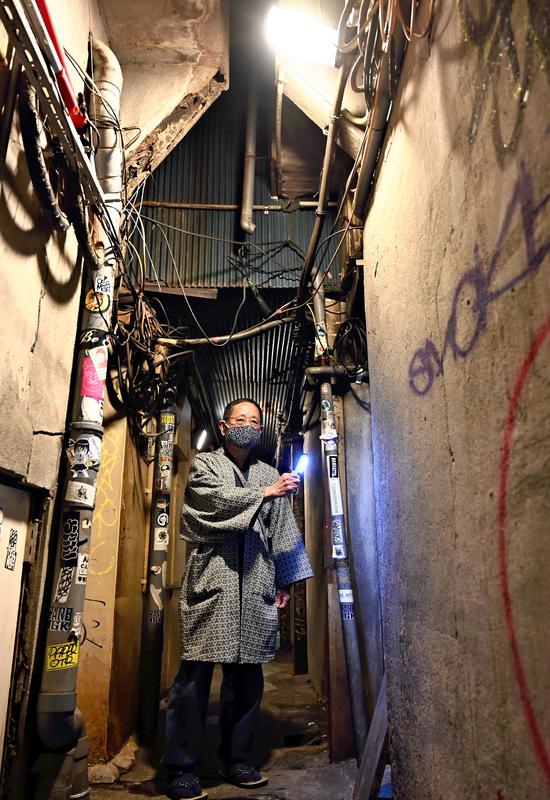
Almost all of the 290 restaurants and bars in the Shinjuku Golden-gai have shut down, leaving the popular nighttime district in Tokyo's Shinjuku Ward deserted.
"There's a risk of being infected with the coronavirus and also a risk of infecting others. Please be careful," 73-year-old Bunmei Tobayama, the president of the Shinjuku Golden-gai promotion association, has told shop owners and the staff of bars that are still open.
He's visited every shop on the second floor, too.
"Climbing up and down steep stairs is hard on my back at this age," Tobayama said with a smile as he went around his "hometown," a dense concentration of deep narrow buildings that looks like an eel's nest.
More than 90% of the shops in Shinjuku's Golden-gai have been closed in response to a request from the Tokyo metropolitan government to suspend business following the declaration of a state of emergency, although several places are still open.
"I'd rather those shops were closed. But I can't force them, as they, our buddies, make a living this way," said Tobayama, who looks after the district.
From late March, Tobayama's bar Kurakura had about five customers a day, and its sales dropped to about 20% of normal levels. However, he kept the bar open even at a loss, because he was concerned about the part-timers who rely on the wages he paid them. After the metropolitan government asked people to refrain from going out, Tobayama decided to close the bar from April 4.
Kurakura has been in business for 41 years since it opened in the Golden-gai. It had faced numerous crisis, including the battles against land sharks that were active behind the scenes during the bubble years, the collapse of Lehman Brothers, and the Great East Japan Earthquake. However, this is the first time for the bar to close for such a long period of time.
"Of course, it's frustrating. I don't really like doing what the government says," Tobayama said. But he added: "Drinking should be fun. We can't create an atmosphere where customers can drink with peace of mind."
The association had heard comments from some members who closed their businesses criticizing those who have remained open, saying, "If a person from just one shop in Golden-gai tests positive, the whole district will collapse."
Tobayama thought this opinion was reasonable, but that doesn't mean the association can force them to close. On April 7, the day the emergency declaration was issued, the association held an emergency board meeting, but it had no choice but to stick to its policy of "everyone deciding for themselves."
Walking in his "hometown," which has lost its vitality, is "really lonely," Tobayama said. But he has faith. "We can conduct our business because we have a landlord called Golden-gai. We're closing our stores to protect the district," he said.
Read more from The Japan News at https://japannews.yomiuri.co.jp/