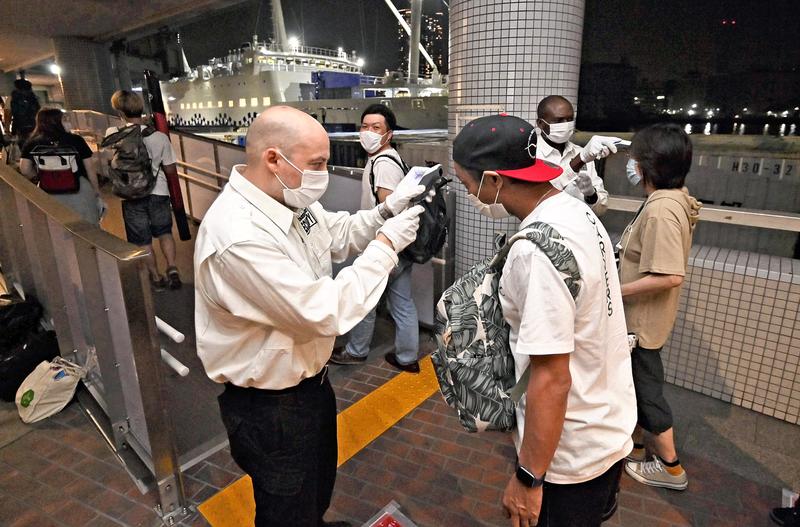
With the arrival of the summer tourism season, local governments on Tokyo's remote island municipalities, where new coronavirus infections have been rare among residents, are worried amid the news of the virus spreading fast in the capital.
Visitors to the islands south of Tokyo Bay are a big source of income to the tourism industry there, but medical services and resources on the islands are lacking.
The municipalities are therefore calling on visitors to thoroughly take preventive measures against the virus, while also expediting the improvement and expansion of tests and other systems on their islands.
On the evening of July 22, just before the four-day holiday period from July 23 to 26, Mayor Hiroshi Maeda of Kozushima village on Kozushima island was at the Takeshiba Passenger Ship Terminal in Minato Ward, Tokyo. He brought with him signboards with messages such as, "There are no camping grounds" and "Sleeping outdoors is prohibited," urging tourists going to the island to take heed.
To avoid people coming into close contact with one another, the village has suspended the operation of its camping ground, which can accommodate about 300 people, so that visitors can only stay in hotels or minshuku home-style accommodations. Each accommodation facility is limiting the number of guests. There are guest rooms for about 900 people on the whole island, yet currently the rooms are available for only about 250 people.
Kozushima is becoming popular among anime fans because an animated film released last summer is set on the island. The amount of visitors to the island during the four-day holiday period in July was lower than expected, even though about 440 people still came.
"To maintain the lives of people working in the tourist businesses, I want many people to come," Maeda said, "but it will be difficult for us to handle someone becoming infected. The only thing I can do is ask visitors to secure accommodations and be thorough with preventive measures against the virus."
--Infection crisis
In April, around the time the central government issued a state of emergency declaration, the municipalities of the islands began calling on tourists to avoid coming to the islands, each in its own style. The requests by the islands were removed or eased after the state of emergency was completely lifted on May 25, and the ban on traveling across prefectural borders was lifted on June 19. As of July 31, the islands have seen only one case of infection, which was on Mikura island. If tourists flock to the islands, there will be a higher risk of more infections, however.
The islands have only one medical institution designated for specified infectious diseases, which is located in the town of Hachijo on Hachijo island. Even that hospital has only two negative pressure rooms that prevent air from leaking outside. Therefore, if someone is found to be infected with the virus, the patient will be, in principle, taken on a helicopter to a hospital on the Honshu mainland.
To conduct polymerase chain reaction (PCR) testing, the town used to send specimens to the mainland, but they have introduced antigen tests from June, which take only about 30 minutes to obtain results.
"It's become easier to respond because we can get the results faster with antigen tests," said a town official in charge of the tests.
Many other islands have poor systems for testing and handling patients. Therefore, the Tokyo metropolitan government is planning to send antigen test kits to the islands and transport those who have tested positive to Honshu. Under the plan, high-risk contacts will also have a sample collected and sent to Honshu, which will then be used for PCR testing to decide whether they are infected.
The ferryboat to the village of Ogasawara, which is about 1,000 kilometers south of Honshu, has halved its capacity for passengers, to about 400. The ferryboat is the only means of transportation for visitors coming to the village, which covers the Ogasawara islands. The village has rented three minshuku rooms for visitors who have shown symptoms that indicate infection.
The town of Oshima on Oshima island will install mobile X-ray equipment outfoors sometime in August. The town is also planning to start antigen tests.
In May, a resident who had returned from the mainland tested positive for the virus in the village of Mikura. The village is considering renting minshuku rooms for those showing coronavirus symptoms and is already distributing face masks to residents for free.
"Many tourists were walking around without masks during the July holidays" a village official said. "There is an awareness gap between the islanders and tourists regarding the infection crisis."
--Ferryboats and flights in cooperation
Ferry and flight companies are collaborating with the villages as well. Tokai Kisen Co., which operates ferries from the Takeshiba pier in Tokyo and other wharfs, has reduced the maximum number of passengers on board to about 70% to avoid crowding. The company also checks passengers' temperature before they board. Shinshinkisen Co., which runs ferry services from Shimoda Port in Shizuoka Prefecture, has halved its number of passengers.
New Central Airservice Co., which operates flights from Chofu Airport in Tokyo, put up English-language notifications about the temporary closure of camping grounds on the islands.
"Tourists going to the islands include many foreigners, so it is absolutely essential we meticulously provide information," said a company official in charge. "We'd like to stay in close cooperation with the island municipalities and ensure the safety of the islands."
Read more from The Japan News at https://japannews.yomiuri.co.jp/