Growth in the number of Japanese nationals living in Tokyo has slowed as fewer people moved to the capital following the outbreak of the novel coronavirus.
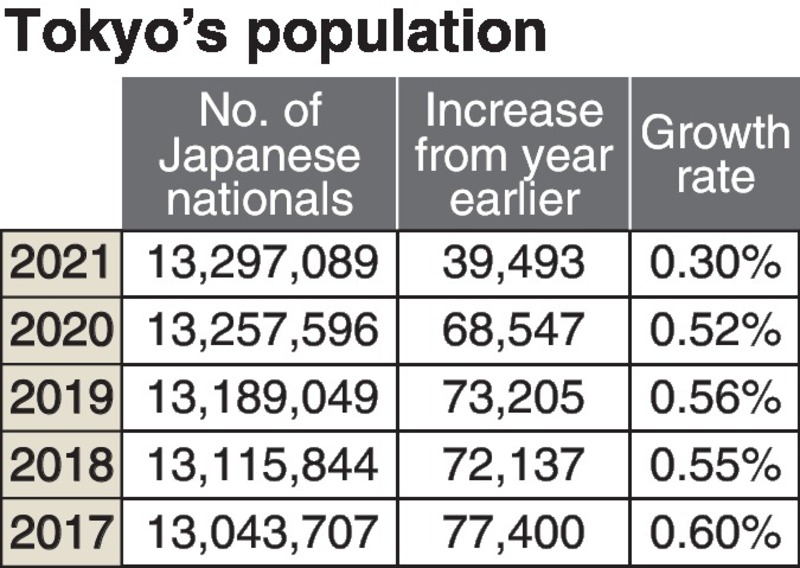
According to a survey based on the Basic Resident Registration by the Internal Affairs and Communications Ministry, Tokyo's population of Japanese nationals had increased by 39,493 as of Jan. 1, 2021, up 0.3% from a year earlier.
As of Jan. 1, 2020, the number of Japanese residents had swelled by 68,547, an increase of 0.52%, from the same date in 2019.
The government has been attempting to halt the overconcentration of people in Tokyo by promoting telecommuting and other measures. However, some observers believe the slowed growth is a temporary phenomenon amid the spread of the virus, and it is therefore necessary to urgently take drastic steps.
--Impact of COVID-19
The number of people moving into Tokyo decreased by about 18,000, while those moving out increased by about 13,100.
As there was no impact from the spread of COVID-19 as of Jan. 1, 2020, a senior ministry official judged that people might have moved to get out of Tokyo amid the pandemic. As the virus spread nationwide last year, the risk of infection was said to be particularly high in Tokyo, where the population is densely concentrated.
The first state of emergency was declared in April last year, triggering the spread of telecommuting that allows people to work from home.
Over the past year, 42 prefectures saw their populations drop. In all of these prefectures, however, the rate of decline shrank.
The populations of Chiba and Saitama prefectures shifted from declining to increasing, while the rate of population growth rose in Okinawa and Kanagawa prefectures. According to a government official, this shows that the outflow of people to Tokyo has decreased.
--Promoting migration
To correct the overconcentration of people in Tokyo, the government has set a goal of achieving a balance in the movement of people between the Tokyo metropolitan area and regional areas by the end of fiscal 2024.
It has introduced measures such as tax incentives for companies relocating to regional areas and subsidies for people who move there, but no significant results have been achieved.
As interest in regional areas grows amid the COVID-19 disaster, the government is hoping to encourage people to move out of Tokyo.
The promotion of telecommuting is one such measure. In the third supplementary budget for fiscal 2020, the government has earmarked a "regional development telecommuting subsidy" to support the development of satellite offices by local governments, among other efforts.
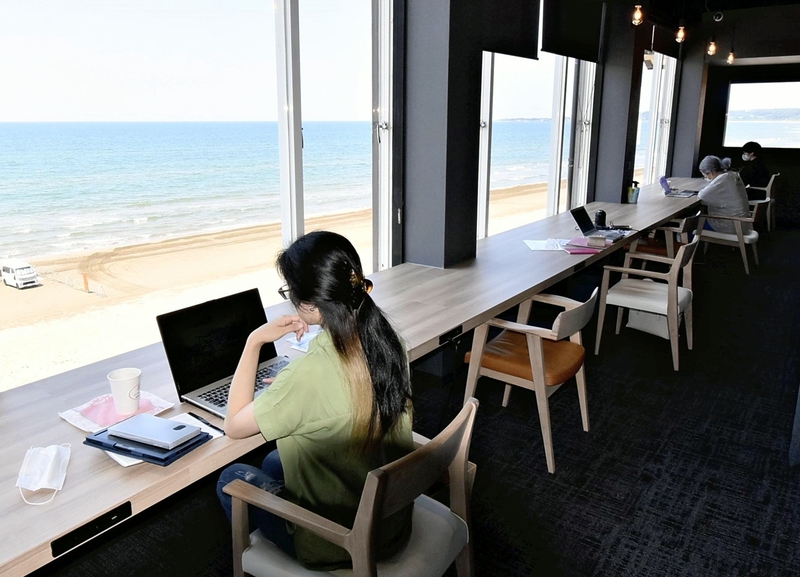
In Hakui, Ishikawa Prefecture, which faces the Sea of Japan, the Co-working Base Chirihama was opened on Monday on the second floor of a rest house along the coast, where people can telecommute.
The facility is equipped with Wi-Fi, a multifunctional printer, and private booths for online meetings, using a grant to provide a fulfilling environment for work.
--No end in sight
However, it is unclear whether more people will migrate to regional areas as the government hopes.
Although the rate of population growth in Tokyo has slowed down, the number of residents has yet to decline. The figure as of Jan. 1, 2021, was still 39,493 higher than one year before.
"We've discovered that even the outbreak of a virus cannot easily change the trend," a senior Cabinet Secretary official said.
There seems to be a limit to the spread of telecommuting.
In a survey conducted in July by the Japan Productivity Center, a public interest incorporated foundation, a total of 49.7% of respondents said their work efficiency had "decreased" or "slightly decreased" when asked about working from home.
"Telecommuting will settle down once corona is resolved. I don't think it'll become more widespread in the future," said Akira Kakioka, a senior researcher at the center.
Read more from The Japan News at https://japannews.yomiuri.co.jp/