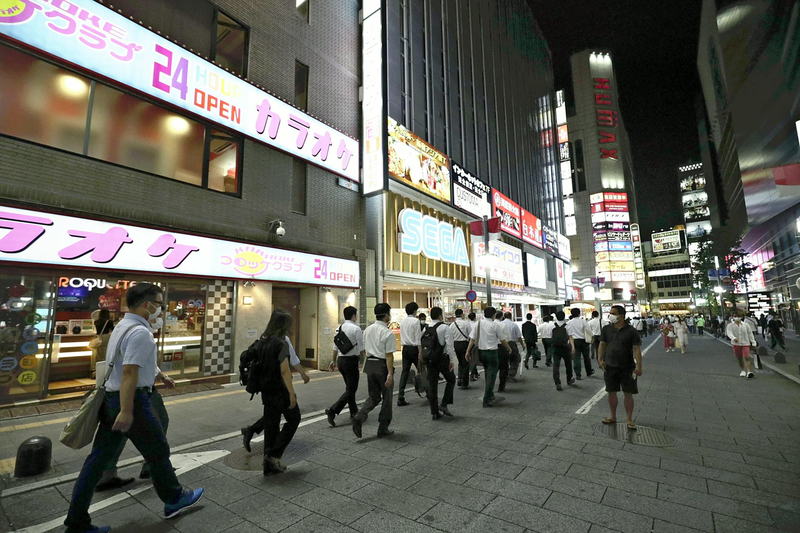
The Tokyo metropolitan government has asked eating and drinking establishments and karaoke venues to cut their business hours to stop the growing spread of the novel coronavirus, but it remains unclear whether this will be effective and how many operators will heed this request.
The Tokyo government took this step Thursday after the capital reported a record-high 367 new infections that day. However, it is difficult to force operators to take steps under the revised law on special measures for new types of influenza, and the Tokyo government will need to cough up for additional countermeasures at a time when its finances are already strained.
Infections have surged in Tokyo during July, and Thursday's figure topped the previous record of 366 new cases set on July 23. The figures announced daily can fluctuate wildly depending on factors such as the number of tests done several days earlier and the dates that public health centers report their results. A seven-day rolling average of cases more clearly reflects infection trends. This weekly average in Tokyo was 56.9 people as of July 1, but the figure topped 250 people on July 23. This number has plateaued somewhat over the past few days but crept up to a record-high 258.3 people Thursday.
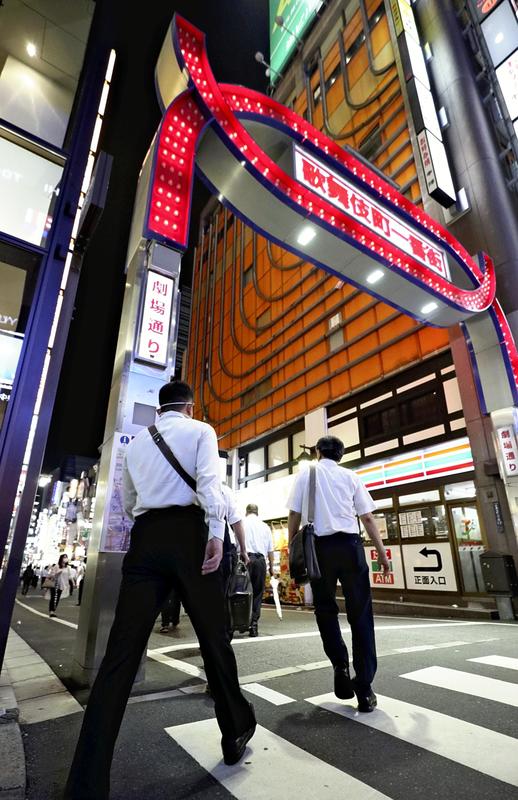
Although expanded testing is partly behind the increase in infections identified, the Tokyo government is concerned about the diversifying routes of infection among residents. There has been a spike in cases originating not only at nightlife spots in which employees entertain clients in close-contact settings, but also after people have gathered at other types of restaurants to eat and drink together. There were 104 such cases between July 23 and 29, an about fivefold increase from the 19 such infections identified between June 15 and 21.
The Tokyo government has taken steps such as calling on residents to voluntarily refrain from going out on nonessential trips and having officials go around establishments in entertainment districts. However, this approach has not shown any tangible results. The special law does not contain any penalties for business operators that refuse requests to temporarily close their doors or shorten their hours.
"All we can do is just keep imploring them to do this," a senior metropolitan government official said.
On July 24, Tokyo government officials accompanied Metropolitan Police Department personnel conducting checks on host clubs and other nightspots based on the law governing adult entertainment businesses. This law was established to stipulate matters such as conditions for acquiring a license to operate such a business; it does not cover countermeasures against infectious diseases. Under the current law, Tokyo government officials have no recourse if such an establishment refuses to allow them inside.
Being financially strapped also is hindering the metropolitan government's handling of the problem. Giving payouts to businesses that comply with the request to close will be essential, but the Tokyo government has spent about 1.4 trillion yen on coronavirus countermeasures since February. Its coffers are already running low. Consequently, compensation paid to businesses that temporarily close as requested will be cut from the previous level of 500,000 yen (and 1 million yen for operators of multiple shops) to 200,000 yen this time.
"The Tokyo government lacks both carrots and sticks, so the fight against coronavirus is really stretching us," a second senior metropolitan government official said.
At a press conference, Tokyo Gov. Yuriko Koike urged the central government to revise the special law.
--425 tertiary students infected
At least 425 university, junior college and technical college students have been infected with the coronavirus, according to education ministry sources.
About 60% of these students became infected during July, prompting the ministry to warn students about the risk of catching the virus at events such as drinking parties and during club trips.
The Education, Culture, Sports, Science and Technology Ministry requires all universities, junior colleges and technical colleges to report any infections detected among their students. As of July 26, a combined 425 infections had been confirmed, of which 267 were reported during this month.
Several coronavirus clusters have broken out at universities in Japan. In July, five Kyoto University students who belonged to same extracurricular activity group that ate meals and did other events outdoors caught the virus. Yokohama National University announced in late July that eight students had become infected. Many were members of the same university club, and it seems they became infected while eating together outside the university.
Coronavirus cases also have been reported at several private universities.
Read more from The Japan News at https://japannews.yomiuri.co.jp/