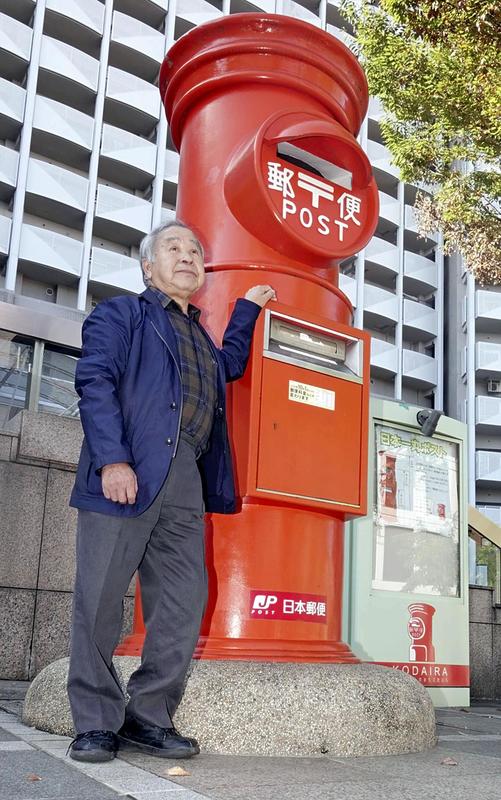
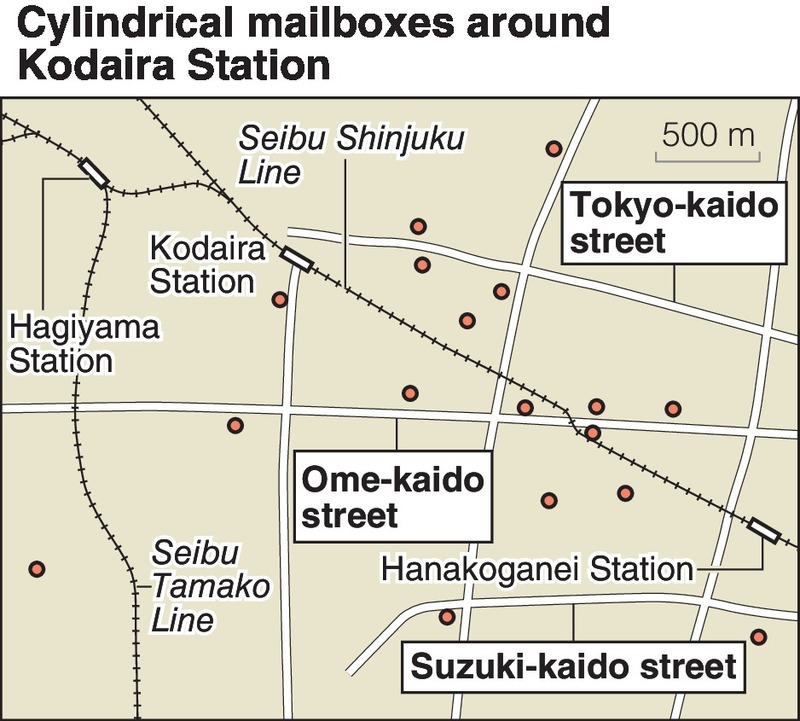
The city of Kodaira could be called the "town of cylindrical mailboxes" -- there are still 32 of these red, column-shaped mailboxes in use in the city, more than any other local government in Tokyo. Why does Kodaira have so many, when they stopped being made about half a century ago?
A book published by a citizens group in 2001 is believed to have first drawn attention to the proliferation of cylindrical mailboxes in Kodaira. Titled "Michikusa no Sankosho, Gurin Rodo no Machi Kodaira" (A reference for loitering on one's way, the Green Road town of Kodaira), the book was published with financial support from the city.
It introduces the Kodaira Green Road walking course and other parts of the city, which is rich in nature.
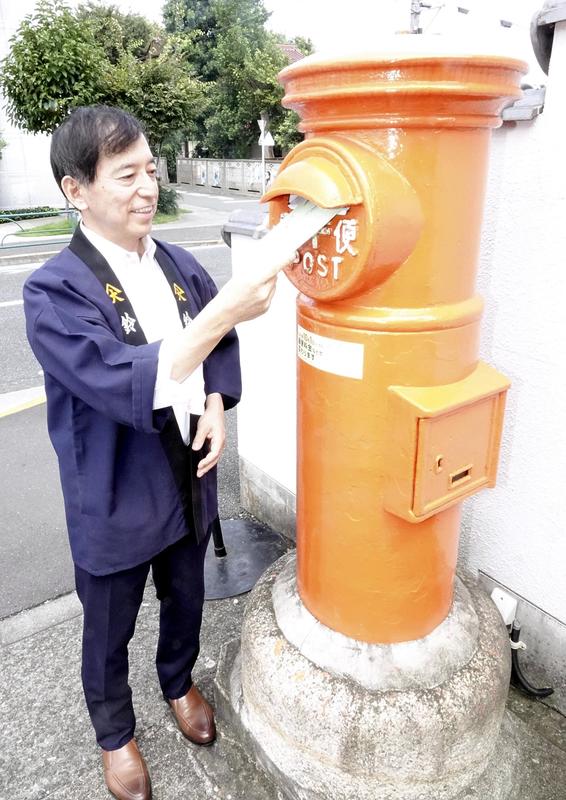
Photographer Hiroshi Inoue, 61, from Hino, Tokyo, who provided content for the book, said he found cylindrical mailboxes throughout the city. Having confirmed with the Kodaira Post Office that the city is home to 37 cylindrical mailboxes overall at that time, Inoue introduced them with photographs in a story titled "Kodaira Posuto Monogatari" (Kodaira mailbox story) in the book.
Former Kodaira Post Office master Takeshi Hayashi, 67, of Nerima Ward, Tokyo, read the article six years later and tied it to regional vitalization efforts.
Hayashi, who also was a former director of the Postal Museum Japan, told people related to a local commerce and industry association and the Kodaira city government that the city has over 10 more cylindrical mailboxes than the cities of Fuchu and Akiruno.
Those cities have the second-largest number in Tokyo, with 18 such mailboxes each.
Rising to fame
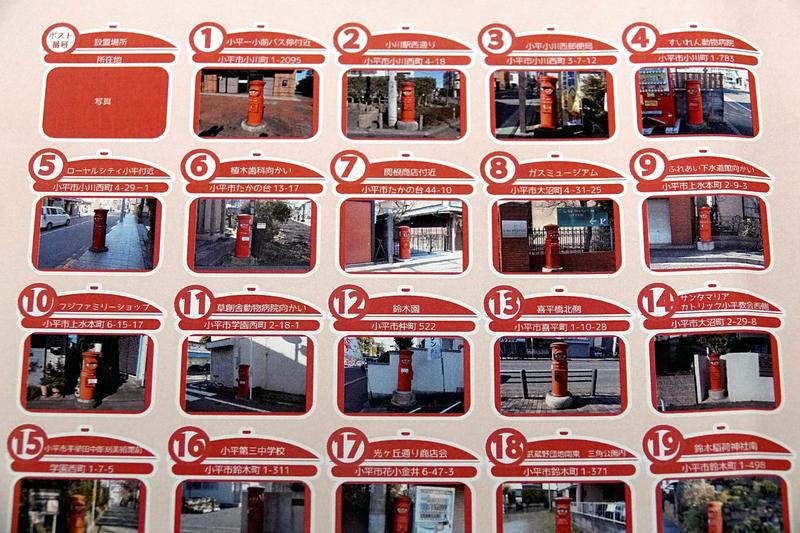
Cylindrical mailboxes immediately became Kodaira's specialty. Photo exhibitions featuring such mailboxes across the nation were held in the city, and sightseeing maps showing their locations were distributed. Events touring the mailboxes were also held.
In 2009, local volunteers created a 2.8-meter-high cylindrical mailbox, the "nation's tallest," and set it up in front of Seibu Railway Kodaira Station. This effort was led by Sanji Uchino, 74, who said the participants were eager to create a new symbol for the city.
"We contributed ideas for its production. The body of the mailbox was made with a pipe, and the head was a wok," Uchino said.
Japan Post Co. has not released nationwide statistics on the number of cylindrical mailboxes used by each local government, but according to Nagoya photographer Takumi Shoji, 55, the cities of Beppu, Oita Prefecture, and Kamakura, Kanagawa Prefecture, are also home to a large number.
According to the Beppu Post Office and the Minami Kanto branch office of Japan Post, there are 30 cylindrical mailboxes in use in Beppu and 31 in use in Kamakura.
"Kodaira may have more cylindrical mailboxes than any other local government in the nation," said Shoji, who has photographed them across the country.
Too small for A-4
Most of the existing cylindrical mailboxes were built post-World War II, from 1949 on. Their official name can be translated as "Mailbox No. 1 (Round)."
The mailboxes are about 1.35 meters tall and about 40 centimeters in diameter. To prevent them from falling, they are set on a heavy stone base, about 20 centimeters tall and about 60 centimeters in diameter.
There were about 50,000 cylindrical mailboxes nationwide around 1970, but as of March this year, the number had dropped to about 4,600, or less than one-tenth of the peak figure. This is because A-4 letter-sized envelopes, which came to be widely used for business purposes, have to be bent in order to be dropped into cylindrical mailboxes, and it became necessary to increase the capacity of mailboxes because of the increase in postal demand.
Local nature, broad-mindedness
"The number of offices didn't increase much around main roads in Kodaira, because many of them are designated as scenic areas with restrictions on construction," said Tsuneo Suzuki, 60, chairman of the Kodaira Chamber of Commerce and Industry, explaining why such mailboxes are still in use in Kodaira.
There are 28 such scenic areas in Tokyo, including four in Kodaira. From the north, they are areas around the Tokyo-kaido street, the Ome-kaido street, the Suzuki-kaido street and an area adjacent to the Tamagawa Josui Waterworks. They were designated as scenic areas in 1962.
About half of Kodaira's cylindrical mailboxes are located in areas where the construction of buildings taller than 15 meters is prohibited.
Another reason for their continued popularity may be the nostalgia that the mailboxes evoke for days gone by.
Kumiko Motohashi, 78, has one such mailbox on the premises of her home. She had it moved from a store that used to be run by her parents-in-law.
"I just didn't want to the mailbox to be gone after the shop closed," Motohashi said. "I heard that a local post office received many phone calls asking what happened to the mailbox when it was removed from the store," she said.
Suzuki also has a cylindrical mailbox -- it used to be at a public hall and is now outside a wholesale tea store he runs along the Ome-kaido street. He asked to take it to his store after the closure of the public hall.
"I'd been familiar with the mailbox since I was a child," Suzuki said with a smile. "There may be many warm-hearted people in Kodaira who don't mind that they can't drop A-4 size envelopes into the mailbox. I think this kind of broad-mindedness and the nature in Kodaira kept the mailboxes around town."
Read more from The Japan News at https://japannews.yomiuri.co.jp/