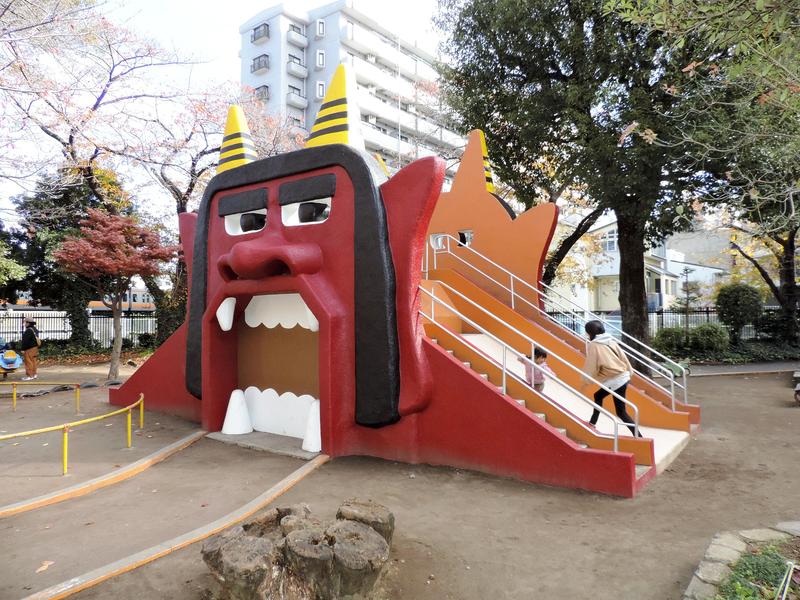
TACHIKAWA, Tokyo -- There is a small playground called Oni Park -- "oni" means Japanese horned ogre -- about a five-minute walk east from the South Exit of JR Tachikawa Station. The name comes from its unusual slide with huge faces of a red ogre. This distinctive slide often appears in cartoons and dramas, and is revered by fans of the works.
The park was built in 1981 and its official name is Tachikawa-shi Nishiki Dai-Ni Koen (Tachikawa city Nishiki No. 2 park). Within the 1,700-square-meter open space are also swings and other playground equipment. But apart from the slide, which is made of reinforced concrete and modeled after huge faces of the red ogre on both sides, the park is rather unremarkable in Japan.
The red ogre faces are 5.4 meters tall from the ground to the tips of their yellow horns, and the height of their wide-open mouths is 2.2 meters. When visitors stand for photos in front of the faces, they appear to be eaten by the ogre. So, Oni Park has been an instagrammable spot for a long time.
The slide was a location for the TV drama series "Gokusen" starring actress Yukie Nakama, the TV drama "Nagi no Oitoma' starring actress Haru Kuroki, and the manga "Saint Young Men" by Hikaru Nakamura.
Because of its eccentricity, it has attracted attention on the internet, drawing comments such as, "It's so powerful! Children who see it for the first time may cry."
Toshiyuki Furukawa, 64, a former Tachikawa city government official, was in charge of the design of the slide. He was in his 20s at the time.
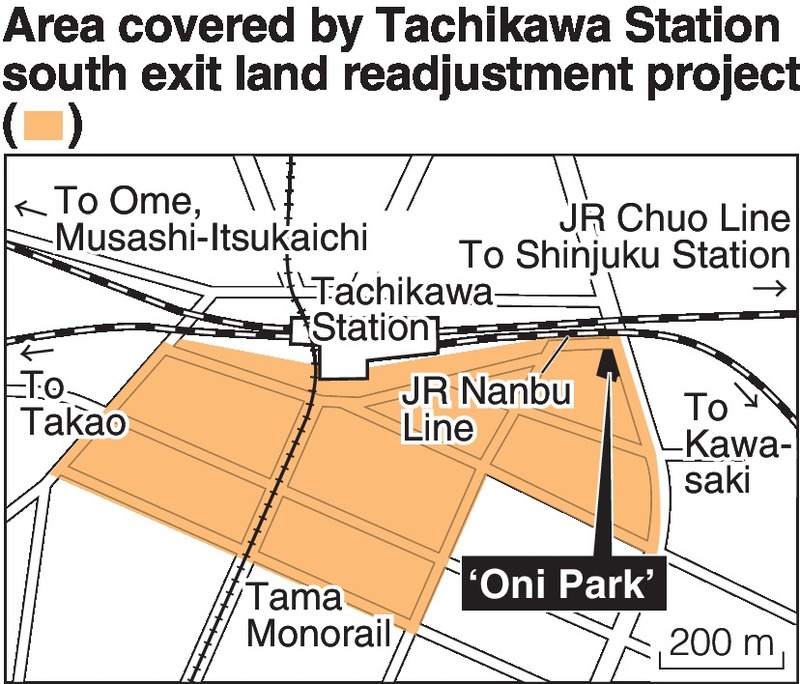
In the 1960s, the south exit of Tachikawa Station, where many small shops were located, was overcrowded with people and cars because the square in front of the station and the roads were narrow and there were no sidewalks.
In 1966, the city government started a land readjustment project to expand the square and roads in an area of about 28 hectares near the south exit. Oni Park was built as part of this project.
According to Furukawa, because the park was small, it was necessary to build a tunnel under the slide to make a path across the park.
Furukawa came up with an idea of making the entrances of the tunnel look like a wide-open mouth of a red ogre. Both ends of the tunnel are now closed.
Then in November 1980, when he was working for a section of the land readjustment project, he drew up a blueprint for the present slide.
"Anyway, I designed it to make a handsome face. My boss pointed out the strength and safety of the slide, but the design was endorsed smoothly," he said.
The park is located northeast of the land readjustment project area, and it corresponds to the direction called kimon, from which an ogre is supposed to enter and exit. He decided to explain the design externally that the red ogre protects the kimon unlucky direction in the city.
"I was really happy to see many children playing with the slide after it was completed," Furukawa said.
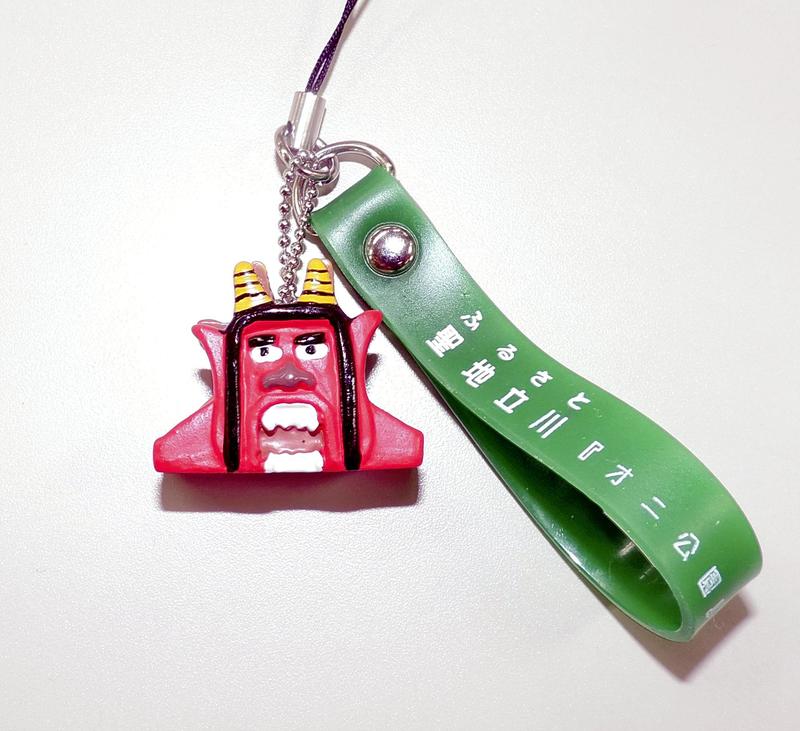
After being featured in TV dramas and comics, the slide became a symbol of the area and has played a role in vitalizing it. In 2009, a group of young shop owners from the local Nishiki shopping street promotion association created a cell phone strap that resembles the slide, with the explanation that "[Oni Park is] a sacred place where the red ogre guards the area."
Since 2015, the Oniuma Festival, which means very yummy food festival, is held annually at Oni Park, featuring lines of stalls run by local shop owners. At the venue, an original snack food called Oniumaibo is also handed out.
"While the red ogre on the slide is powerful, it is also fun to laugh at unconsciously. This is an asset to the city because it only exists here," said Masahiro Takahashi, 53, vice president of the association and the owner of a Chinese restaurant.
The red ogre, loved by the people of Tachikawa, has been keeping its watchful big eyes open to protect the city.
Read more from The Japan News at https://japannews.yomiuri.co.jp/