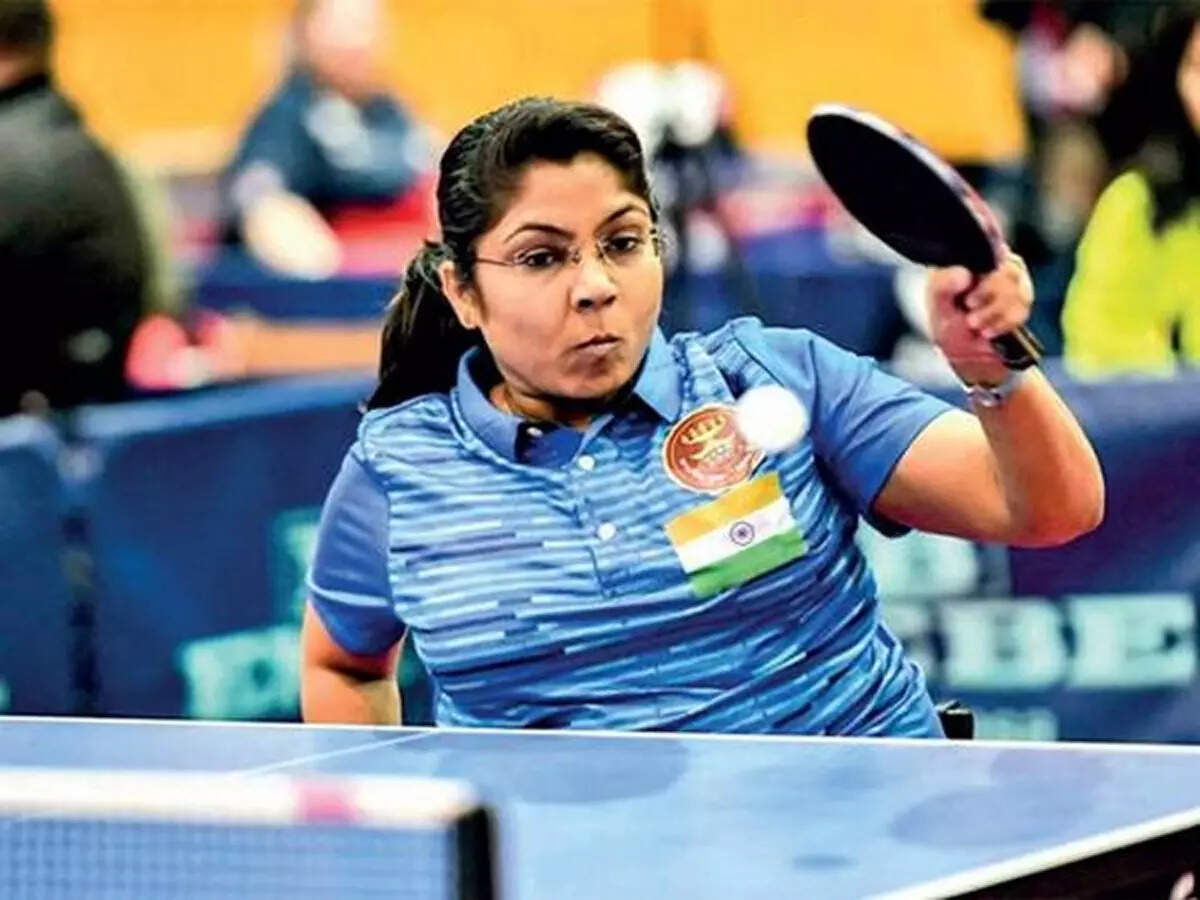
Making her debut at the Paralympics a memorable one, India’s Bhavina Patel outclassed reigning Paralympic champion and world No. 2 Borislava Peric-Rankovic of Serbia to enter the semifinals of the women’s singles Class 4 event in Tokyo. And she continued her giant-killing spree on Saturday, defeating China's world No. 3 Zhang Miao for a place in the gold-medal match.
The quarterfinal win on Friday ensured that Bhavina became the country’s first para table tennis player to ensure a medal in the Paralympics. The 34-year-old Indian beat the Rio gold medallist 11-5, 11-6, 11-7 in 18 minutes in their last-eight contest. She earlier saw off the challenge of Brazil’s Joyce de Oliveira 12-10, 13- 11, 11-6 in the Round of 16.
After winning the semifinal on Saturday, Bhavina is now looking good for a historic gold. She fought hard to eke out a 7-11, 11-7, 11-4, 9-11, 11-8 win over Miao in the semis. The Indian will take on world No. 1 Chinese paddler Ying Zhou in the summit clash on Sunday at 7:15 am IST.
Bhavina, who hails from Vadnagar in Gujarat’s Mehsana district, moved to Ahmedabad after marrying Nikul Patel, who has played junior cricket for Gujarat. Her father runs a small cutlery shop in the village.
“She is 90% disabled but she has the will-power and determination of 10 able-bodied persons. I get inspired from her will and confidence,” Bhavina’s husband Nikul told TOI over phone from Tokyo, referring to his wife's disability due to polio affliction in childhood.
Athletes in Class 4 category have fair sitting balance and fully functional arms and hands. Their impairment may be due to a lower spinal cord lesion or cerebral palsy.
Gujarat State Table Tennis Association president Vipul Mittra said, “She has been a top-class player for more than a decade now and I am happy that she got a chance to showcase her talent at sports’ biggest stage. I am sure she will continue to shine and inspire others.”
Bhavina’s coach Lallan Doshi told TOI said the para paddler is reaping the rewards of her resilience and hard work.
“We have put in a lot of effort to improve the coordination between hand, eye and mind. We have been studying her opponents and devising strategies to make her shots difficult for them,” Doshi said.
The improvement in her game has been possible because of “quick responses” through exercise, he said, adding that the focus has been on “receiving the next ball” and “blocking”.
“She was made to train against two players, helping her body achieve flexibility,” Doshi said.
(With inputs from PTI)