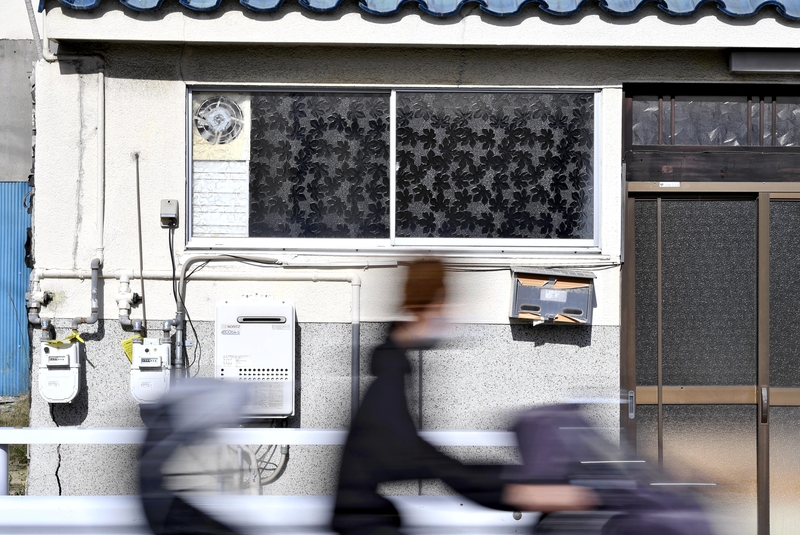
Tokyo's 23 wards, Osaka and Kobe logged 204 solitary deaths in 2018, according to data gathered from their medical examiner's offices.
These are defined as deaths that are not discovered for at least 4 days, even if the deceased is living with family members.
Such deaths may not be reported because the spouse or other cohabitant has dementia or is bedridden. The figure highlights one of the new challenges Japan's aging society is facing.
While there is no legal definition of or national statistics on solitary death, Tokyo's 23 wards, Osaka and Kobe have medical examiner systems to investigate the cause of death in cases that are unlikely to involve criminality. Each medical examiner's office keeps its own records.
Of the 204 solitary deaths, 163 were in Tokyo's 23 wards, 35 were in Osaka and six were in Kobe. These marked record highs for Tokyo's 23 wards and Kobe.
According to the Tokyo Medical Examiner's Office, there were 68 solitary deaths in the 23 wards in 2003, the first year records were taken. The number exceeded 100 for the first time in 2010.
The 2018 deaths comprised 104 men and 59 women. It took four to seven days to discover the body in 87 deaths, eight to 30 days in 54 deaths, 31 days to one year in 20 deaths, and more than one year in two deaths.
"The number of multiperson households that are isolated from the community may be increasing," an official at the office said.
According to the Osaka prefectural medical examiner's office, the 35 solitary deaths in Osaka city comprised nine who were in their 60s and eight each in their 70s and 80s. The household structures were two people living together in 32 deaths and three people living together in three deaths.
The survivor was a spouse in 21 cases, the largest proportion.
The most common reason the death was not discovered was because the surviving family member had dementia in nine cases. In three cases the family member was bedridden. In two cases a husband and wife living together both died.
It took four to seven days to discover the body in 27 deaths, eight days to one month in seven deaths, and more than one month in one death.
"We understand the importance of preventing the isolation of multiperson households. However, it's difficult to create specialized policies because it's impossible to understand the details of each household environment," an official of the Health, Labor and Welfare Ministry's community welfare section said.
Shukutoku University Prof. Yasuhiro Yuki, an expert in social welfare, said: "Nationwide, I wouldn't be surprised if the number of solitary deaths was over 1,000. This is because there are more households where one person needs care, such as due to dementia or being bedridden. This will probably get more serious going forward. The central and municipal governments need to do a nationwide survey soon and create a framework for looking out for people through the assistance of community residents and others."
Read more from The Japan News at https://japannews.yomiuri.co.jp/