Spectators gathering from both home and abroad to see the 2020 Tokyo Olympics and Paralympics will be greeted by robots. Preparations for omotenashi hospitality are being made at airports, railway stations and event venues. The upcoming sports extravaganza will likely provide the country with a chance to demonstrate its abilities as a powerhouse for robotics.
"The monorail is on the first floor of the basement." "Miss, I'll tell you about the restaurants popular among airport employees."
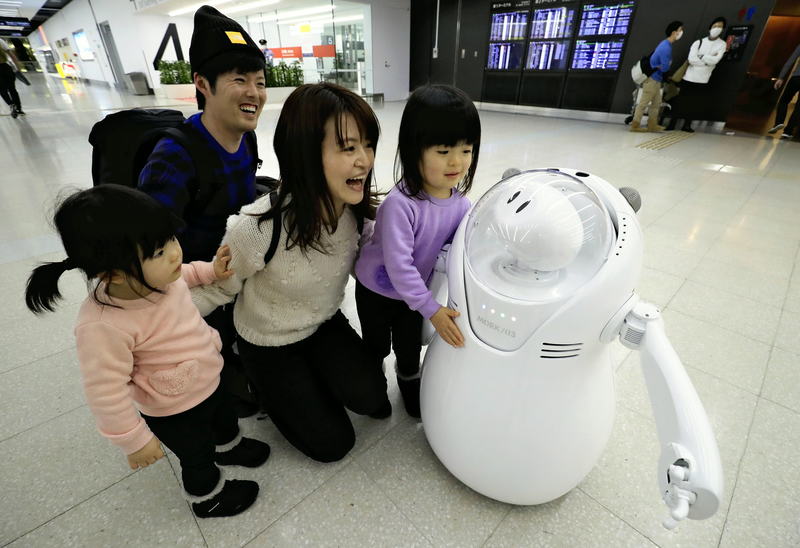
An 80-centimeter-tall robot was seen one day running around the international terminal of Haneda Airport, a gateway to Japan, uttering these phrases using its electronic voicebox. As the robot held out its hand, a foreign traveler widened his eyes in surprise.
Japan Airport Terminal Co., which operates the Haneda airport building, has developed the robot named "Mork," which is an avatar that is manually operated via remote, with a start-up company. The robot will be fully launched during the Olympic and Paralympic Games.
Japan Airport Terminal launched a Haneda Robotics Lab project in 2016 to utilize robots while the games are held this summer.
Haneda has visited the testing site for more than 20 of the robots, which will provide cleaning and security services. Yutaka Kuratomi, 41, who has been involved in the project, said enthusiastically, "We'd like to make Haneda Airport a place where foreign visitors can experience Japan's technologies and ideas at the very beginning of their visit."
Making up for shortage in manpower
The previous Tokyo Games were held in 1964, which was the year when Japanese were finally able to travel overseas freely, and with the opening of the Metropolitan Expressway's Haneda Line and Tokyo Monorail service, Haneda Airport was crowded with foreign athletes.
Almost half a century later, the international terminal was opened in 2010 and operates 24 hours a day, 365 days a year. The annual number of people going through Haneda Airport topped 80 million in 2016.
Haneda ranks high in the list of global airports rated by Skytrax, a British research firm, but is no match for first-ranked Singapore Changi International Airport. In terms of the number of visitors, Haneda even falls behind Chinese and Middle Eastern airports.
"If we ignore the prospect that manpower will taper off, it will be impossible for Haneda to grab the top rating or even maintain its high ranking." With this resolution, Kuratomi and others involved with Haneda Robotics Lab project invited the developers to conduct mobility tests on dozens of robots in the empty terminal, late at night.
After trial and error, "Mork" was finally accepted. An official from the company that developed "Mork" said they expected that the robot would "attract global attention if it is used at the airport."
The operation of new routes flying above central Tokyo, to and from Haneda Airport, will start on March 29, thereby accelerating the expansion of international flights. Kuratomi aims to take a leap toward making Haneda "No. 1 in the world," saying, "By utilizing robots to deal with infectious diseases and disaster, among other things, we'd like to enhance the international competitiveness of Haneda."
Providing security in 4 languages
A security robot was introduced at Narita Airport last June, making it the first domestic airport to begin using such a robot. The "Secom Robot X2" developed by major security firm Secom speaks to visitors in four languages ― Japanese, English, Chinese and Korean ― and is able to move around the terminal while maneuvering through a crowd of people autonomously without coming into contact with them.
Narita International Airport Corp. aims to introduce a guide robot in addition to the already utilized security robot before the opening of the Olympic Games, noting, "A new form of airport operation will be demonstrated not only as a measure to bolster security but also as a measure to resolve a shortage in manpower."
Hirohisa Hirukawa, director of the Robot Innovation Research Center at the National Institute of Advanced Industrial Science and Technology, stated its expectations on the spread of robot utilization, saying: "The use of robots has been centralized in factories, but the range of their abilities has begun to expand to airports and railway stations. The use of robots has been wanting in such fields as logistics and nursing care, both of which have been hit hard due to the lack of manpower available. The Tokyo Games will provide a good opportunity for more widespread use of robots."
AI use to increase at railway stations
Omotenashi hospitality using cutting edge technologies has been spreading to other public transport systems as well.
Takanawa Gateway, a new station on the JR Yamanote Line and Keihin Tohoku Line that will open on March 14, will begin full-scale operations of unmanned convenience stores utilizing artificial intelligence. The AI will recognize what items are selected by which customers through video cameras inside the store and automatically calculate the total cost.
Security and cleaning robots will be operated at the station and an AI-based guide will be available as well to help visitors find their way around. There will be areas where people utilize virtual reality to experience the charms of traveling, as well as a new type of automatic ticket gate that will be able to scan QR codes. President Yuji Fukasawa of East Japan Railway Co. (JR East) said that Takanawa Gateway was "designed to make users feel as if they were at a futuristic station."
Toei Transportation will likely introduce a new security system at their subway stations in which if a suspicious object is detected by an AI-equipped security camera, it will automatically alert security and other officials, before the opening of the Tokyo Olympics.
Universal design (UD) taxis, which are now widely used, are wheelchair friendly and provides easy access for elderly people. As of the end of last January, 18,000 of about 50,000 taxis running in central Tokyo are UD models. Efforts have been made to introduce multilingual tablet terminals as well as training drivers to be able to converse in English.
Sharing moments at event venues
Robots will also welcome athletes and spectators at event venues during the Olympics.
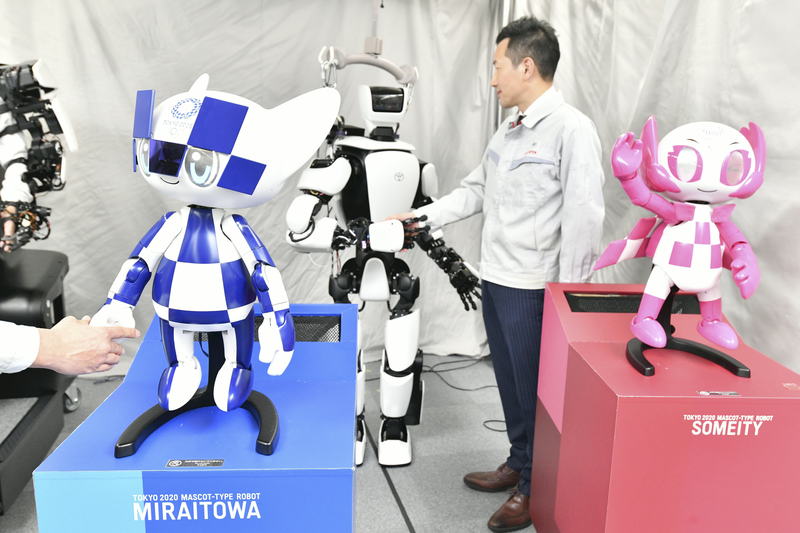
What will likely catch the attention of many people are robots of Miraitowa and Someity, the mascots of the Olympics and Paralympics. When the robots -- standing at about 60 centimeters tall -- are approached by someone, they will express various emotions through eye, head, arm and leg movements.
Tomohisa Moridaira, 46, of Toyota Motor Corp. who had been involved in the development of the robots, said, "We'd like to create robots that entertain athletes and spectators by using the mascots that symbolize the Games."
In addition to these robots, humanoid robots that move more like humans will be active as well. A pair of remote-controlled humanoid and mascot robots will team up to interact with athletes, such as shaking hands with them, as spectators watch.
At the National Stadium, robots will be on standby to escort disabled spectators to their seats. In some other event venues, a service is scheduled to be introduced that will allow spectators to order food and drinks from their seats via a tablet, that will then be delivered to them by a robot.
Read more from The Japan News at https://japannews.yomiuri.co.jp/