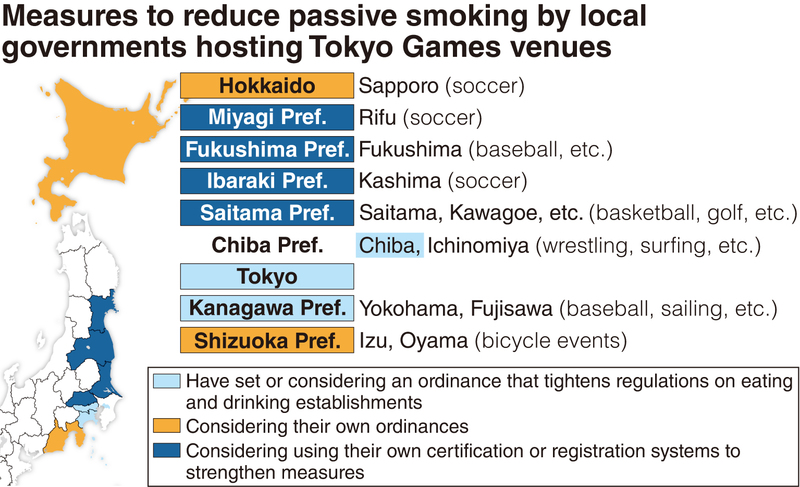
Local governments that will host sports venues for the 2020 Tokyo Olympics and Paralympics have been failing to take concerted action to prevent passive smoking.
Tokyo, the host city of the Games, has enacted an ordinance to prevent passive smoking that is stricter than national regulations, and while some local governments are following suit, many remain at the stage of reviewing possible measures.
There is a fear that differences in regulations could cause confusion among visitors to multiple venues. Experts point to the need to compile standardized rules for cracking down on passive smoking.
After the June Metropolitan Assembly session in which the assembly enacted its own ordinance that included penalties, Tokyo Gov. Yuriko Koike said proudly, "Tokyo, as the host city of the Olympic and Paralympic Games, has managed to create a system [to prevent passive smoking]."
The International Olympic Committee is promoting a "tobacco-free" Olympics, and past host cities have set strict regulations.
Under Tokyo's ordinance, restaurants and bars that hire an employee, regardless of their size, are subject to the smoking ban, in principle. The ordinance will cover about 84 percent of restaurants and bars in Tokyo. Still, its regulations are looser than those of other host cities in the past.
On the other hand, the revised Health Promotion Law enacted in July is more lenient than Tokyo's ordinance. The national law permits smoking at existing small restaurants and bars with a customer seating area of 100 square meters or less. As a result, only 45 percent of all eating and drinking establishments are expected to be subject to the smoking ban.
Makuhari Messe, a large convention center in Chiba city, will host Olympic wrestling and fencing events. In July, Chiba Mayor Toshihito Kumagai said he aims to submit a draft ordinance similar to Tokyo's ordinance to the city assembly as early as September, and to enforce the ordinance in April 2020.
"Considering that [Chiba] is a host city just like Tokyo, I considered it necessary to enact an ordinance on our own. It is desirable for local governments that host venues to take a standardized approach to a certain extent," Kumagai said.
Mimicking national laws
Meanwhile, some local governments that had been aiming for their own ordinances are only imposing regulations that are similar in scope to those of the national government, while others have regulations without concrete measures.
Gov. Heita Kawakatsu of Shizuoka Prefecture, where bicycle events will be held, said in April, "[Shizuoka Prefecture] will keep in step with Tokyo." However, according to the draft outline of the ordinance released in August, regulations on eating and drinking establishments are to be based on national laws.
"We aim to enforce the ordinance in April next year, so we gave weight to speedy procedures," said a city official in charge.
Hokkaido, meanwhile, will provide a venue for soccer events. The Hokkaido assembly compiled a draft ordinance to prevent passive smoking in May last year. However, due to opposition from some assembly members, deliberations have been postponed.
A Hokkaido official in charge said, "We consider it necessary to first take thorough measures in Hokkaido based on laws of the national government."
Meanwhile, a number of local governments hosting Games venues have decided to deal with the issue by using existing systems rather than establishing their own ordinances.
For example, the Ibaraki prefectural government has introduced a system to certify facilities that achieve smoking bans on their premises or within buildings. About 500 restaurants and supermarkets have been certified and display stickers to the effect.
A prefectural official in charge explained, "By widening the certification system, we can expect stricter measures than with laws."
Tomoyuki Suzuki, a visiting professor of sports policy at Kokushikan University who participated in the campaign to host the Games in Tokyo as a Tokyo metropolitan government employee, said: "It is very unkind to foreign tourists to have different rules depending on the local government. The organizing committee for the Games should take the initiative in urging the central and related local governments to establish unified rules."
Read more from The Japan News at https://japannews.yomiuri.co.jp/