Fears are mounting over whether the new coronavirus will force the cancellation or postponement of the Tokyo Olympic and Paralympic Games, scheduled for this summer, after the World Health Organization called the disease a pandemic Wednesday.
Outbreaks of the infectious disease the world over are gradually affecting qualifying meets and preliminary events for the Games.
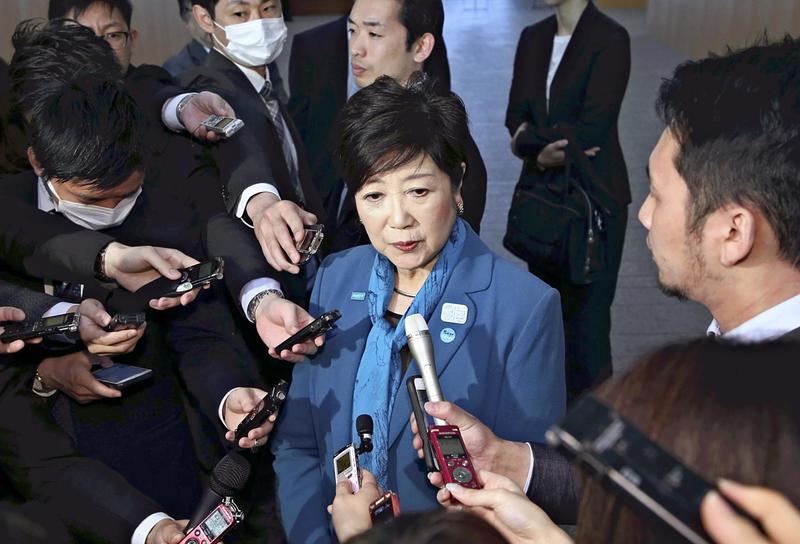
"It can't be said that [the WHO announcement of a pandemic] would have no impact on the Games," Tokyo Gov. Yuriko Koike said in sharp tones Thursday when reporters asked her about the pandemic announcement. "But I think cancellation is unthinkable given that sufficient preparations have been made so far and people have been looking forward to the Games."
After hearing the comment by Koike, a senior official of the Tokyo metropolitan government said: "I was so surprised that the governor admitted a possible effect on the Games. I suppose she must have a significant sense of urgency."
Since February, many events through which athletes would qualify for the Games have been canceled or postponed.
The wide spread of the virus infection has had an especially significant effect on badminton, golf and other sports events in which players are selected for the Games based on their world ranking and the points they gain in competitions.
The national swimming championships are set to be held in April, with the national championships of athletics to follow in June. Both competitions are used to select competitors for the Tokyo Games.
Olympic organizers have decided to downsize the arrival ceremony in Japan for the Olympic torch on March 20, as well as other related ceremonies.
The torch relay is expected to start on March 26 in Japan, but organizers are considering calling for people to voluntarily refrain from gathering to watch runners along the course.
International Olympic Committee President Thomas Bach insisted at a press conference on March 4: "Neither the word 'cancellation' nor 'postponement' was mentioned today during the Executive Board meeting … We are fully committed to the success of the Tokyo Games."
However, a member of the Tokyo Organizing Committee of the Olympic and Paralympic Games' executive board has said a postponement of the Games would be one option in light of the growing spread of the virus worldwide.
The contract signed by the International Olympic Committee, the Japan Olympic Committee and the Tokyo metropolitan government contains a provision stating that the Olympic Games can be terminated if the IOC has "reasonable grounds to believe, in its sole discretion, that the safety of participants in the Games would be seriously threatened or jeopardized for any reason whatsoever."
Yet some observers said that if the Games are canceled, the IOC could lose the massive income it receives by selling broadcasting rights to U.S. television broadcasters. It also is not easy to put off the Games to autumn, when many other sports events are held.
It is possible that the Games could be held with no spectators, like the Spring Grand Sumo Tournament that is currently under way in Osaka.
However, a government source said the biggest problem is whether athletes would take part in the Games.
When the mosquito-borne Zika virus spread during the Rio de Janeiro Games in 2016, the World Health Organization said it was not necessary to postpone or cancel the Games. But golf player Hideki Matsuyama and some top tennis players withdrew from the Olympics because of concerns over the Zika virus.
"We hope the situation will return to normal as soon as possible. All we can do now is to prepare for the Games without making a fuss, placing ultimate priority on the safety of players and spectators," a senior official of the Tokyo organizing committee said.
Read more from The Japan News at https://japannews.yomiuri.co.jp/