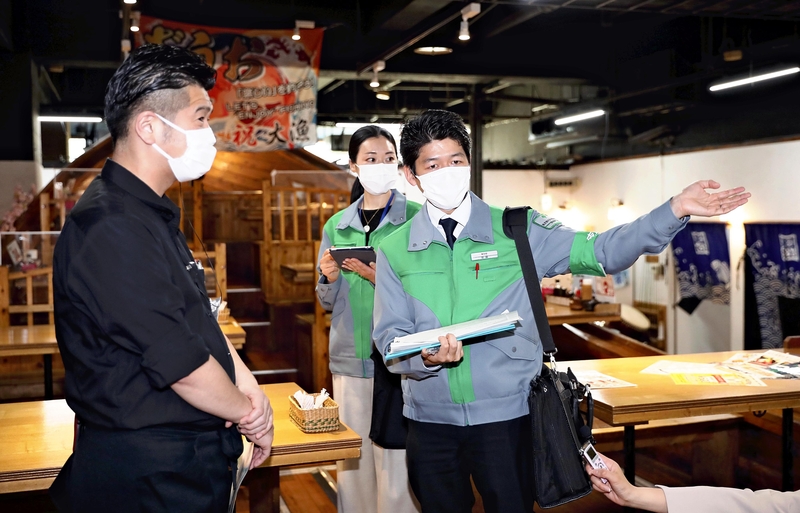
On the first day of emergency-level priority measures against the novel coronavirus, implemented Monday in 39 cities and wards in Tokyo, Kyoto and Okinawa prefectures, civil servants patrolled restaurants and bars to check the status of infection control measures in Tokyo, where eateries were asked to move up their closing time from 9 p.m. to 8 p.m.
The measures allow governors to take actions similar to those implemented during a state of emergency to prevent the spread of the virus.
As some eateries refused to comply with the request to close their doors at 8 p.m., the degree to which the metropolitan government can win their understanding and support for the measures will be the key to the prevention of the spread of novel coronavirus infections.
-- 200 on patrol
Two Tokyo metropolitan government officials visited izakaya bar Tsuribune Chaya Zauo in the Nishi-Shinjuku district of Shinjuku Ward on Monday afternoon. With a checklist in their hands, they conducted an inspection to see if the bar was taking infection control measures in 20 areas, including ventilation and installation of acrylic panels. "Please be careful not to make this bar too crowded, including the employee lounge," one of the officials said.
Manager Takayuki Kato, 41, said: "I was able to confirm correct infection control measures [through the officials' visit]. We would like to ask our customers to refrain from talking loudly."
Twenty Tokyo metropolitan government officials patrolled restaurants and bars Monday in pairs. The metropolitan government plans to increase the ranks of those on patrol teams to 200 by commissioning some of the work to a private company. Tokyo plans to check about 110,000 restaurants and bars without an advance notice in areas subject to the priority measures.
--Request rejected
In line with the early-closure request under the measures, the metropolitan government established a financial support system that takes into account the size of the business to win more support from eateries.
Compensation of 40,000 yen to 100,000 yen per day will be available for small and midsize outlets that comply with the request. Large companies are eligible to receive 40% of the decline in their sales, capped at 200,000 yen per day.
Ikka Dining Project., Ltd. in Ichikawa, Chiba Prefecture, which runs about 70 establishments in the Tokyo metropolitan area, including Yataiya Hakata Gekijo izakaya pubs, started to close their doors at 8 p.m. as requested.
Ikka Dining Project had run its business as usual after a state of emergency was declared in January since large companies were not eligible for the then financial support system. Yukiko Kataoka, 31, a public relations official of the firm, said: "The financial support awarded in the latest system is not enough for outlets in central Tokyo where rents are high, but we feel satisfied with the payment decided based on the size of the business."
On the other hand, Global-Dining, Inc. in Minato Ward, Tokyo, which operates about 30 eateries in Tokyo, including Gonpachi washoku restaurants, continued their business as usual after 8 p.m. Monday. The Tokyo government is allowed to order eateries to obey the request and even impose fines of up to 200,000 yen if they fail to comply with the order. The company said it would accept shortening business hours if it is given the order.
--Golden Week
The national government called for voluntary restraint on unnecessary and nonurgent travel across prefectural borders in the municipalities subject to the emergency-level priority measures through the Golden Week holiday period in May.
About 80% of shops and other businesses opened Monday on the Nakamise-dori shopping street in Taito Ward's Asakusa district, a popular Tokyo sightseeing spot, but there were few tourists. There also were few people seen eating on the street.
"As few foreigners come to Asakusa, we depend on tourists from other prefectures. But the measures are making it difficult for them to travel to Tokyo," said Yoshimi Nakatasuka, 65, of Nakatsuka, a shop that sells sweet okoshi rice crackers and light sponge cakes filled with sweet red bean paste.
Read more from The Japan News at https://japannews.yomiuri.co.jp/