The government has lodged a strong protest with South Korea after one of its destroyers locked-on to a Self-Defense Forces aircraft with fire-control radar, because the act can be considered almost equal to the use of weapons.
The Maritime Self-Defense Force's P-1 patrol plane was locked-on to by a South Korea Navy Gwanggaeto-daewang class destroyer around 3 p.m. on Thursday off the Noto Peninsula in the Sea of Japan.
"We're detecting a fire-control radar lock-on. What's your intention?" an officer aboard the surveillance plane asked over the radio. However, the crew received no response from the destroyer.
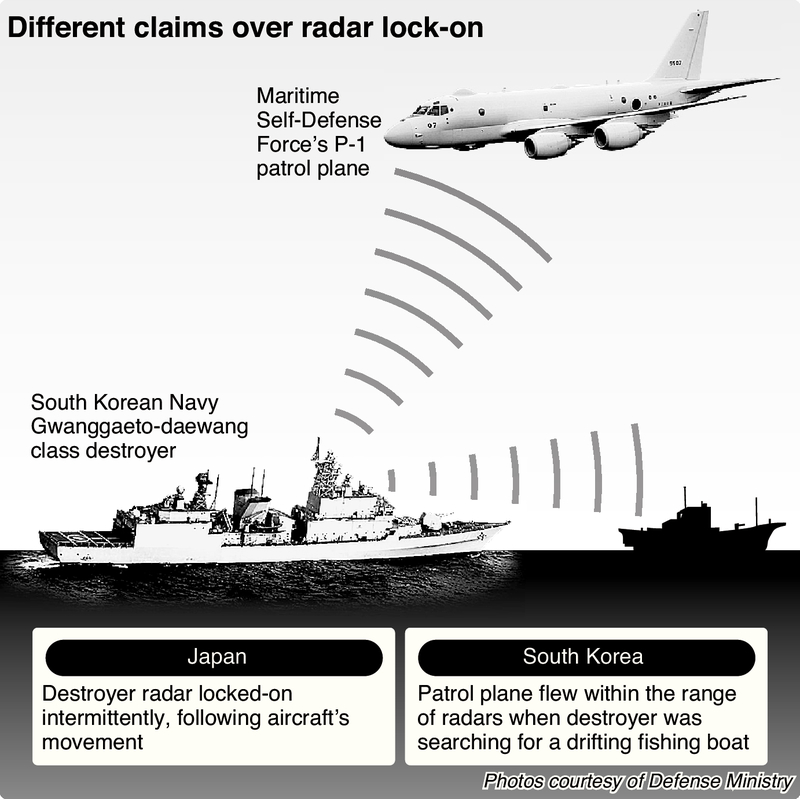
According to Japanese government sources, the P-1 aircraft, which belongs to the Atsugi Air Base in Kanagawa Prefecture, was flying over Japan's exclusive economic zone for surveillance purposes at the time of the incident. When the plane was nearing the South Korean destroyer, a fire-control radar lock-on was detected, activating alarms on the plane.
A fire-control radar lock-on is considered an act almost equal to the use of weapons, a situation abnormal enough to "prompt U.S. forces to launch an attack in case of emergency," according to an SDF source.
The alarm prompted the P-1 aircraft to immediately leave the vicinity, but the lock-on continued intermittently, according to sources.
Used 'for search operations'
A South Korean Navy source, meanwhile, told The Yomiuri Shimbun that the destroyer was "searching for a drifting fishing boat" at the time of the incident.
"The vessel was using all the radars it has, and during that moment, the [MSDF] patrol plane flew within their range," the source said, adding that this explanation had already been provided to the Japanese government.
SDF sources, however, said the explanation was not convincing. When searching for a vessel, a standard surface type radar is normally used. Fire-control radar, however, is deployed to automatically track a target for the purpose of hitting it with a missile or other munitions, whether in the air or on the surface. Therefore, fire-control radar is different from radars used for search operations on the surface of the water.
In January 2013, the Japanese government also lodged a strong protest after the South Korean Navy used a fire-control radar against an MSDF destroyer and helicopter around the Senkaku Islands in the East China Sea. The following year, Japan, the United States, China and other countries compiled the Code for Unplanned Encounters at Sea, an international standard stipulating procedures for avoiding accidental clashes. The code, which South Korea has also signed, said that locking-on to an aircraft or surface vessel should be avoided.
Japan believes that the South Korean destroyer was actually conducting a search operation for a fishing boat. On Thursday, South Korea saved crew members aboard a North Korean fishing boat in the Sea of Japan and returned three survivors and the body of another to the North on Saturday, according to the Unification Ministry.
Nonetheless, the government lodged the protest with Seoul through diplomatic channels, believing that the radar lock-on was conducted for other purposes than the rescue mission.
Read more from The Japan News at https://japannews.yomiuri.co.jp/