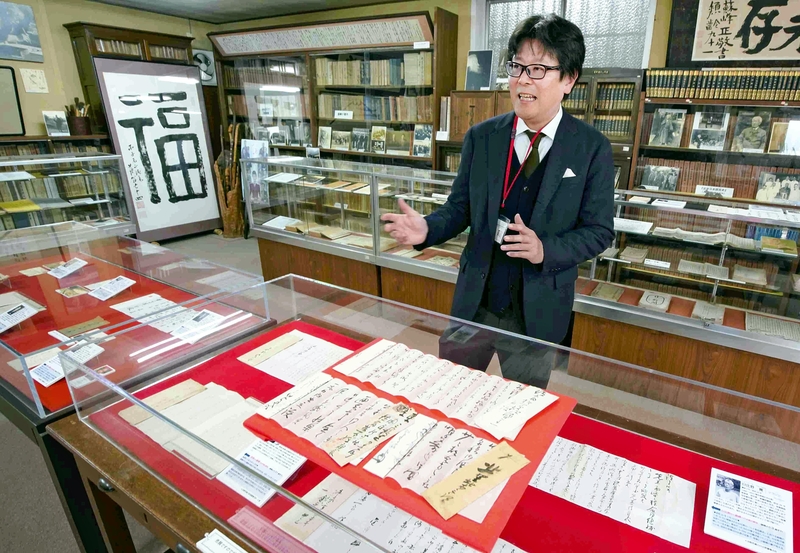
Soho Tokutomi (1863-1957), a journalist and historian active from the Meiji era (1868-1912) through the Showa era (1926-1989), was a prolific letter writer. About 46,000 letters he received from about 12,000 people are preserved and can be viewed by the public -- for a fee -- at the Soho Tokutomi Museum in Ninomiyamachi, Kanagawa Prefecture.
The senders represent a wide range of philosophies and fields, including statesman Kaishu Katsu, author and poet Akiko Yosano, and Shiso Kanakuri, the so-called father of marathon in Japan.
"To secure time for writing letters, he [Soho] is said to have refrained from going out drinking as much as possible," said museum staffer Nobuhiko Shiozaki, 53.
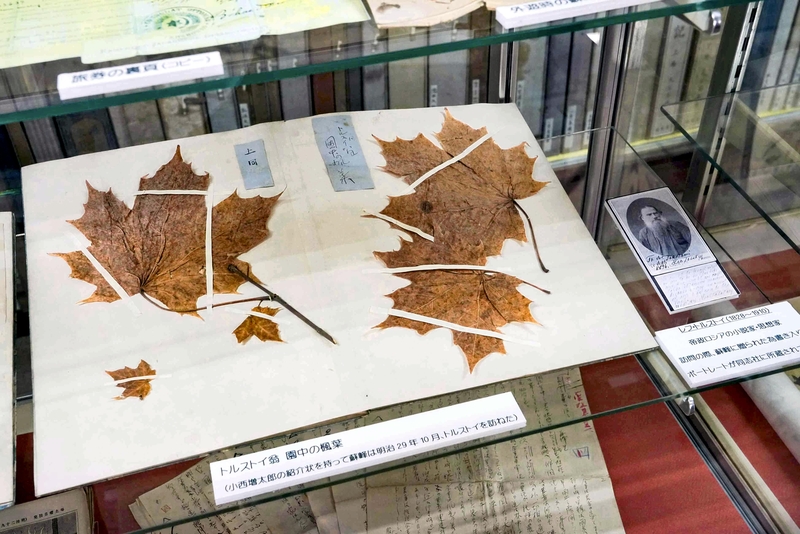
What sort of person was Soho, with his broad range of acquaintance with people who themselves shaped Japan's modern and present-day history? Soho was born into a family of samurai rank in the Higo domain, presently Kumamoto Prefecture. He was the older brother of Roka Tokutomi, a noted novelist who wrote "Hototogisu" (The Cuckoo).
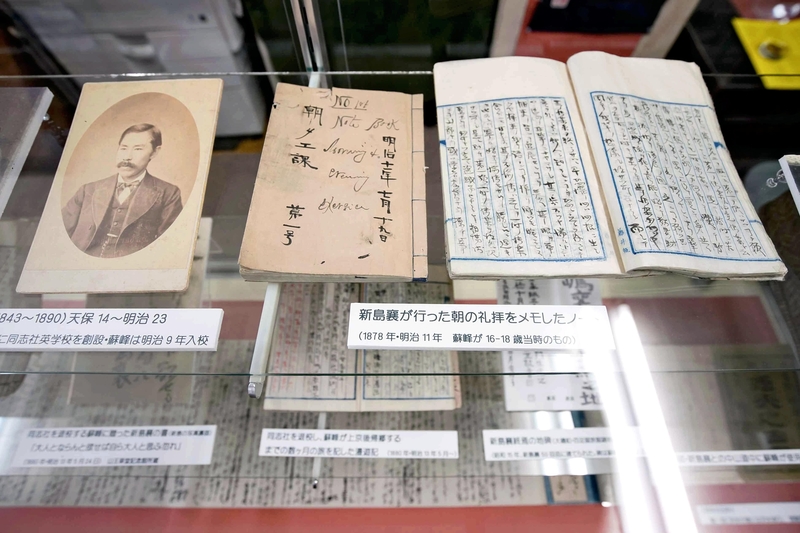
Soho was interested from childhood in newspapers, and collected them in the Edo period (1603-1867). These newspapers are on display at the museum, along with manuscripts of speeches and diaries written by Soho. All are well preserved, illustrating his assiduous nature.
Soho eventually went to Tokyo, where he published a news magazine called Kokumin no Tomo (The People's Friend), and the Kokumin Shimbun newspaper. Initially, he advocated "heimin shugi" (democracy), which respects the right of individuals and aims at the realization of an egalitarian society.
After the Sino-Japanese War, however, Soho was converted to imperialism. As the era changed to Showa, with Japan's engagement in fighting spreading to China and Southeast Asia, he inspired people with his speeches, winning tremendous support from the public. Many publications and his books that pay homage to emperors trace Soho's footsteps.
After the end of World War II, Soho was named a Class A war criminal -- although the case against him was eventually dropped -- and he lost much of his support. However, he was backed by Hikoichi Shiozaki, who was Soho's secretary and Nobuhiko's grandfather. A photograph taken during his later years shows Soho as a genial old man, retaining nothing of the former self who made eloquent speeches.
Before his death, Soho entrusted Hikoichi with the management of his enormous number of documents, including letters. "I want these to be used for historical research in the future," Soho told him.
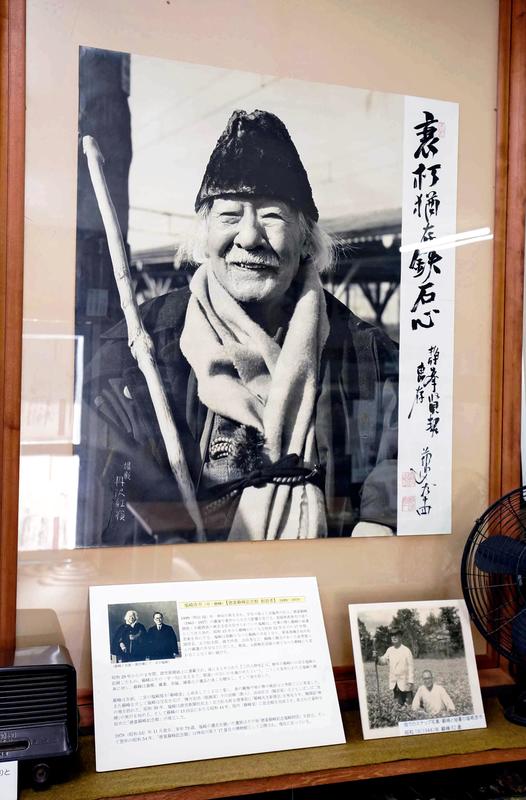
He chose his own posthumous Buddhist name before his death. Nobuhiko said, "He might have put his thoughts into his posthumous name -- 'Things did not work out as I hoped and there was much criticism, but I won't give in.'"
The enormous number of letters he received over his 94 years of life and the numerous other documents have proved useful for various types of research, as first-class materials that vividly depict modern and post-modern history.
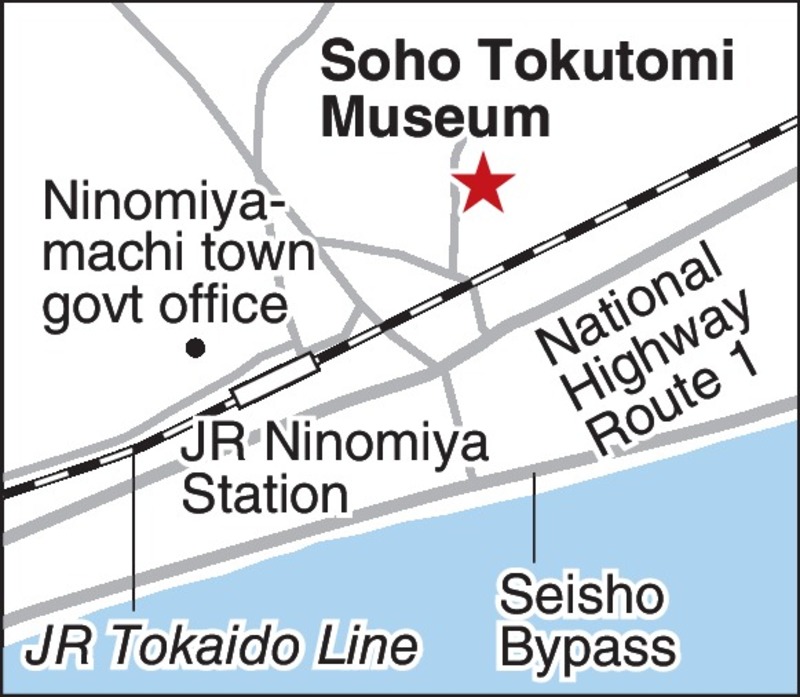
-- Soho Tokutomi Museum
Established and opened in May 1969 by Hikoichi Shiozaki, Soho's former secretary, within the premises of Shiozaki's home. Since 1979, it has been managed by the foundation established by Shiozaki's descendants.
Address: 605 Ninomiya, Ninomiyamachi, Kanagawa Prefecture
Open: 10 a.m.-4 p.m. Closed on Mondays and during the year-end and New Year periods.
Admission: 500 yen for adults; 400 yen for high school and university students; free for junior high school students or younger.
Information: (0463) 71-0266
Read more from The Japan News at https://japannews.yomiuri.co.jp/