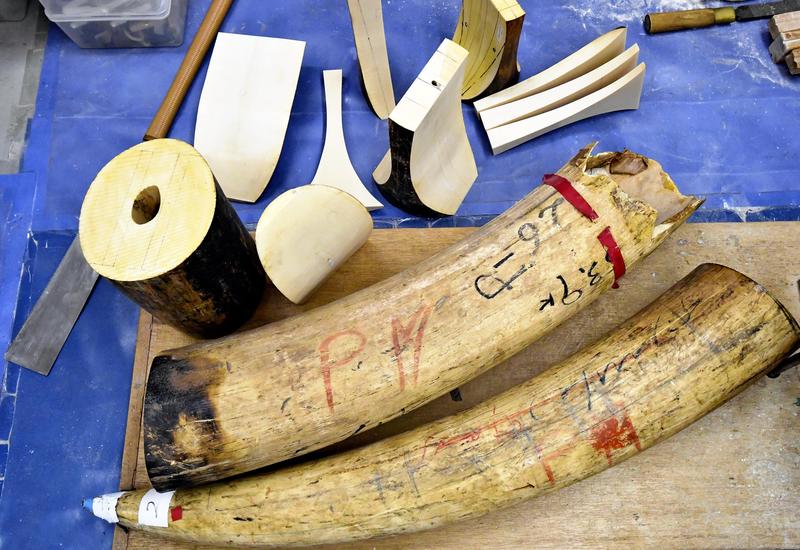
The Tokyo Metropolitan Government is considering a plan to strengthen restrictions on ivory, for which international trade is banned by the Washington Convention.
It is very rare for a local government to restrict ivory trade, as it comes under the jurisdiction of the central government. But what seems to be behind the move is Gov. Yuriko Koike's desire to keep in step with international public opinion, which values increased restrictions on the trade ahead of the Tokyo Olympics and Paralympics this summer.
However, the domestic demand for ivory used in producing inkan seals and other goods is still strong and there are not a few calls among those involved in the ivory-related business to "protect ivory culture."
"Is it necessary to use ivory for the production of seals?" "Japan's regulation and controls are insufficient." These opinions pressing for tighter regulations were voiced one after another at a meeting of the metropolitan government's expert panel on Jan. 28.
International trade in ivory has been banned in principle since 1990 under the Washington Convention, formally known as the Convention on International Trade in Endangered Species of Wild Fauna and Flora. Domestic trade, however, is permitted in Japan for ivory imported before the restriction was put in place. While buying and selling ivory to make seals and to use in musical instruments has continued, more and more cases of ivory being smuggled into China and other countries have been exposed. Criticism has mounted that Japan's exception for domestic trade "contributes to the smuggling and illegal transactions" of ivory.
During the panel meeting, the metropolitan government expressed concern about ivory potentially being taken out of Japan during the Tokyo Games when the number of foreign visitors is expected to increase. It was decided that the metropolitan government would come up with a policy after conducting interviews with those involved in ivory-related businesses.
The metropolitan government's move to clean up the ivory trade was said to have been triggered by a letter Koike received from Bill de Blasio, mayor of New York City, which is Tokyo's sister city. De Blasio called on Koike to work toward banning the ivory trade in Tokyo and shutting down Japan's ivory market ahead of the Games.
Koike has taken the stance that the metropolitan government "will ascertain which policy to take through discussions at the expert panel." A senior metropolitan government employee interpreted her intentions, saying, "She seems to consider it necessary to work toward coming into line with international public opinion." The possibility has emerged that the metropolitan government will go ahead with restricting the ivory trade independent of the central government.
There are about 3,000 ivory dealers in Tokyo, including stationery shops and department stores. According to a Tokyo ivory arts and crafts association, ivory craft has a history of more than 300 years. Go Tsurumi, chairman of the association, said that the association "is willing to offer cooperation to prevent the illegal removal of ivory." At the same time, however, he emphasized that "dealers are bearers of the culture as well. Hence we hope discussions will be held about measures to comply with rules without the presumption of market closure."
As international public opinion becomes unilaterally inclined toward stricter control of the ivory trade, some southern African nations, where the elephant population has been growing, propose that proceeds from transactions of ivory taken from elephants that died of natural causes be used for conservation activities. Iwate Prefectural University's former professor Yoshio Kaneko, who has worked at the secretariat of the Washington Convention, pointed out that the convention is "intended to recommend transactions if they are legal and eliminate illegal trade."
"It should be noted that a total ban on transactions is feared to encourage rather than discourage illegal trade and would not necessarily lead to elephant conservation," Kaneko said.
Read more from The Japan News at https://japannews.yomiuri.co.jp/