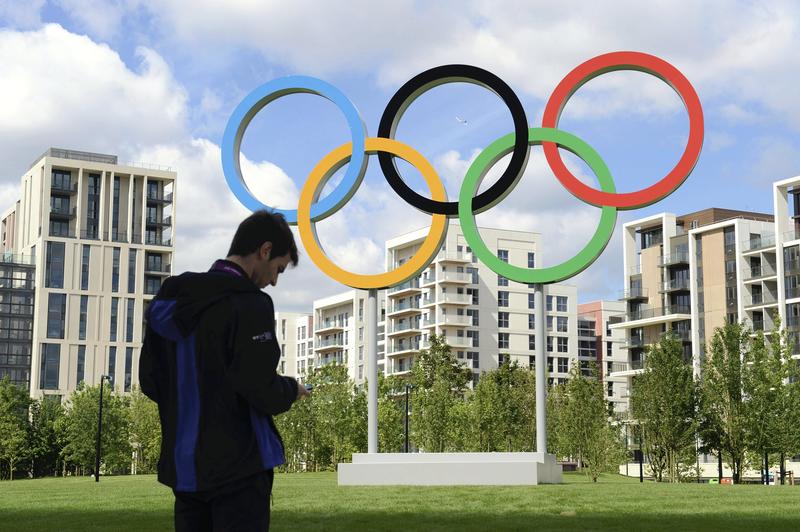
How to reduce food waste is being studied in the lead-up to the 2020 Tokyo Olympics and Paralympics, as a huge amount of food has been thrown away during past Games.
The organizing committee of the 2020 Games wants to come up with better ways to serve meals to minimize "food loss," with an eye on taking advantage of information and communication technology (ICT).
"I hope the upcoming Tokyo Games will set a trend of reducing food loss," Yuko Sakita, who chairs a resource management working group of the organizing committee, said during a symposium on the issue in Kyoto on Oct. 30.
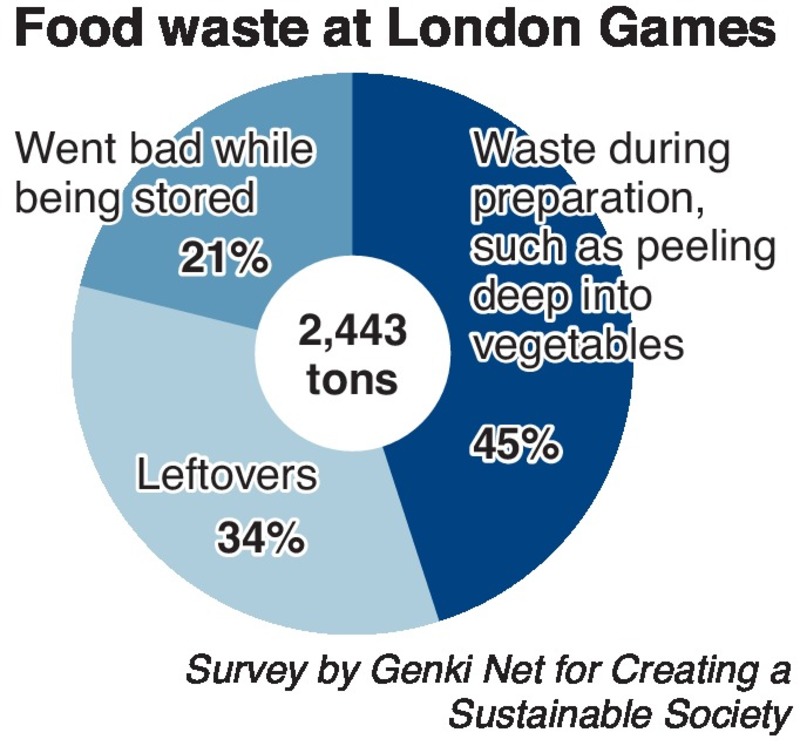
At the event, Sakita shared data on food waste at the 2012 London Games, which was surveyed by Genki Net for Creating a Sustainable Society, a Tokyo-based incorporated nonprofit organization that she chairs.
According to the survey, the London Games produced 2,443 tons of food waste. Of this figure, 45 percent was discarded when cooking, due to actions such as peeling deep into vegetables. Leftovers accounted for 34 percent, and 21 percent came from food that went bad while being stored.
"The London Games served as an opportunity to raise public awareness in Britain about food waste, prompting restaurant operators and other entities to form a network," Sakita said. "I hope the Tokyo Games will be a good opportunity [for the nation] to seriously tackle the issue."
According to the Agriculture, Forestry and Fisheries Ministry and other sources, there is about 6.46 million tons of food waste a year in Japan. This is equivalent to about 17,700 tons per day -- or a bowl of rice (139 grams) per person daily -- being discarded.
At the Tokyo Games, up to 45,000 portions a day will be provided at the main dining hall at the Athletes Village alone, in buffet and other serving styles. The village also will house another dining hall that will serve Japanese cuisine and the nation's local specialties, as well as one for the staff. In addition, food courts will be set up at competition venues for spectators.
To reduce food loss, the organizing committee believes it is necessary, among other things, to accurately grasp the flow of athletes and other people, and provide the appropriate amount of food. It plans to utilize ICT to consolidate data on the flow of athletes when they pass through gates at each facility, as well as grasp athletes' dietary preferences by collecting daily data in a bid to reduce leftovers.
Toward the Tokyo Games, the agriculture ministry has also started researching food waste at international sports events. At the women's volleyball World Championship held in September and October, the ministry checked leftovers from meals provided to the athletes and officials of some participating teams and asked them to answer questionnaires.
The results of the analysis will be shared with municipalities that will host training camps for the Tokyo Games or that have registered with the "host town" initiative for international exchange.
"Japan is the birthplace of the spirit of 'mottainai' [an expression of regret over wastefulness], and should not suffer shame on this issue," a ministry official said.
Read more from The Japan News at https://japannews.yomiuri.co.jp/