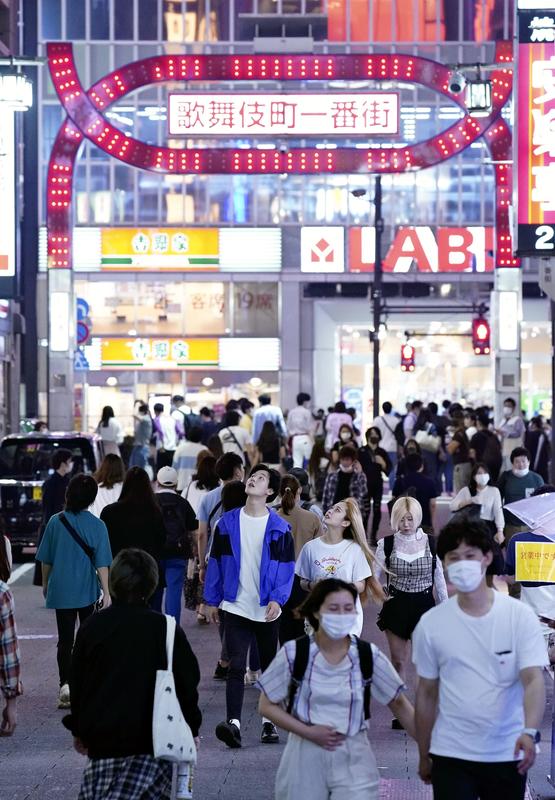
At least 181 of the 5,236 people in Tokyo who have been confirmed infected with the novel coronavirus as of May 31 were working at bars, clubs and other similar establishments in the nightlife districts where employees have close contact with patrons, according to Yomiuri Shimbun analysis of information on infected persons announced by the metropolitan government.
The Tokyo metropolitan government fears infections will increase in the nightlife industry.
The first time a person from the nightlife industry in Tokyo tested positive for the virus was on March 18. The number from the industry surged in April. For the 181 positive cases, the infection routes could not be traced for more than 70%.
The metropolitan government has occupation information for 3,868 people out of the 5,236 cases. On top of the occupation list are company employees at 1,152 and medical professionals at 530. In the metropolitan government tally, people working at nightclubs, hostess bars, host clubs and other similar establishments are grouped as working in an industry servicing customers. Of the 181 infected people working in the industry, 110 are women and 71 are men. Apart from these, 214 people working at restaurants and bars, including izakaya Japanese pubs, have also tested positive.
The number of people from the industry who tested positive increased in the first half of April then gradually decreased. In late April, there were consecutive days when no one tested positive from the industry. Since May, the number of positive tests have been small yet is becoming conspicuous again.
The percentage of those whose infection routes are unknown is 57%, or 2,989 people in Tokyo, whereas it is 76.8%, or 139 people, for the above 181 cases. People working in this industry are not inclined to reveal customer information, which appears to be the main reason why the infection routes of so many of them cannot be traced. The largest age group among these 181 infected people are those in their 20s at 80.
There are fears that infection is spreading not only among workers in the industry but also to customers. According to the metropolitan government, of the 184 people who tested positive for the virus in the capital from May 26 to June 5, about 20%, or 38 people, either work at or visited nightlife establishments and the like. Nearly 20 of them were either employees or customers at host clubs.
The Tokyo metropolitan government continues to request that hostess bars and other such dining and drinking establishments suspend operations. In collaboration with local medical associations, the metropolitan government on Friday started educational activities in the capital's major nightlife districts, such as Kabukicho in Shinjuku Ward.
"It is necessary to take effective measures for the nightlife districts," said Tokyo Gov. Yuriko Koike at a regular press conference on Friday. "We are considering various ways to make customers and workers feel secure."
Prefectures neighboring Tokyo are also heightening vigilance in their nightlife districts. Saitama Prefecture is continuing to request nightlife-related dining and drinking establishments suspend operations. Saitama Gov. Motohiro Ono has called on residents to strictly avoid visiting entertainment and nightlife districts in Tokyo.
Chiba Prefecture is also continuing to request similar establishments suspend operations but is planning to completely lift the request on June 19, as the number of people who have tested positive in the prefecture per day lately has been either zero or in the single digits.
Kanagawa Prefecture lifted for all industries its request to suspend operations at the end of May on condition that they take appropriate measures for preventing infection. Since lifting the request, the prefecture has not found any cases in which infection is suspected in the nightlife industry.
Meanwhile, Nihon Mizushobai Kyokai, a Tokyo-based industry group of women working at hostess bars and other similar establishments, is demanding that employees of such establishments wash their hands once every 30 minutes and wear masks when in contact with patrons.
"There are many such establishments that strictly adhere to those measures," said Kaori Koga, who heads the association. "It doesn't make sense that the Tokyo metropolitan government groups our communities as 'nightlife districts' and puts us all in a negative light."
Read more from The Japan News at https://japannews.yomiuri.co.jp/