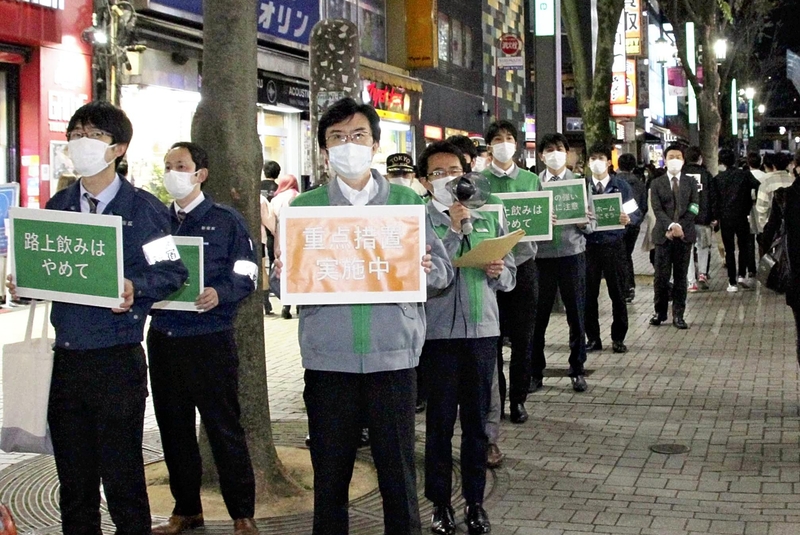
The number of new coronavirus patients a day in Tokyo could exceed 2,000 in two weeks if almost all infections are highly contagious strains from a N501Y mutation, including so-called British variants, and more than 6,000 will be hospitalized, according to an estimate presented at the Tokyo metropolitan government's coronavirus monitoring meeting on Thursday.
A sense of crisis over the spread of the infectious variants has grown in the capital.
According to the metropolitan government, 32.8% of the patients tested between April 12-18 were infected with the N501Y mutant strains. The National Institute of Infectious Diseases estimates that by early May, between 80% and 90% of coronavirus infections in the Tokyo metropolitan area will be replaced by the variants, just like what is happening in the Kansai region.
On Thursday, 861 were newly infected in Tokyo, with 1,689 hospitalized. At the current rate of increase, the average number of daily infections a week would reach about 1,170 in about two weeks and about 2,140 after four weeks.
"We need to be vigilant about the spread of the [mutant] viruses," said Norio Omagari, director of the Disease Control and Prevention Center at the National Center for Global Health and Medicine.
In Osaka, where N501Y mutant strains are already rampant, a record 1,242 were confirmed to be newly infected a day on Wednesday, and some hospitals are reporting a shortage of hospital beds.
The Health, Labor and Welfare Ministry reported that 2,352 people infected with the coronavirus variants were confirmed in the week ending Tuesday. The figure was about 1.5 times higher than the previous week.
Some say that the N501Y mutant strains have spread throughout all age groups in contrast to the conventional virus, which infects fewer children. The percentages of infections among those under 20 were about 10% with a conventional virus as of April 13, and about 20% with variants as of Monday. Group infections have been reported in club activities at schools.
On April 16, the Tottori prefectural government announced that seven students who belong to a sports club at Tottori University of Environmental Studies were infected with the coronavirus.
"The virus is getting really contagious. It transmits simply by talking without wearing masks," said Tottori Gov. Shinji Hirai said.
The N501Y mutation is believed to have increased infectivity due to the virus' shape being easier to bind to human cells. According to a study by a British university, the risk of death from the British variant, which has currently been spreading in Japan, may be about 1.6 times higher than that of the conventional strain. In overseas studies, some data suggests that the amount of virus contained in droplets exhaled from infected people is high.
"The British variant is more contagious to human cells and is likely to spread widely among children and adults," Osaka University Prof. Tsuyoshi Inoue, who specializes in structural biology, said. "The virus is growing at an overwhelmingly fast rate and is possibly making patients' symptoms worsen."
Read more from The Japan News at https://japannews.yomiuri.co.jp/