The organizing committee of the 2020 Tokyo Olympic and Paralympic Games unveiled details of the Olympic torch relay route in December, showing where in Japan the torch will visit, and perhaps more interestingly, how it will be carried across the country.
Some of the novel methods to be adopted along the route include torchbearers traveling on a horse-drawn sled, running alongside a steam locomotive, sailing on a boat, and even swimming using a traditional Japanese stroke.
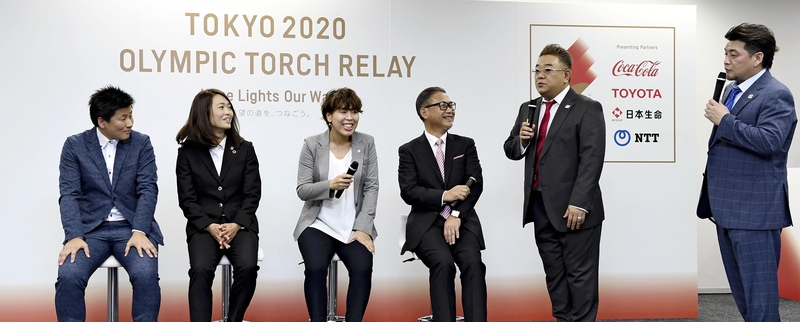
"I'm looking forward to giving it my all," said Azusa Iwashimizu, 33, a member of Japan's World Cup-winning women's national soccer team, who has been selected along with her former team members as the runners in the first leg of the relay route.
The relay will start on March 26 at Fukushima Prefecture's J-Village national sports training center, which was used as a base during recovery efforts after the 2011 nuclear accident at Tokyo Electric Power Company Holdings Inc.'s Fukushima No. 1 nuclear power plant.
Nadeshiko Japan won the FIFA Women's World Cup in 2011 just four months after the Great East Japan Earthquake. Their victory and fighting spirit throughout the tournament was a source of encouragement for the disaster victims, prompting the committee to select the players as the first runners of the torch relay for the Tokyo Games, which have been dubbed the "Reconstruction Olympics."
The torch will travel to a ski resort in Inawashiro in the prefecture where a torchbearer on skis will carry it down the slopes of a mountain. In Motegi, Tochigi Prefecture, it will be carried by a torchbearer running alongside the area's much-loved steam locomotive.
"The Olympic Games used to be a distant event for me, but hearing that the torch will pass through a road in front of my house has suddenly made it feel much closer," said a 45-year-old man from the town.
In Gifu Prefecture, the torch will be carried in a gondola up Mt. Kinka to Gifu Castle, where 16th-century warlord Oda Nobunaga lived. The torch will pass through Ise Jingu shrine in Mie Prefecture and UNESCO World Heritage sites in Wakayama Prefecture, including temples on Mt. Koya and along the Kumano Kodo pilgrimage routes, before entering Shikoku via Nara and Osaka.
The torchbearer on the Naoshima island leg of the relay will get to cross paths with avant-garde artist Yayoi Kusama's "Red Pumpkin" sculpture in Kagawa Prefecture. The relay will also visit Okinawa Prefecture, starting at the site of Shuri Castle in Naha, which was devastated by fire in October.
"I hope that our desire to reconstruct the castle will be conveyed all over the world," said a 65-year-old woman who runs a shop near the castle.
In Hiroshima, a torchbearer will cross the Motoyasu River, swimming from the site of the Atomic Bomb Dome to the Hiroshima Peace Memorial Park while carrying the torch, using a traditional Japanese swimming stroke.
The relay route will travel through Hokuriku to Hokkaido, where a torchbearer will ride on an iron sled drawn by a large horse in Obihiro, a city famous for its sled racing tradition.
The torch will arrive in Tokyo for the final legs on July 10, when it will be carried across all of the capital's municipalities, including its remote Pacific islands, before heading on July 24 to the new National Stadium, where it will be used to light the Olympic cauldron at the opening ceremony when the Games officially begin.
"Under the assumption that people will be posting images on social media during the relay, the route was chosen with the hope that locations worth visiting in Japan would be promoted around the world," a senior member of the organizing committee said.
Read more from The Japan News at https://japannews.yomiuri.co.jp/