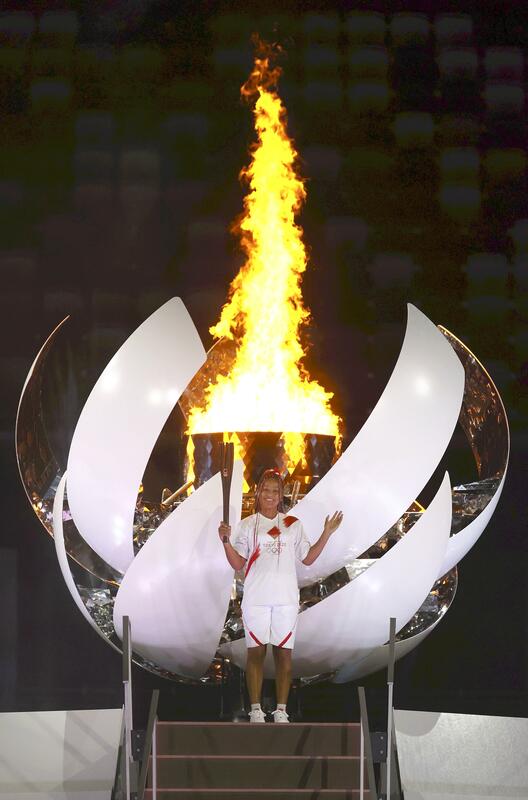
The Tokyo Olympics, which sought to emphasize diversity and harmony, provided a forum for athletes to deliver a range of outstanding performances, including tennis player Naomi Osaka, who lit the Olympic cauldron.
"She has spoken out about various things. I thought she was the most appropriate person," said Takayuki Hioki, the executive producer of the opening ceremony.
Many people would agree with this reason.
With roots in Japan and Haiti, she has supported the Black Lives Matter movement, revealed that she has suffered bouts of depression, and raised awareness of the importance of mental health among athletes. She is a woman who transcends national boundaries and she was the perfect choice as the final torchbearer for a Games whose major themes were diversity and harmony.
During the opening ceremony parade, both men and women served as flag bearers to promote gender equality. Japan was represented by basketball player Rui Hachimura and wrestler Yui Susaki. The 50-centimeter height difference between them was a heartwarming reflection of the diversity theme.
And for the first time, the Olympic oath was taken by three mixed pairs of male and female athletes, coaches and judges during the opening ceremony.
However, several incidents involving individuals at the heart of the management of the sports extravaganza were completely against the theme of the Games.
First, Yoshiro Mori resigned as chairman of the organizing committee over comments widely seen as sexist. The person in charge of staging the opening and closing ceremonies also quit after he made a proposal that insulted the appearance of a female celebrity.
Then the music composer for the opening ceremony, who had boasted about bullying in the past, resigned and the director, who had made fun of the Holocaust in a comedy show, was dismissed just before the opening ceremony amid widespread criticism.
It is hard to say that the scenes witnessed during the opening ceremony reflect the current state of Japanese society.
But perhaps the scandals and the opening ceremony have set the tone for how Japan should change in the future.
In terms of gender equality, it can be said that considerable progress has been made at the Tokyo Games.
The percentage of female athletes at the Olympics rose to a record high 48.8%. In addition, the number of events in which men and women compete as a single team, such as judo mixed team and table tennis mixed doubles, has increased from nine in the previous Olympics in Rio de Janeiro to 18.
On the other hand, the organizing committee has had a high proportion of men in senior positions. In response to international condemnation of Mori's remarks, the committee has increased the percentage of women on its board of directors from about 20% to more than 40%.
The advancement of gender equality in the sports arena has shone a spotlight on inequalities in the real world.
The Tokyo Olympics have made us realize many things, both good and bad.
-- The reality of refugees
Diversity at the Olympics, by drawing participants from countries and territories from around the world, is at the core of its principles. However, some young athletes fall through the cracks.
That is why amid the sudden surge of refugees in 2015 that became a global issue, the International Olympic Committee announced the formation of a Refugee Olympic Team. Ten athletes were selected to take part in the 2016 Rio de Janeiro Olympics, and a number increased nearly three-fold to 29 athletes across 12 sports for the Tokyo Games.
The increase in refugee team members was not unrelated to the fact that between Rio and Tokyo, refugees across the world increased by about 20% to nearly 80 million, according to the IOC.
Swimmer Yusra Mardini, 23, was a member of the refugee team at both Rio and Tokyo from Syria. She fled her country by pushing a boat with a broken motor in the water for hours until reaching shore.
She said she is grateful for being able to participate in two consecutive Games, but added that in an ideal world, there would be no need for the team, although she accepts the reality.
To ensure the safety of the refugee team, the United Nations adopted an Olympic Truce to run from seven days before the Tokyo Olympics to seven days after. This followed the practice started in 1994 from a proposal made by the IOC, which sought to revive an ancient Greek tradition to convey a message for building peace.
Nevertheless, harsh reality was exposed during the Tokyo Games as the Syrian civil war raged on and a U.N. office was bombed in Afghanistan.
Read more from The Japan News at https://japannews.yomiuri.co.jp/