This article is the fourth installment of a series in which The Yomiuri Shimbun looks back at the Tokyo Olympics and considers the legacy the Games may leave behind. Here we will consider the economic effect and losses brought about by the Tokyo Olympic Games.
In considering the Tokyo Olympics and the legacy the Games may leave behind, it may be helpful to look at the "balance sheet" of the Tokyo Games, including the economic gains and losses.
According to the budget plan released by the Tokyo 2020 organizing committee at the end of last year, the cost of hosting the Games was estimated at 1.64 trillion yen, the largest in the history of the Summer Olympics.
When the decision was made to bid for the Games, the committee estimated that the cost would be 734 billion yen. Yet, the budget more than doubled due to additional costs resulting from the postponement of the Games by one year, and measures taken against the spread of the novel coronavirus.
The Tokyo Games are expected to suffer a deficit as ticket revenue -- which was expected to be about 90 billion yen -- was virtually erased due to a ban on spectators at most venues.
In principle, the Tokyo metropolitan government is supposed to cover the deficit, but Tokyo Gov. Yuriko Koike said she would discuss this matter with the parties concerned.
Arranging for the central government and the International Olympic Committee to share the cost will likely prove difficult.
-- Tourism boom went bust
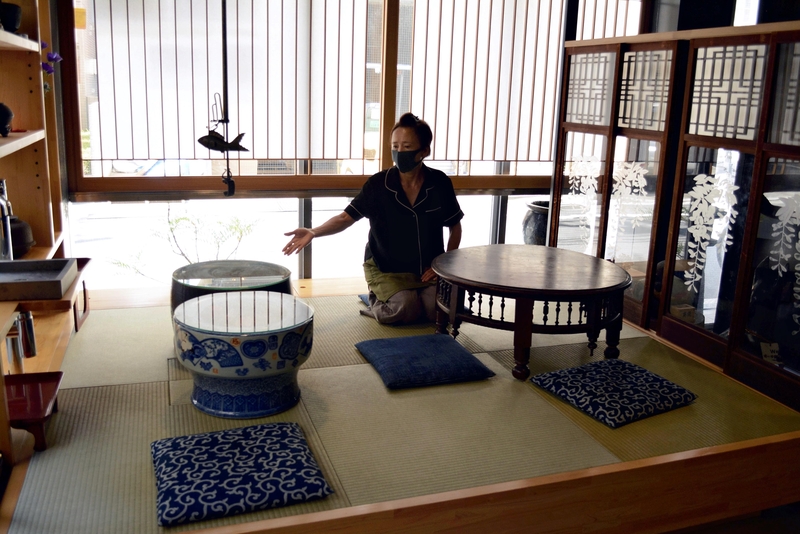
"I thought this inn would be fully booked during the Olympics," said Toshiko Ishii, 64, who runs the Andon Ryokan in Taito Ward, Tokyo, sighing deeply as she stood in the empty building.
Andon Ryokan had been operating at a brisk pace before the COVID-19 disaster. The inn was popular among visitors to Japan for its combination of Japanese touches and modern atmosphere, with 90% of its guests being foreigners.
Expecting the Tokyo Olympics to bring in even more foreign guests, Ishii spent 20 million yen on a large-scale renovation in February last year.
Shortly thereafter, the situation took a sudden turn for the worse amid the pandemic. The number of reservations for this month is in the single digits, and the inn's 20 rooms sit mostly empty.
The government has a goal of increasing the number of visitors to Japan to 60 million in 2030. In 2019, before the pandemic occurred, the number of visitors to Japan was 32 million.
The Tokyo Olympics were supposed to turbocharge progress toward this goal. There was an expectation that spectators and athletes would use social media to spread the word about Japan's charms all over the world -- but this did not come to pass.
Katsuhiro Miyamoto, a professor emeritus at Kansai University, has estimated the theoretical economic benefit of the Tokyo Games based on different patterns such as the presence or absence of spectators.
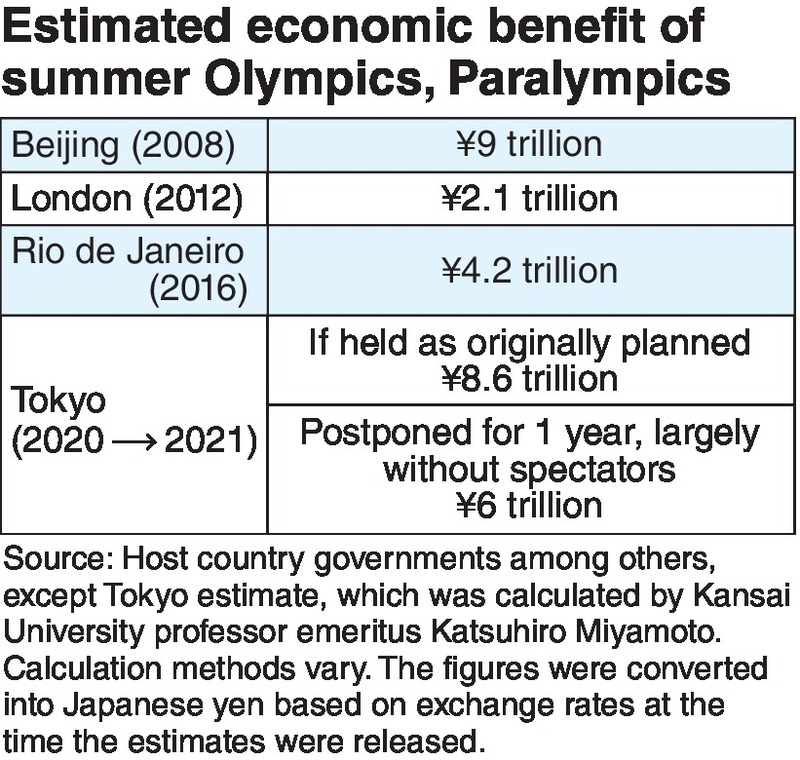
He calculated that the Games would have generated 8.56 trillion yen in economic activity if they had been held as planned.
A wide range of ripple effects were expected, including consumption by athletes and spectators, the utilization of the Olympic Village afterwards, and the development of transportation infrastructure, among others.
The economic benefit would have been less than that of the 2008 Beijing Games, which was calculated on a similar basis, but more than that of the 2012 London Games and 2016 Rio de Janeiro Games.
However, many of the expected economic benefits were lost due to the COVID-19 disaster, and the costs associated with postponing the Games for one year came to about 640 billion yen.
The economic benefit is estimated to be about 6 trillion yen, as the expected consumption from overseas visitors did not materialize. However, if the Games had been canceled, the economic benefit would have been even smaller -- about 3.4 trillion yen.
Read more from The Japan News at https://japannews.yomiuri.co.jp/