The Tokyo Olympics and Paralympics have drawn to a close. This is the second installment in a series exploring the significance and issues of a Games held under quite unusual circumstances.
On Aug. 19, just days before the Tokyo Paralympics kicked off, Tokyo Skytree was one of about 200 worldwide landmarks that were lit up in purple to mark the start of WeThe15, a campaign the International Paralympic Committee spearheaded.
The effort was organized in cooperation with 20 international groups to raise awareness about the 15% of the world's population who live with disabilities.
The Tokyo Olympics faced questions such as the value behind putting on the sports extravaganza, while conversely, Paralympics officials first focused on promoting the importance of holding the Games and subsequently meeting expectations to leave behind a legacy.
The images of powerful performances of British athletes grabbed the attention of locals at the 2012 London Paralympics, promoting the notion that "Paralympians are awesome."
Craig Spence, the IPC's chief brand and communications officer, expressed his hope that the Tokyo Games would take things a step further, becoming the starting point to spur change toward creating a society in which it is only natural that people have differences.
The 2020 Games from the outset put a priority on building a legacy on the part of public awareness, aiming to help people pursue a more fulfilling way of life, while keeping in mind future changes in Japanese society.
In particular, how much the Paralympics could change the public attitudes was considered a key in creating an intangible legacy.
The performances of the athletes at the Tokyo Paralympics certainly enthralled a large portion of the public. For example, the athletes displayed strategy in boccia, teamwork in wheelchair basketball and various skills they have developed to function well within their specific sport based on their unique disabilities.
Viewers might have considered the athletes to be "disabled," at first, but before they realized it, those notions started to fade away.
When Paralympic swimmer Tomomi Ishiura competed, students at her alma mater, Kita-Suwa Elementary School in Joetsu, Niigata Prefecture, cheered her on as they watched on TV.
"It was awesome how fast she was swimming despite being blind," a fifth-grade girl said. "I also want to give lots of different things a try."
Thus, what people gleaned from the humanity the athletes exhibited can work as an opportunity for the public to eliminate preconceived notions about their own and society and to accept differences among peoples.
The novel coronavirus pandemic forced the Tokyo Games to make myriad changes such as shutting spectators out of most of the competition venues.
However, the achievements made during the eight years after Tokyo was selected to host the 2020 Games have not been meager, including education on the Paralympics and social recognition for the sports extravaganza.
According to a survey by the Yamaha Motor Foundation for Sports, there were only five TV commercials featuring para athletes in 2013. That figure jumped to 95 in 2016.
"I think it'll be important to see how changes in public mindset can be applied in society," said Mami Tani, who delivered one of the final speeches during Tokyo's bid for the Games and competed in the triathlon at the 2020 Paralympics.
"It would be wonderful if we could say something like this in 10 years: 'Society is this way now because Japan held the 2020 Games.'"
--Many schools learn tough lesson
The pandemic forced a vast number of the venues for the Olympics to close their doors to spectators, while the general public was kept out of all Paralympic venues in principle. Nonetheless, schools were allowed to take some students to view a number of competitions, out of consideration for the educational benefits.
During the Olympic Games, students attended events in Miyagi, Ibaraki and Shizuoka prefectures, while at the Paralympics, children visited venues in Tokyo and Saitama and Chiba prefectures.
The children who saw the athletes perform in person indicated they felt a change in their level of awareness of para athletes.
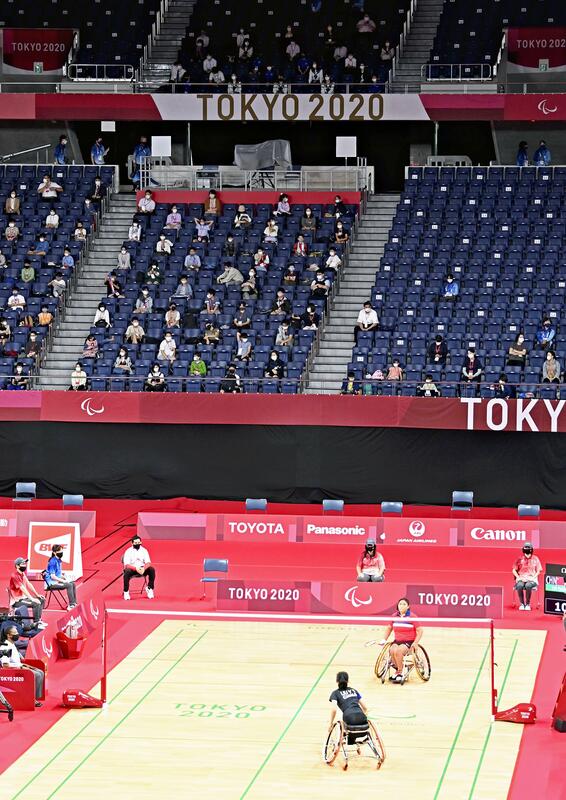
Second-year students at Harajuku Gaien Junior High School in Shibuya Ward, Tokyo, saw wheelchair badminton. One of the spectators, a-13-year-old girl, said she used to think that it would be difficult for athletes in para sports to cover a lot of ground.
Watching the players returning shots by arching their backs, however, "I was surprised to see how much range they had," the student said.
"It's amazing that they have been able to make up for the parts of the body they cannot move with the other parts they can use.
"I feel like the message here is that hard work will always pay off. It made me think I have to push myself hard without giving up," she added.
Meanwhile, local governments had to push themselves to make difficult decisions over the school ticket program for the Paralympics.
The nation saw a resurgence in the spread of infections, with the daily number of new cases topping 10,000 for the first time at the end of July -- as the Olympics were ongoing. The resurgence prompted many local governments to cancel school trips for in-person viewing.
As of January last year, local governments had requested 1.28 million tickets for students and teachers to attend competitions at the Olympics and Paralympics, according to the organizing committee. However, only about 4,700 children were actually able to visit Olympic venues, while the number totaled 15,330 at the Paralympics.
--Major facilities to face challenges
The permanent facilities among the event venues will be passed on to future generations. It will be a challenge to figure ways to utilize and maintain the complexes that were built at great expense to the country.
National Stadium in Shinjuku Ward, Tokyo, which was the location of the opening and closing ceremonies and the athletics venue, was built at a cost of 156.9 billion yen. The plan that following the Games was for the stadium to be renovated into a facility dedicated to sports by removing the track area.
However, the government is considering maintaining the track at the stadium, mainly because it has received a proposal from the world athletics governing body to hold the world championships there.
The rights to manage the stadium will be sold to a private entity.
It would be difficult for the complex to turn a profit, considering the annual maintenance cost is estimated at 2.4 billion yen, while the former National Stadium used to generate an annual revenue of about 600 million yen to 900 million yen.
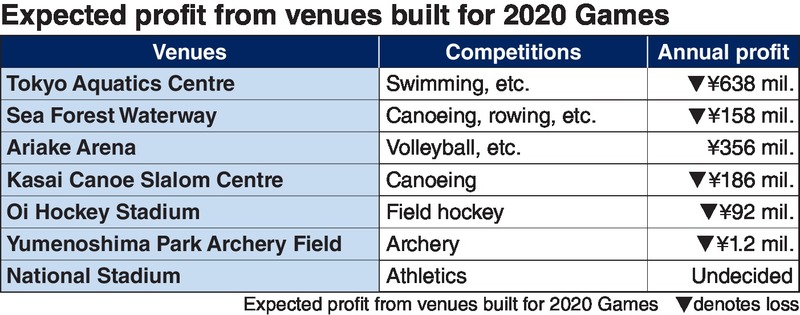
The Tokyo metropolitan government built six facilities for swimming, hockey, canoeing and other sports at a sum of 137.5 billion yen. Of those venues, Ariake Arena in Koto Ward is the only facility expected to be in the black, as it can host concerts and other events.
The remaining five are each expected to lose from 12 million yen to over 600 million yen per year.
The metropolitan government will try to increase revenues by generating advertising money and selling the naming rights of the facilities.
"We will rack our brains and come up with something so that these facilities will not become a 'negative legacy' of the Games," an official said.
Read more from The Japan News at https://japannews.yomiuri.co.jp/