The Tokyo Olympics and Paralympics have drawn to a close. This is the first installment in a series exploring the significance and issues of a Games held under quite unusual circumstances.
"What a journey. What sport. What a Games. What more can I say than arigato, Tokyo. Together, against the odds, we did it," said International Paralympic Committee President Andrew Parsons at the closing ceremony on Sept. 5, expressing his gratitude that the hurdles caused by the coronavirus were overcome so the Paralympics could proceed.
Dignitaries from around the world attended the Games and said the event could be held only because Japan was the host country.
French Sports Minister Roxana Maracineanu on Aug. 5 met with Tamayo Marukawa, minister in charge of the Tokyo Olympic and Paralympic Games. With France hosting the 2024 Games, Maracineanu asked Marukawa to pass along any know-how so her country could learn from Japan's experience.
The success of the Games was achieved through a collective effort involving the nation's high-quality medical services, skilled personnel and the financial backing of the central Tokyo metropolitan governments, as well as a reliance on trial and error.
The International Gymnastics Federation held a tournament in Tokyo in November, and four countries participated. Overseas athletes and officials were required to take coronavirus tests every day. To restrict contact between visitors and the outside world, organizers employed a "bubble method," which had already been implemented in the United States and some European countries.
No athletes or officials were infected with the coronavirus during the event, demonstrating both domestically and internationally that international competitions are possible when thorough countermeasures are implemented.
In May, Japanese officials monitored various aspects of competitions, such as how athletes were moving around at events including qualifying tournaments and devised improved infection prevention measures.
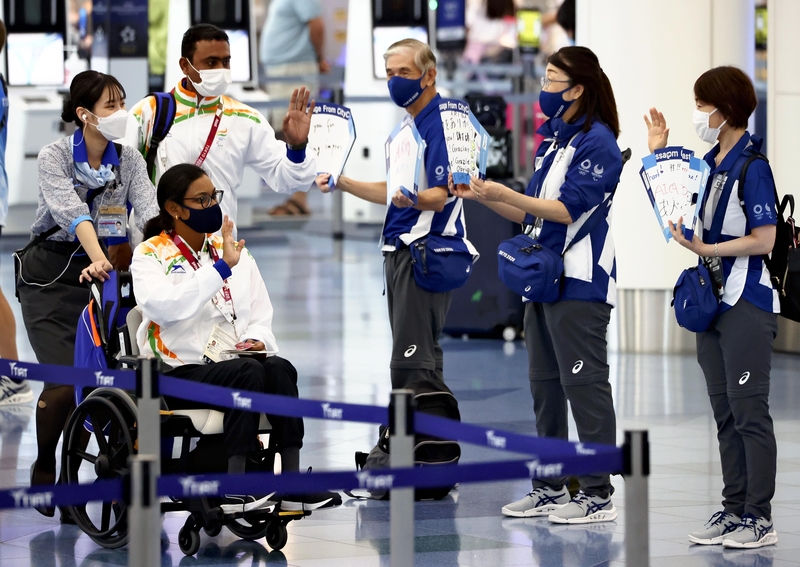
After the Games began, many Olympic and Paralympic officials, volunteers and staff from the central and Tokyo metropolitan governments worked together to conduct coronavirus tests every day, quarantine people who tested positive and manage the movements of athletes and visiting officials.
Personnel frequently disinfected balls and venue floors, and athletes hung their medals around their necks during medal ceremonies. Such efforts helped to mitigate infections among athletes and keep competitions going.
Among athletes, volunteers and related officials, 853 people tested positive for the novel coronavirus from July 1 through Sept. 6, including 41 athletes, according to the Olympic and Paralympic organizing committees.
While there were some holes in the bubble, there have been no reports of infection clusters spreading from overseas Olympic athletes and officials to residents, according to the Health, Labor and Welfare Ministry.
To finance these infection prevention measures, the central and metropolitan governments earmarked additional funds of 80.9 billion yen and 40 billion yen, respectively.
The Japanese government also laid the groundwork for obtaining support from the international community at the G7 summit in June.
The government's determination to ensure the Games were a success was in part because of a rivalry with Beijing, which is holding the Winter Games next year.
"If the Tokyo Games fails and the Beijing Winter Games succeeds, it could be interpreted that the Chinese authoritarian regime is superior to democratic countries in terms of coronavirus countermeasures," a Cabinet member said. "We definitely needed to avoid that scenario."
Hosting a successful Games proved it is possible to hold the world's largest sports event and continue social activities while fighting the coronavirus, and established a milestone for overcoming the virus.
Before the Games began, public opinion was divided on whether to cancel, postpone, or hold the event due to concerns about the spread of infections.
An unrealistic "zero coronavirus" slogan was advocated, and there were exaggerated objections, such as when the Constitutional Democratic Party of Japan leader Yukio Edano said, "Overseas athletes and officials [coming to Japan] would result in something like an exhibition of coronavirus variants from around the world."
Prime Minister Yoshihide Suga did not provide a sufficient explanation about the significance of holding the Games, which created a vicious cycle of increasing dissatisfaction and criticism emanating from opposition parties and the public.
The next focus will be on settling the bill.
While ticket revenues of about 90 billion yen were expected, the actual amount was significantly lower because most venues did not allow spectators. In principle, the metropolitan government is expected to cover the cost, but Tokyo Gov. Yuriko Koike has indicated she will negotiate with the central government and other entities to share the burden.
If taxpayer money is going to be used, the central and metropolitan governments need to carefully explain the significance of the Games to gain the public's understanding.
Read more from The Japan News at https://japannews.yomiuri.co.jp/