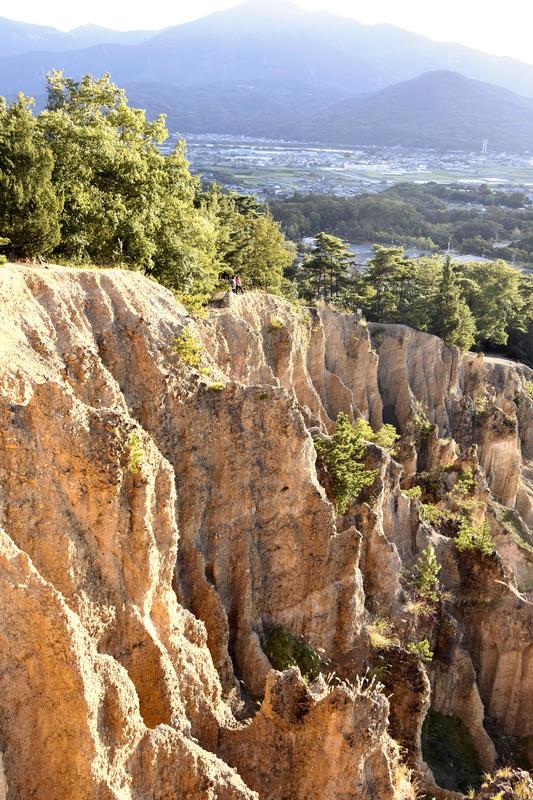
AWA, Tokushima -- When I traveled in the western part of the United States during my school days, I saw Bryce Canyon National Park, which remains clear in my memory more than 30 years later. Reddish pillars of earth stand in a wild mountainous area, and the shape of the ground made me think of another planet. I never expected to see the strange scenery in Japan that looked like a part of that American park.
The Awa no Dochu sand pillars in Awa, Tokushima Prefecture, are about 50 meters high, 90 meters wide and 50 meters deep. Seeing the landscape from an observation platform, I was overwhelmed.
Toshiaki Miki, 84, is the head of a volunteer guide group for the pillars. According to Miki, "This area was an alluvial fan of the Yoshino River, and the land was originally created as earth and sand brought by the river piled up a million years ago."
The huge Median Tectonic Line fault system runs almost directly below the area, and the land was elevated due to earthquake activity and other factors. Subsequently, the land, which was composed of sand, gravel and other materials, was eroded by rain, and a section containing stones and other materials that were resistant to erosion formed the pillars.
There are a total of five sand pillars in the area, but only one of them can be seen easily. This is called the Hatogatake and was designated as a national natural treasure in 1934.
The number of people visiting the place declined at one point, but it began regaining popularity when it was selected as one of the 88 best pieces of scenery in the Shikoku region two years ago.
"When we were children, the pillars on the right-hand side were higher, but now the pillars on the left-hand side are rougher. The shapes of the pillars will be a little different tomorrow than they are today," Miki said.
After enjoying the exciting landscape, I tried a short section of the Shikoku Pilgrimage at the recommendation of Yumi Inai, 51, the secretary general of the Awa City Tourism Association.
"Of the 88 pilgrimage temples associated with Kobo Daishi [Buddhist monk Kukai], four temples in Awa are close to each other and so [they're] good for beginner pilgrims," Inai said.
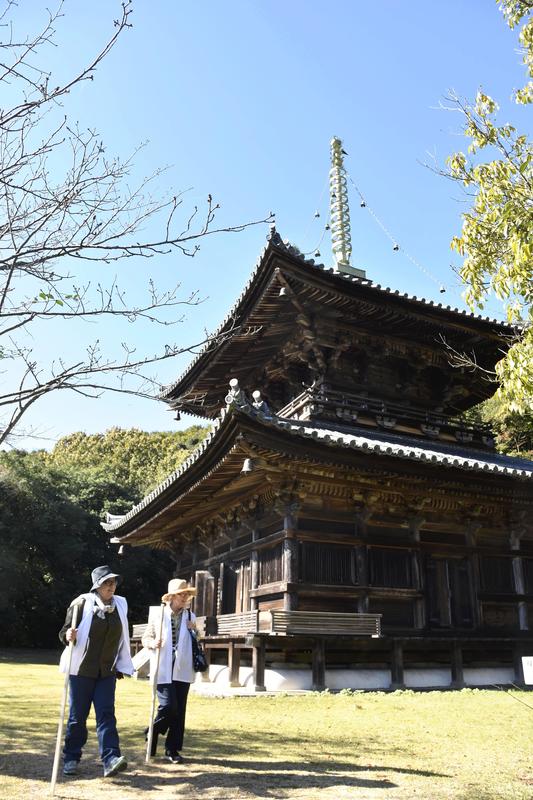
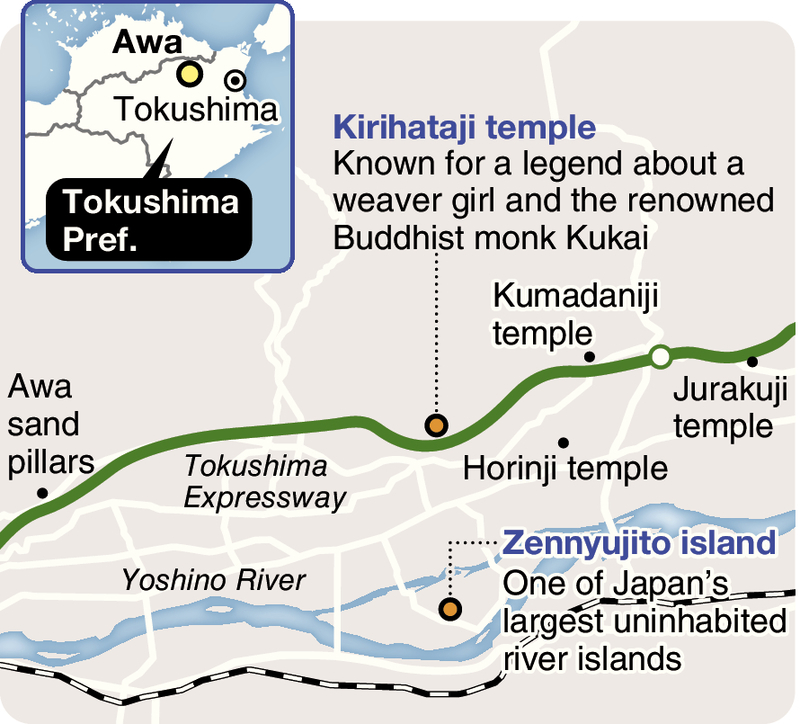
I parked my car at the Jurakuji temple, the seventh pilgrims' temple, and began walking along the Asan mountains. The agricultural area where grapes and strawberries are actively grown was quite a sight. A monument at the side of a road says that the land had suffered from drought until an agricultural waterway opened.
Along with the pilgrimage route, the culture of entertaining visitors takes root firmly. When I got lost, a driver of a small truck parked and kindly told me, "You should go this way." At a free rest stop in a converted vinyl greenhouse, Hiroichi Okuda, 90, offered me coffee. He said he had met 12,000 people over the 18 years since the rest stop opened. "I met many young people not in education, employment or training in a certain period, while now, many of the pilgrims are pensioners enjoying their retirement lives," Okuda said.
I visited the Kumadaniji temple, the eighth pilgrims' temple with the beautiful Deva gate, and the Horinji temple, the ninth pilgrims' temple where straw sandals were dedicated by visitors praying for the health of their feet. My legs gradually felt tired and heavy. The flat road turned into a climb, and as I passed through the gate of the Kirihataji temple, the tenth pilgrims' temple, I saw a 333-step stone stairway in front of me. It took four hours to walk the 12-kilometer route. After finishing my pilgrimage, I felt tired but comfortable, along with a slight sense of achievement.
Hot Tarai udon
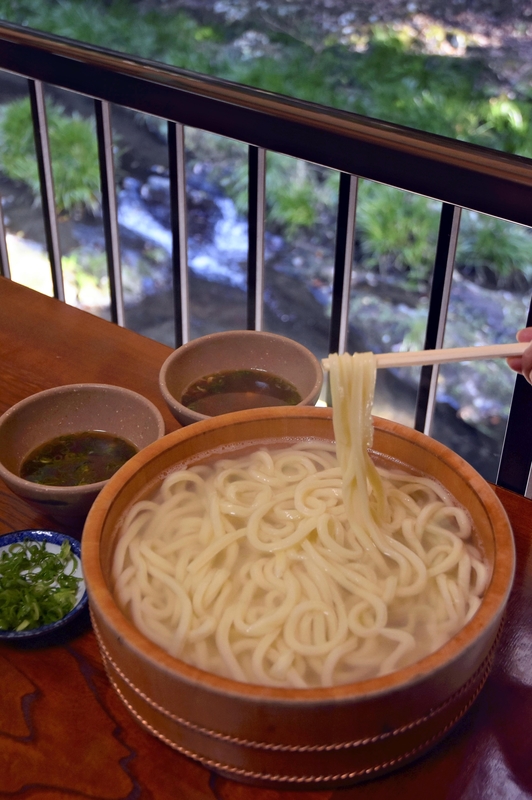
Along the Miyagochidani River in the mountains in the northeastern part of Awa, there are six restaurants offering Tarai udon (Udon noodles in a wooden tub). The dish is a local specialty unique to the area where wheat cultivation was widespread, as rice cultivation was difficult due to the lack of rain. The name "Tarai-udon" came from the practice of transferring udon noodles from a pot to a tarai tublike vessel called a hanbo, so that many people could eat the noodles together.
Niimiya is a long-established Tarai-udon restaurant, founded more than 50 years ago.
The owner said: "The main feature of our dish is homemade thick noodles kneaded with eggs. We make customers wait for 20 minutes to offer freshly-boiled noodles."
I ate noodles from the steaming hanbo vessel, and the sticky texture of the noodles went well with the dashi broth made from dried fish and kombu kelp. It was pleasant to eat the noodles while watching a fresh stream. The Tarai udon dish costs 560 yen.
Dry sweets using traditional sugar
In the border area between Tokushima and Kagawa prefectures, wasanbon traditional sugar is produced from the small sugarcane variety called chikuto, which is said to have been brought by pilgrims from the Kyushu region.
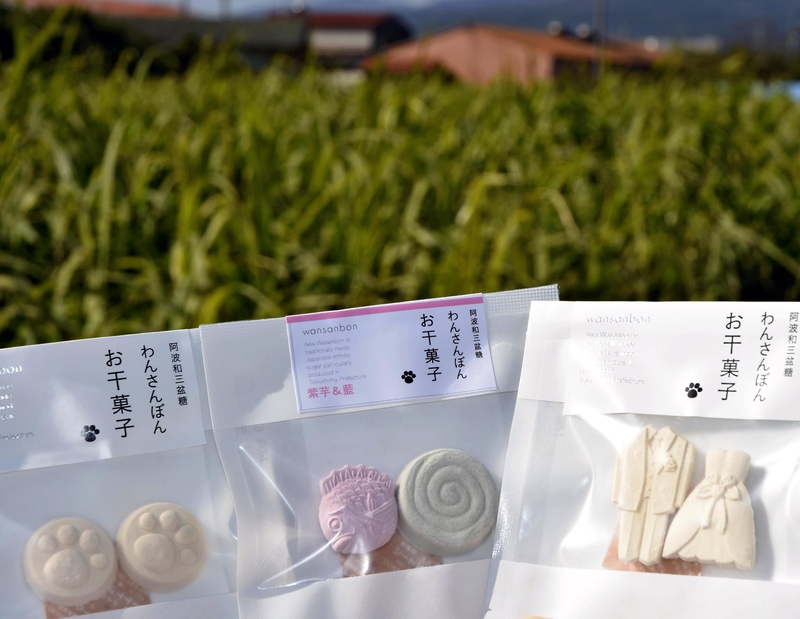
Koki Hattori of Awa has been producing and selling dry sweets called Wansanbon, using the sugar, since 2018. The sweets have various flavors and shapes, including a dog's paw.
Wansanbon sweets are available at a store of the same name, located next to the Hattori Sugar Manufacture, as well as online. The price is 378 yen for a set of two Wansanbon sweets.
Access
It takes about 80 minutes from Haneda Airport to Tokushima Airport. From the airport, it takes about 30 minutes by bus to Tokushima Station, and 17 minutes by taking the JR Tokushima Line limited express to Kamojima Station. You can get to Awa by taxi from the station.
For more information, call the Awa City Tourism Association at (0883) 35-4211. You can make a reservation for a guide to the Awa no Dochu sand pillars.
Read more from The Japan News at https://japannews.yomiuri.co.jp/