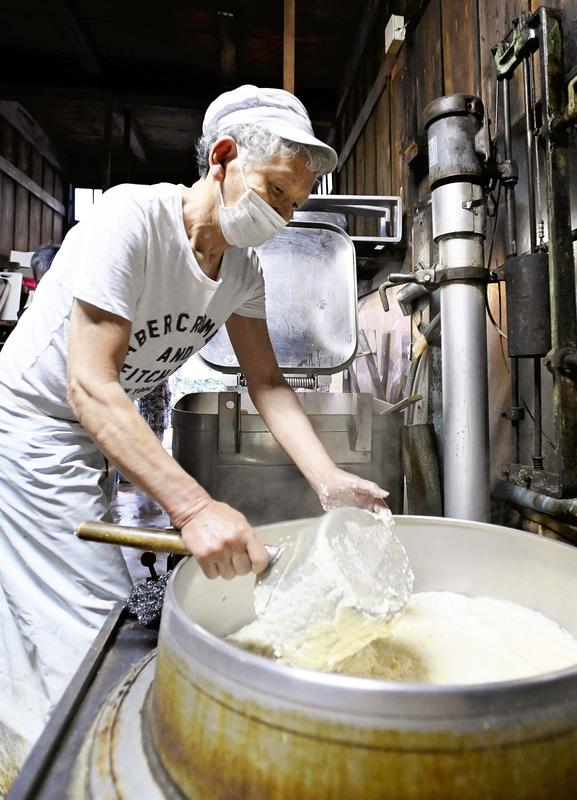
An increasing number of tofu producers, both companies and family-run businesses, have had to close in the wake of the coronavirus outbreak.
Tofu producers had already been experiencing poor business performances due to falling prices for tofu products, but they were dealt an additional blow when orders for school lunches were canceled after the widespread closure of schools and restaurants that had bought tofu from them temporarily closed.
An official from a business association of tofu producers said, "Even after lifting of the state of emergency, there are a remarkable number of tofu stores whose sales have not been able to recover to the levels before [the virus ordeal], so the dietary culture of tofu faces a crisis."
Tosho Takachi, a company that operated 17 tofu stores under the Hachioji Itchoan chain, mainly in Tokyo's western Tama region, went under on March 25.
Hiroshi Takachi, 54, who was president of the company, lamented the loss. "I felt confident that my company had supported food supplies in local communities, but ..."
His father established the company 54 years ago in Hachioji. Initially, his father sold tofu by walking the streets in residential areas while blowing a bugle.
The company developed new products, including spring rolls made of yuba soy milk skins and tofu with starchy black vinegar sauce, to expand tofu's potential as a food.
The new products became popular so the company began operating its stores in station buildings and department stores too.
Sales had been on the decline for the past few years, mainly because the prices of soy beans and other materials had risen and competition with other deli shops had become fiercer.
The company tried to recover by increasing school lunch sales and collaborating with door-to-door delivery service companies. But in the midst of these efforts, the coronavirus began to spread.
Since January, when the first infection in Japan was confirmed, elderly people, who were the stores' main customers, have refrained from going out. The company's sales plunged by about 40% from the year before.
When elementary and junior high schools were closed in early March, orders for about 3,000 sets of fried tofu in soup and other products for school lunches were canceled en masse.
Takachi said: "Though we had been trying to escape our poor business performance, the new coronavirus dealt the final blow and my company went under. As it all happened in a very short period of time, my mind still hasn't caught up to reality."
There were four tofu producers that collapsed with 10 million yen or more in debt due to the impact of the coronavirus crisis as of Monday, according to Tokyo Shoko Research Ltd., a credit research company. The four are in Hokkaido, Miyagi, Tokyo and Shizuoka prefectures.
It has also been confirmed that several other tofu stores in Tokyo closed down.
Zenkoku Tofu Rengokai, a Tokyo-based federation of about 1,000 tofu producers, said that management of these businesses is aging, and about 60% of tofu producers across the nation have no more than three employees.
As more people than before are eating at home due to calls to stay home, some tofu stores have increased their sales by selling products to supermarkets. But the federation said that a large number of tofu stores have faced a decrease in customers.
When restaurants temporarily closed or shortened their business hours under the state of emergency, it was another blow for the stores.
Echigoya, a family-run tofu store in the Kandatacho district in Chiyoda Ward, Tokyo, was established about 100 years ago. But in April, about 30 clients of the store, including izakaya pubs and soba noodle restaurants, that account for 80% of the store's sales, temporarily shut up shop following the declaration of a state of emergency.
The store could only sell its tofu to individual residents in nearby areas. Monthly sales, which had been about 700,000, yen plunged to about 150,000 yen.
Yoshiaki Ishikawa, 77, the third-generation owner of the store, said, "Sales of tofu, which is essential to the Japanese diet, have not seen any change even after disasters or economic slumps. But this is the first time the sales have worsened to this level."
The store is run by Ishikawa and two of his family members.
Among the store's business clients, many of them reopened in June, but some have permanently closed.
However, because the number of people who eat out at the establishments has not recovered, tofu orders at Ishikawa's store are about 50% of before the coronavirus crisis.
Ishikawa said he has dived right in to sales activities to find new client restaurants in the nearby district.
Read more from The Japan News at https://japannews.yomiuri.co.jp/