ASHIKAGA, Tochigi -- Textile companies in Ashikaga, Tochigi Prefecture, are working to restore the popularity of meisen, a soft-looking silk fabric that originated in Ashikaga and thrived in the 1930s.
The Ashikaga Fiber Technology Project was launched five years ago with the participation of 11 local companies. There were about 3,200 textile manufacturers in Ashikaga in 1966, but in 2009 this number had shrunk to 700. By 2014, the number had dropped further to below 500, and there was a sense of crisis in the declining textile industry.
"Although meisen itself is not well known nationwide, we have fostered craftsmanship for more than 100 years," said Kimisato Takahashi, 44, vice president of the project team and president of silk products manufacturer Gachamanlab Co.
"Also, various types of businesses have been involved in meisen production. So I thought we could make use of our strengths by working together," Takahashi said.
Promotional activities for meisen were first on the list for the project team. Taking an approach of "first they have to see the product and get to know it," it has held exhibitions both in Japan and overseas.
Drawing on its network of contacts, the team held an exhibition of meisen fabrics and dyed goods in Paris in 2016. Local designers and manufacturers who were interested in kimono asked questions one after another at the venue.
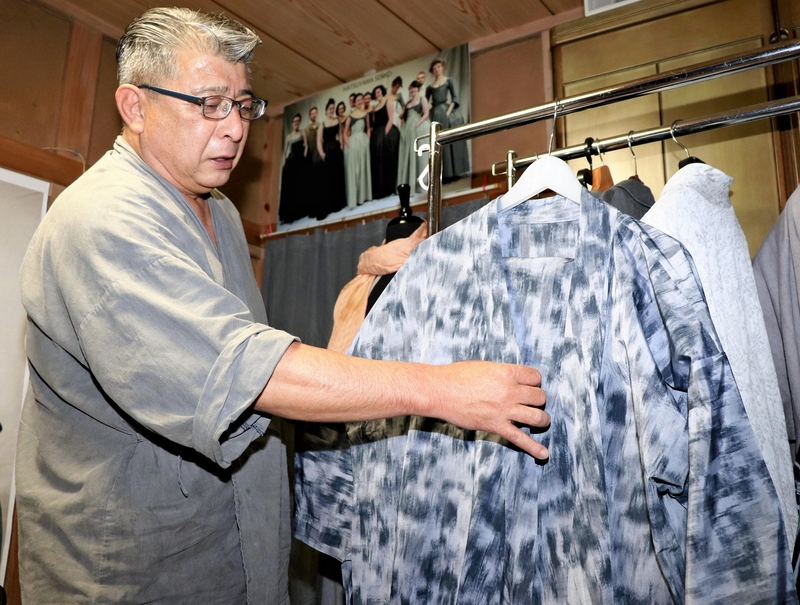
Fresh ideas from Paris became clues for how the team could utilize materials and artisanship. One of the project's member companies is Hatsuyama Dyers Corp., a long-established dyeing and processing business with more than 100 years' experience. It has been highly praised for the light coloring, deodorization and antibacterial qualities of its charcoal dyeing.
Cooperation between companies has increased, with Hatsuyama Dyers and other project participants jointly commercializing Ashikaga gasuri ikat (pattern textiles).
"I'm glad that I had this final chance to rebuild my business, and the textile industry in Ashikaga," said Hatsuyama Dyers President Ryoji Hatsuyama.
Hatsuyama started teaching charcoal dyeing at a local school in 2016, and in 2019, a professor from Ecole Duperre Paris, a top art school, visited Ashikaga to see the textile industry there. Exchanges between the two parties have increased.
In an effort to attract young talent, the team has been actively working with universities that offer special courses in fibers and textiles. Since 2016, members of the team have given lectures at Tama Art University and the Yokohama University of Art and Design, and also conducted a two-day tour of factories in Ashikaga, which includes practicing the skill of tenassen, or dyeing by hand.
These activities are in their sixth year, and the number of companies participating in the project has increased to 18.
"If people can take a handweaving tour in Ashikaga, or buy textile products such as meisen inexpensively, we can revitalize the whole town through tourism," Takahashi said.
"There are also many requests from designers in Japan and abroad to jointly develop products with dyed fabrics. It's going to be fascinating," Hatsuyama said.
There seems to be no end in sight to reviving the "fabric city."
Five locations have been designated as Japan's major production centers of meisen. In addition to Ashikaga, there is Chichibu in Saitama Prefecture; Isesaki and Kiryu in Gunma Prefecture; and Hachioji.
In the early 20th century, meisen was all the rage for everyday wear and fashionable dress for ladies because of its bold patterns, soft colors and reasonable prices.
With growing interest in kimono among young people and foreign tourists, there have been moves around Japan to use meisen in projects boosting regional development.
Since 2008, Ashikaga has held events where people can enjoy walking around the city wearing an outfit made with meisen. Chichibu lends meisen kimono to tourists, and Isesaki holds a fashion show and fair every March.
Read more from The Japan News at https://japannews.yomiuri.co.jp/