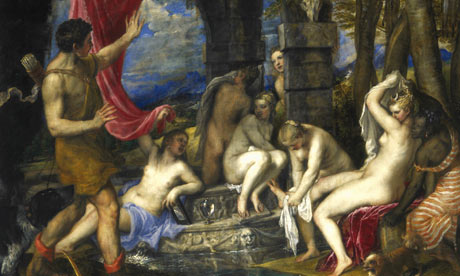
Titian's Diana and Actaeon is to finally go on view at the National Gallery in London on 12 September 2009, celebrating its recent purchase for the nation. This sumptuous feast of fleshly light, in which the carnal and the ethereal are somehow one and the same, is one of the grandest European paintings, a jewel in the crown of the career of this incredible painter. It is also a hymn to lust.
Why did this Venetian painter dedicate so much of his genius to sex? Before me as I write is a catalogue of Titian's complete works. It has plenty of religious works in it, of course, and many portraits whose poses have been borrowed and rivalled by painters down the centuries. But you can't avoid the seductions of Titian when you look through his complete works.
Two young men picnic with two young women in his early painting known in French (because it's in the Louvre) as Concert Champêtre. The men have fine clothes on. The women don't. Their poses are cleverly contrived to conceal their breasts – but if you think Titian is coy, read on. His painting Flora makes it clear that concealment and revelation, for him, are tactics in an artistic and sensual game: Flora wears a white shift that falls from her shoulder to reveal a nipple in a spectacular painterly seduction.
In his Sacred and Profane Love, Titian compares a richly clothed beauty with her companion who reveals almost everything. And then in 1538, with the Venus of Urbino, he portrays an unknown woman lying on her bed showing us her golden body in all its wonder.
It's the intimacy and closeness of this picture that takes you aback – you feel so near to her. And here, as in all Titian's sensual paintings, there is a love, indeed an awe. Diana and Actaeon, done nearly 20 years after the Venus of Urbino, takes a late longing look at women's bodies. In his earlier nudes the body is given to the spectator with a bold fullness: Flora and the Venus of Urbino are solid, real. The bodies of the bathing goddess and her companions in Diana and Actaeon are more elusive. It's flesh as such, not one woman, that is on view in this painting. It is the old painter's imaginary orgy.