
Welcome to this week’s blog. Here’s a roundup of your comments and photos from last week.
A very interesting question as to how we consume books was raised by conedison:
While watching a film or play I believe that if you find yourself complimenting the acting, directing, writing etc, this actually means the film/play isn’t really working for you. I think the ultimate compliment is subjectivity – to be so caught up in the story that its component parts go, for the time being, unnoticed. But is it the same while reading a book? Is the ultimate compliment subjectivity? After all, a film/play only takes a few, consecutive hours of our time while reading a novel requires a much more considerable investment. We start a book. We stop when the tube or train stops at our station. Hours pass. We return to reading on the way back home, then stop, then start again, perhaps in bed just before sleep. We repeat this process many times. In other words, we have many hours in between to evaluate what we’ve been reading. And through this inevitable evaluation do we not distance ourselves emotionally? Can we ever truly submerge our critical sense and just “go with the flow”?
Among the responses were:
Chris James: Maybe it’s a question of age/experience? I found it a lot easier to “go with the flow” when I was younger, but now, approaching the half-century, I find myself being much more analytical. I can appreciate a film for its tight script, wonderful photography, etc, whereas I never did when I was 15. It’s the same with books. In my teens and twenties, pulp fiction could leave me dazzled, but these days I appreciate more the skill of the writer in pulling me in to the tale; the turn of phrase, the deft plot twist.
judgeDAmNation: I can’t remember any specific examples offhand, but I can recall that with a number of books I’ve abandoned over the past year I can remember reading the first chapter or so and thinking to myself, “The prose is very good,” so I think you may have something here. If I’m properly enjoying a new book I’d instead be thinking “This is amazing,” or alternatively I wouldn’t think anything as I’d be too busy reading more of the book ...
Sara Richards: As a musician I love following music with a score, seeing how the composer has used and shaped his material. It makes for a truly immersive experience and although people have argued that this detracts from the music I don’t agree. So with books how does this work? I think I have been reading for too many years to be able to read uncritically. I don’t always like something that I consider cleverly written but I hate bad writing and, increasingly, bad editing.
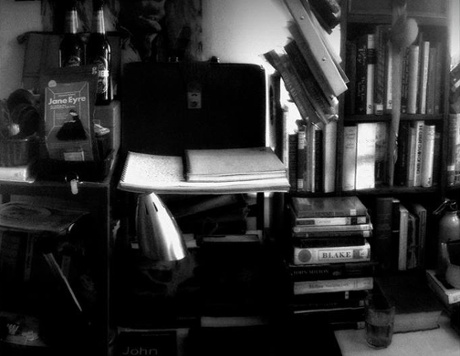
Thomas Pynchon’s post-9/11 novel Bleeding Edge has an interesting table-mate in Jeremy Simms’s dioning-room:

Up next
Our dining table, clear for a change. I am about to sit down and begin.
AggieH shared a discovery:
“Jeg er voksen, men det glemmer jeg når jeg vågner så brat.”
“I am grown up, but I forget that when I awake with a start.”
I am grown up, but I forget that when I read Ingvild H. Rishøi. Historien om Fru Berg. Literally: The Story of Mrs. Berg. Immediately one of the best story collections I’ve read. Stripped bare writing. Stripped bare nerves. I felt small again, and defenceless, as I read.
Children, childhood, youth & families: here is trouble and tension, here are everyday lives filled with splinters and cracks. Like Hanne Ørstavik, Rishøi makes you feel scared of the dark in broad daylight. Like Ørstavik, the effect is intensified because the writing is elegantly spare. And very well-turned, with teeny twists that catch you unawares.
AlleinAllein was one of the readers who discussed Michael Faber’s cult novel Under the Skin, turned into a film directed by Jonathan Glazer and starring Scarlett Johansson last year:
I wish I knew nothing of Under The Skin before I started reading it. I haven’t seen the film but heard a lot about it and through that, I knew a little bit and while it didn’t ruin any of it, I really would have liked to have been surprised by the developments because this book is fantastic. I won’t say anything lest I spoil anything for anybody else but Michel Faber’s prose is absolutely gorgeous, reminding me of a more sinister Fitzgerald and that makes the plot developments all the more intense. One thing I do wonder though is why is it that Scottish people are always written in dialect? You never get that with any other part of the UK but they always have tae talk laik tha’, y’ken?
Has anyone else had any book plots spoiled by the inevitable chitter-chatter about their film adaptations?
MsCarey is dipping into Europe: A History, by Norman Davies, “ in an effort to acquire some information about border changes in Central and Eastern Europe during and after WW1” – a choice that was received with enthusiasm by other readers.
I’m having my usual problem with non-fiction, fascinated whilst reading and promptly forgetting everything when I close the book. I could spend an unlimited amount of time with the Davies book though, splendid vistas lie in every direction.
Finally, to end on a seasonal note, MajorWhipple is reading Sarah Emily Miano’s Encyclopedia of Snow, which is actually a novel about relationships – as well as an ode to snow.

Encyclopaedia of Snow by Sarah Emily Miano
Had this sitting on my shelf for nearly a decade glaring at me. At least I thought it was glaring at me. Turns out it had something in its eye, possibly a wayward snowflake, and it was instead just waiting patiently for me to find the right moment. A joy of a book - its dedication to W.G.Sebald makes perfect sense now. Not to everyone's taste but certainly to mine.
If you would like to share a photo of the book you are reading, or film your own book review, please do. Click the blue button on this page to share your video or image. I’ll include some of your posts in next week’s blog.
And, as always, if you have any suggestions for topics you’d like to see us covering beyond TLS, do let us know.












