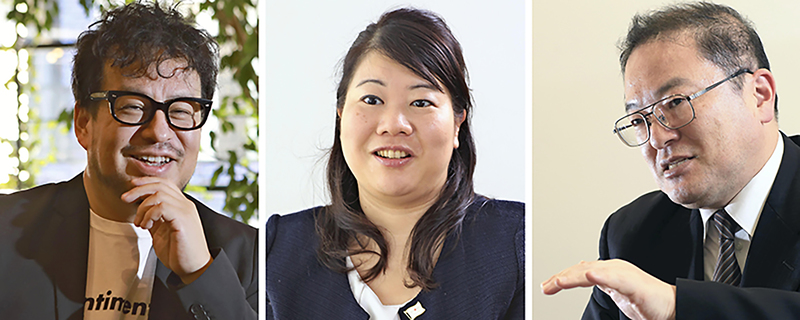
This year marks the 30th year of the Heisei era (1989-) and the beginning of preparations for the "post-Heisei" era, which will begin in 2019. The Heisei era was one in which much of the "Showa era (1926-1989) model" fell apart. As we transition to the new era, how should we live? We spoke to three people who were born in the Showa era and made their careers in the Heisei era to get some insight about the coming era. The following are excerpts from the interviews.
(From The Yomiuri Shimbun, Jan. 24, 2018)
Maintaining identity in pursuit of happiness
Minami Tsubouchi
Secretary General of the Global Fund for Education Assistance
The Heisei era was one in which society's norms were lost and life was tough. Amid the high economic growth of the Showa era, many people felt they could find a better tomorrow so long as they worked hard. They desired and pursued air conditioners, cars and other forms of material wealth.
Regardless of whether you embraced such a mentality or swam against the current, you could choose to live based on your own notion of "happiness."
Happiness was guaranteed to those who embraced the prevailing mentality. For example, lifelong employment was taken for granted. Even if you had trouble at work, you carried on and resisted discussing whether something was "worth doing."
In the Heisei era, these Showa-era norms were called into question. Lifetime employment was no longer the standard, and there was no guarantee of happiness even if you worked until the retirement age. On the other hand, the freedom to pursue fulfillment through other means -- such as by changing jobs -- increased.
Yet you always had to ask yourself: "Was it worth changing jobs?" Ultimately, no one could guarantee your happiness.
In this way, the Heisei era was a series of trials and errors. Speaking personally, I didn't take a direct path to the Beyond Tomorrow Program organized by the Global Fund for Education Assistance, which provides assistance to youths struggling with social or financial difficulties. My first job was at McKinsey & Company. I greatly hesitated to leave, as it's regarded as a top company.
However, I came to where I am after many twists and turns. While working in the Kabul office for the Association for Aid and Relief, Japan, a nonprofit organization, I witnessed the growth and development of a young child disabled by an unexploded shell and came to think that adversity can help people mature.
At World Economic Forum meetings in Switzerland, I learned of the amazing efforts of world leaders to resolve problems through dialogue.
There is still no clear definition for the "right" way to live. Amid the diversification of values, a clear model for absolute happiness will not be established. We pursue "fulfillment" and desire some stability in our lives as we continue to search for a comfortable place of belonging. Finding such a place is more difficult than expected.
The international school in Canada I attended for high school had students from about 70 countries. Everyone differed in terms of customs, culture and ways of thinking. I couldn't understand situations and get anywhere unless I asserted myself. The same can be true in Japan where people's values have diversified.
In an age without norms, it is essential to have defined personal opinions. Concerning the post-Heisei era, we also feel unease, much like we're looking through fog unable to see what lies ahead.
However, uncertainty is not the same as unhappiness. It is only natural that uncertainty accompanies new challenges. The uncertainty of a new challenge and the satisfaction of accomplishment are two sides of the same coin.
Tsubouchi, 40, graduated from Keio University and joined McKinsey & Company in 2000. After working for the Association for Aid and Relief, Japan and the World Economic Forum, she joined the Global Fund for Education Assistance in 2011.
Toward a mature society -- increasing productivity
Kotaro Kuwazu
Head of Nomura Research Institute's Center for Strategic Management & Innovation
Except for the war period, Japan's population grew continually throughout the Showa era. The standard of living also rose, and Japan's economy grew rapidly after World War II.
The beginning of the Heisei era marked a turning point. In 2008, the population reached a peak of 128 million and has since steadily declined. The economy is the product of human activity. It's inevitable that it will struggle as long as the population does not increase.
Japan's population is also aging. Euphemistically, this can be called a "mature" society, but in starker terms it can also be described as "stagnant." These two keywords seem to define the Heisei era.
Not everything has been bad. Information technology began to take off in 1988 and 1989. The proliferation of IT and telecommunications networks allowed for greater productivity in our jobs and better communication in our private lives.
IT has compensated for the population decrease, while our lifestyles have become more diverse and sophisticated. Since 2010, life has become even more convenient with the advent of smartphones. In the past, we relied on paper maps to make our way to destinations, but now we simply look up directions on our smartphones.
This is not necessarily reflected in the GDP, but our quality of life has considerably improved. Online retail services such as Amazon and the growth of online banking have significantly changed our lives.
Japan has reached a turning point. We're forced to change from the Showa-era growth society, in which the population continued to increase, to a mature society coping with population decline.
The 2020 Tokyo Olympics and Paralympics represent a major opportunity for Japan's social structure to pivot to a mature society.
Three key points merit consideration:
-- The first is the labor force. With technological progress, the elderly are gradually becoming more capable of working. Work styles must be reevaluated so people can contribute to society for as long as possible. Individuals must also earn money through their own means rather than rely on pensions, and more women must enter the labor force. Such changes are needed for Japan's economy to reach the next level.
-- The second is immigration. The rate of Japan's population decline is among the fastest in the world, but Europe and China are also moving in that direction. This is leading to a global competition for human resources. Why not more actively welcome talented individuals who can stimulate Japanese innovation? This would also lead to changes in Japanese's awareness of society.
-- The third is how to increase productivity. This is essential for maintaining the level and quality of economic activity, even with a declining population. Japan's machinery industries are still internationally competitive. Its materials and chemical industries also have potential.
Japan's global economic stature may very well have peaked during the Showa era, and a Showa-era mentality cannot be adopted for the post-Heisei era. We must also stop thinking of ourselves as a world power. Adherence to such thinking will lead not only to stagnation, but to a downward plunge if we took a wrong course. We must proceed down the path of a mature society.
Kuwazu, 53, graduated from Kyoto University and joined Nomura Research Institute in 1986 before becoming an executive fellow in 2017. He specializes in communications, technology and marketing strategy.
Foster an environment where creativity flourishes
Toshiyuki Konishi
Copywriter
In the Showa era, when you set out to form your company after graduating from university, your parents begged you to get a "regular job." Your girlfriend told you she would break up with you.
These days you would no longer necessarily expect such a reaction. This is because many people experienced drastic changes during the Heisei era in which major firms declined and new ones emerged and grew from obscurity. This shift in thinking also implies that the Showa-era model of attending a good university and entering a top company is obsolete.
There is no consensus on the definition of happiness and what one must do to achieve it. The post-Heisei era will also be one in which our value-diverse society carries on. In an age in which people are expected to live to 100, I hope this era will be one of "100 million creators." People must cherish the excitement that accompanies doing something new, even if it appears aberrant to others.
In the Heisei era, the internet brought about the excitement of creativity. Companies like Google and Facebook successively emerged in the IT sector, drastically changing our daily lives. Apple founder Steve Jobs and other IT luminaries repeatedly churned out new technological innovations.
Start-ups, which change society and our lifestyles through innovation, are thriving. Airbnb, a U.S. company that offers intermediary services for lodgings, and Uber Technologies Inc., which offers ride-sharing services, are now household names. In the post-Heisei era, start-ups are key to generating excitement for creativity.
The continued rift between ordinary people and the founders of such companies remains problematic. Many find IT to be confusing and tend to put up barriers.
These barriers are a detriment to both parties. Ordinary people are reluctant to try new services unless they understand how start-ups improve their quality of life. As a result, they can't benefit from such services. Start-ups will also be unable to achieve their goal of changing society and won't be able to make profits, leading to cash flow problems.
Fostering communication between both parties is one way to tear down these barriers. Such communication should forgo technical details and focus on concrete explanations of how these new services improve our lives. This is also the fundamental logic behind advertisements, which link the selling and buying parties.
If start-up founders enhance their communication skills, more people will benefit from their services and not be left behind. Creating a society to support start-ups, along with advertising their services, will contribute to the vitality of the next generation.
Konishi, 49, graduated from Osaka University. He joined Hakuhodo Inc. in 1993 before turning independent in 2006. He produced Suntory's Iemon-brand commercial message and did branding for ramen chain Ippudo.
(These interviews were conducted by Yomiuri Shimbun Senior Writer Yoshihisa Watanabe.)
Read more from The Japan News at https://japannews.yomiuri.co.jp/


.png?w=600)