Scientists have discovered that microscopic 'vampire' amoebae existed hundreds of millions of years ago, and they may have been some of the first predators on Earth.
By examining ancient fossils with an electron microscope, paleobiologist Susannah Porter from UC Santa Barbara discovered tiny holes which may have been drilled by vampiric microbes.
The tiny creatures are believed to be the ancestors of modern Vampyrellidae amoebae, and punctured holes in their prey before sucking out the contents of their cells.
Porter, who has published details of her discovery in the Proceedings of the Royal Society B journal, says the holes may be the earliest evidence that eukaryotes, the group of organisms which includes animals and plants, were preyed upon.
"We have a great record of predation on animals going back 550 million years," she said in a statement, "starting with the very first mineralised shells, which show evidence of drillholes."
"We had nothing like that for early life - for the time before animals appear. These holes potentially provide a way of looking at predator-prey interactions in very deep time in ancient microbial ecosystems."
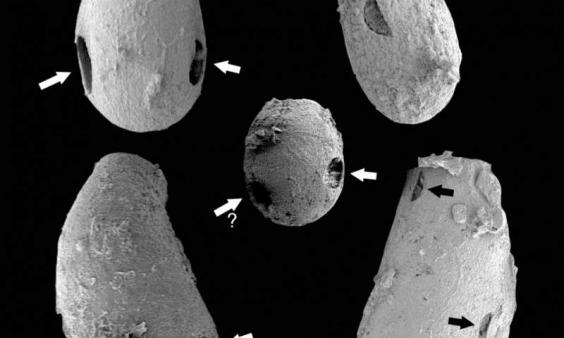
The holes were found in fossilised microbes from the Grand Canyon, which was once an ancient sea. At around 782 million years old, the organisms and their vampiric predators lived long before the advent of animals.
The evidence that predation occurred so long ago may shed new light on the history of life on Earth, Porter believes, particularly on the period around 800 million years ago when eukaryotes began to diversify and spread.
She now plans to conduct further research to find out more about these creatures, and whether their taste for blood increased or decreased over time as their habitat changed.