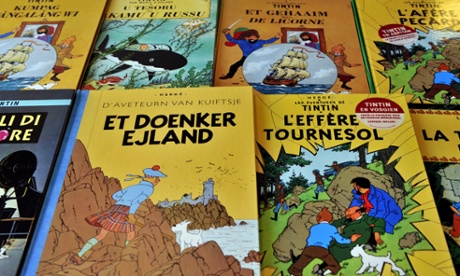
Quite what the incompetent detectives Dupont and Dupond – that’s Thomson and Thompson to British readers – would make of it is anyone’s guess.
Relatives of the legendary Belgian cartoonist and Tintin creator Georges Remi, known as Hergé, are crying “stop thief” after a Dutch court denied them the reproduction rights to the celebrated cartoons.
Hergé’s heirs have decided to appeal against a ruling earlier this week, based on a long-lost letter from Hergé, that these rights belonged to a publisher, and accuse the judges of being as confused as Captain Haddock after several bottles of whisky.
Hergé created The Adventures of Tintin, his first cartoon book to revolve around the boy reporter, in 1929. The first adventure in English was published by the Eagle comic in 1951.
By the time Hergé died in 1983, the comic series ran to 24 books and was one of the most popular of the 20th century. As well as television and radio shows, stage plays and video games there have been several films, including Steven Spielberg’s 2011 Hollywood offering, The Secret of the Unicorn, widely lambasted as an unpardonable crime against the original.
Since Remi’s death, the Hergé Foundation, run by the cartoonist’s widow Fanny and her British husband Nick Rodwell, has maintained an iron grip on Tintin’s image, making a small fortune on merchandising and pursuing all those who reproduce pictures of the boy detective without permission through the courts with the fervour of a snappy Snowy hot on the heels of Rastapopoulos and Red Rackham.
In 2012, the foundation’s company, Moulinsart SA, took a small 680-member Dutch fanclub, the Hergé Society, to court for printing extracts from Tintin books in their magazine.
However during the recent hearing, the lawyer for the fanclub had a trick up his sleeve – a 73-year-old previously unseen document in which Hergé signed over the rights to Tintin to his publisher, Casterman.
After the Hague court decided Moulinsart had no exclusive rights over material from the books, the question was whether other fanclubs would follow suit.
Moulinsart has accused the court of being “totally confused” and is appealing against the ruling.
“Editions Casterman only holds the rights to publish the Adventures of Tintin in paper form. Only Moulinsart SA can exploit or authorise the reproduction of the designs and drawings representing Tintin and all the characters in Hergé’s world,” it said in a statement.
“We will use all means of recourse that Dutch law offers us,” the company added.
Rodwell, who has described Tintin as the “Rolls-Royce of cartoons”, was accused of cashing in on the cartoon hero after he opened the world’s first Tintin shop in Covent Garden, London.
As Le Figaro wrote of Rodwell in 2011: “As in King Ottokar’s Sceptre, he’s the guardian of the room of treasure.”
Last year Hergé’s widow quashed rumours that a new adventure was being prepared, saying: “There will be no more Tintin books.”