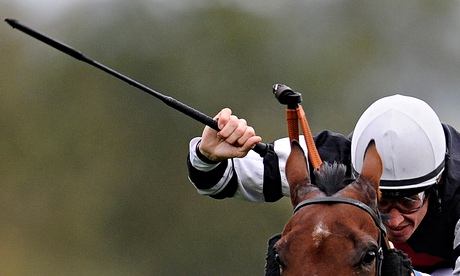
The controversial whip rules, which were back in the news again last week when the British Horseracing Authority came under fire for their original introduction, are certain to be the focus of attention once more when the major races are run this Flat season. Many commentators have called for more tinkering and the pundits and professionals demanding change will be emboldened by the fact that the respected ratings organisation Timeform has weighed in with its own suggestions in its Racehorses of 2014 annual out this week.
“The next review of the whip rules needs to consider dropping the ‘norm’, the specifying of a numerical limit, which is at the heart of most of the problems … the rules need to be flexible enough to fit individual cases and to place more emphasis on the incorrect use of the whip, rather than how often it is used,” states Timeform in its 1,216-page tome covering all aspects of last year’s Flat racing season.
Timeform’s strongly worded views on the subject, in essays on the Ascot Gold Cup winner, Leading Light, and Champion Stakes victor, Noble Mission, highlight the fact that “the publicity which usually accompanies whip suspensions given to leading jockeys after big races is an embarrassment to the sport and serves only to give the impression to the wider public that racing is cruel”.
It highlights that “research conducted for the last review of the whip rules showed that 99.25% of all runners from January 2004 to April 2011 competed without any whip offence taking place. In other words, misuse of the whip is not a welfare issue in racing.”
Timeform argues that racecourse stewards should be expected to exercise much more discretion and judgment over the use of the whip. It also points out that, if those calling for the disqualification of horses “[on whom] the whip was used in a way deemed unacceptable” were successful, it would have resulted in Brown Panther, the horse that finished fourth in the Gold Cup, getting the race in the stewards’ room.
Timeform concludes that “anything apart from the very careful use of any powers of disqualification would risk too many possible miscarriages of justice and would be certain to create controversy, as well as risking the alienation of punters and racegoers”.
Noble Mission’s victory was the highlight of the fourth running of the Champions’ Day at Ascot and Timeform remains sceptical that Great British Racing’s desire to attract the best horses in the world to the event is going to work, given that the mid-October date has resulted in testing going out on the track for the last three meetings run under that banner.
“British Champions’ Day seems more likely to become established in the long term as more of a meeting for good horses who relish the soft going, rather than as the single defining championship meeting – ‘the decider’ – which its promoters over-ambitiously hoped for,” states Timeform, which argues that Champions’ Day prize money is “irrationally high for events that are bedding in as domestic or at best ‘regional championships’ as opposed to events that might eventually come to be regarded as of truly global importance.”
One of the stables that should be challenging for honours at the end of this campaign is the Godolphin yard, which has underperformed for a number of years but which has started 2015 in excellent fettle. There are already plenty of pointers that this will be a much more productive season than last year, when its Group One victories in Europe totalled one.
The 2014 Middle Park Stakes winner, Charming Thought, will be one of the horses leading the charge for Godolphin which, as Timeform points out in its essay on the colt, brought in the riders William Buick and James Doyle to “bring some stability to [the stable] as it emerges from arguably its most important transitional period since its creation in the early 1990s, long-serving racing manager Simon Crisford having stood down in the wake of the 2013 steroids scandal”.
“New jockeys are only one piece of the Godolphin jigsaw, however, and it will always be the quality of the horses that is the key factor,” says Timeform, which says: “This was addressed some years ago by the acquisition of a number of horses, headed by Derby winner New Approach, who are now among those establishing themselves as top stallions at Darley, which had Dubawi, Shamardal and Teofilio in the top five in the Anglo-Irish sires’ table in the latest season.”
Godolphin will surely have another horse worthy of contending for the title “best horse in the world” soon and that honour in the International Classifications went to Just A Way in 2014, a “surprising decision” for Timeform, given that it did not even rate the colt the best from his country last year.
One runner who has added much to recent seasons, 2014 included, has been Cirrus Des Aigles and Timeform continues its campaign to allow geldings such as him to run in some of the world’s most important races that he is currently barred from.
“It is frustrating,” it argues, “that geldings are still discriminated against in Europe. One might have thought that, in an era when so many of racing’s traditions are being trampled underfoot by the ‘modernisers’, this old prejudice was one that would have been flattened by now.
“Cirrus Des Aigles was the highest-rated gelding in the history of [the] Racehorses [annuals] at his peak, and his continued ineligibility for the greatest race in his own country [the Prix de l’Arc de Triomphe] has been a travesty. The idea that geldings should be excluded from the top races because those races exist for the purpose of selecting the best colts for breeding belongs to a bygone era.”
The exclusion is not an issue in America but Timeform highlights a much more serious concern in the States, stating that “the biggest problem facing North American racing is the culture of drug use”.
Timeform highlights that “the organisers of the Breeders’ Cup, a meeting that should be the cause for celebration around the racing world, sought to introduce a ban on raceday medication but they found it impossible to swim against the tide and went back to the status quo in the latest season”.
The entry on the André Fabre-trained Flintshire, runner up in the Turf race at the meeting, discusses the use of drugs at the Breeders’ Cup in detail. Fabre famously refuses to use lasix on the horses he sends to the fixture and Timeform concludes that it would help if other handlers followed his example.
Timeform concludes: “If all the Europeans elected not to run their horses on medication at the self-styled ‘World Championships’ it might just encourage the likes of [prominent American trainers] Bill Mott, D Wayne Lukas and Todd Pletcher to join them in making what could be a powerful statement.
“Until the Breeders’ Cup is run under the same raceday medication rules as the world’s other major international events, no one can be sure that the victories there are the result simply of true ability.”
There are plenty of other subjects under scrutiny in the pages covering 10,940 individual horses including all the 9,700 runners that competed on Britain’s tracks last season, with a useful section comprising Timeform’s famous ‘p’ horses, those horses thought likely to improve, and the ones given a capital ‘P’, those considered ‘capable of much better’.
Of those on that list Convey looks very interesting if only for the colt becoming the first Sir Michael Stoute-trained two-year-old since the subsequent Derby winner Workforce to record a Timeform rating in excess of 100 when winning at Kempton in October. GM Hopkins, who finished in the pack when probably finding the softish ground against him in the Lincoln last Saturday, and Muthmir, who Timeform believes has the potential to take high rank among the sprinters, are two others to note particularly.
Racehorses of 2014 costs £79 and can be ordered online at www.timeform.com