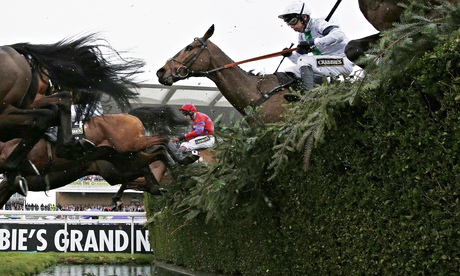
There were huge sighs of relief after the Grand National in April passed without serious incident for the second year running but Timeform fear the world’s most famous race may be headed for a fate similar to that of the FA Cup.
“It is hard to say precisely when the FA Cup was dealt the first of the blows that have arguably reduced its status to one notch above the League Cup, but its fall from grace is a cautionary tale, one that shows how difficult it can be for a sporting institution to maintain its profile in a fast-evolving world,” point out the racehorse ratings experts in their latest Chasers & Hurdlers volume, out this week.
Timeform are wholly opposed to any more changes to the National and firmly believe this year’s running highlighted the radical nature of the alterations already undertaken and the transformation of this unique event into a very different test of horse and rider. In particular, they contend, Pineau De Re would not have won before what they have dubbed the ‘plastic Grand National era’.
“Pineau De Re was anything but fluent at times,” point out Timeform, “shrugging off a number of mistakes and making a notably bad one at the 13th which he would almost certainly not have got away with at Aintree in the past.”
The softer, plastic cores of the redesigned forces has meant: “The National has become a different race, with the accent, if anything, now more on possessing thorough stamina than on measured, safe jumping which used to be a prerequisite.”
They conclude: “It is too early to be able to assess whether the extreme steps taken, with the aim of reducing the risks, will also reduce the excitement for the watching public over the years and threaten the race’s enormous popularity.”
If the victor of the most famous and valuable race of last season was fortunate, then according to Timeform the winner of the most prestigious event in the jumps calendar – the Cheltenham Gold Cup – was even more so. Lord Windermere will always be the horse credited with victory in the 2014 running of chasing’s Blue Riband but, while praising the connections of On His Own for their sporting acceptance of the verdict, Timeform reckons that there would have been a fair prospect of overturning the decision of the Cheltenham stewards not to alter the placings after the closest ever finish to the race.
Their argument is: “The winning distance was a short head and no good advocate would have had difficulty [at a British Horseracing Authority inquiry] arguing a convincing case that [Lord Windermere’s] marked deviation caused sufficient interference to cost [On His Own] at least the couple of inches by which he was beaten.”
The BHA itself comes in for some stinging criticism for what Timeform state is the racing rulers’ “growing secrecy”. They begin their essay on the Jonjo O’Neill-trained Johns Spirit with the question: “What goes on behind the scenes in British racing?” Their answer is that you won’t find out much from the sport’s regulatory body.
The Godolphin drugs scandal (at the conclusion of which the sport’s followers “were only allowed to see the report’s conclusion and a few selected paragraphs”) and the Sungate episode (“when the identities of eight of the nine trainers and 34 of the 43 horses involved were never published”) are given as prime examples, while in this edition of Chasers & Hurdlers it is the episode involving “the rumpus over the Cheltenham medical team’s treatment of Davy Russell at the 2013 Cheltenham Festival” that exercises the Timeform team.
“Part of the function of any regulatory body is to reassure followers of the sport that the game is ‘clean’. Openness is a prerequisite. Human nature being what it is, actions by the BHA that smack of a ‘cover up’ or ‘whitewash’ can have unfortunate consequences for racing’s integrity, particularly its integrity as a betting medium,” they conclude.
The most anticipated race of the jumps season this side of Christmas must surely be the clash between Sire De Grugy and Sprinter Sacre in the Tingle Creek Chase at Sandown in December. It will be a pity if Sprinter Sacre, rated the third greatest jumps horse in Timeform history behind only Arkle and Flyingbolt, doesn’t achieve the resonance in the general public’s mind that Arkle, Red Rum, Desert Orchid and Istabraq did and the Sandown race will be a chance for him to begin to do that.
“No jumper’s season was savoured quite so much as that of the Desert Orchid Chase winner Sire De Grugy [the race in which Sprinter Sacre pulled up with a heart condition]. His bold campaign was certainly enjoyed to the full by his enthusiastic owners and appreciated by the wider public who voted him Jumps Horse of the Year,” point out Timeform, who, perhaps a little surprisingly, have awarded More Of That the honour of their horse of the campaign.
More Of That, the winner of the World Hurdle at the Cheltenham Festival in March, “has made astonishing progress to reach top championship standard over hurdles in just five starts and there is no more exciting prospect on the British jumping scene”, believe Timeform who, in their essay on the O’Neill-trained runner, recall the achievements of Captain Christy, the last horse to win the Cheltenham Gold Cup (back in 1974) in his first season over fences.
There are countless other topics discussed in the 1,000-plus pages covering the A–Z of the 9,185 runners from the 2013-14 season which covers every British runner plus the cream of the Irish crop but it’s winner-spotting that many will want to purchase this annual for.
Of the horses in the two-page section devoted to those “thought capable of noteworthy improvement” the names of Beat That, Mayfair Music, whom I recall seeing make her racing debut at Fakenham, and Kings Palace stand out as a trio of obvious candidates to me while Brother Du Berlais, Capote and Deputy Dan will be ones of particular note when switched to fences.
Timeform’s Chasers & Hurdlers is published by Portway Press at £75.