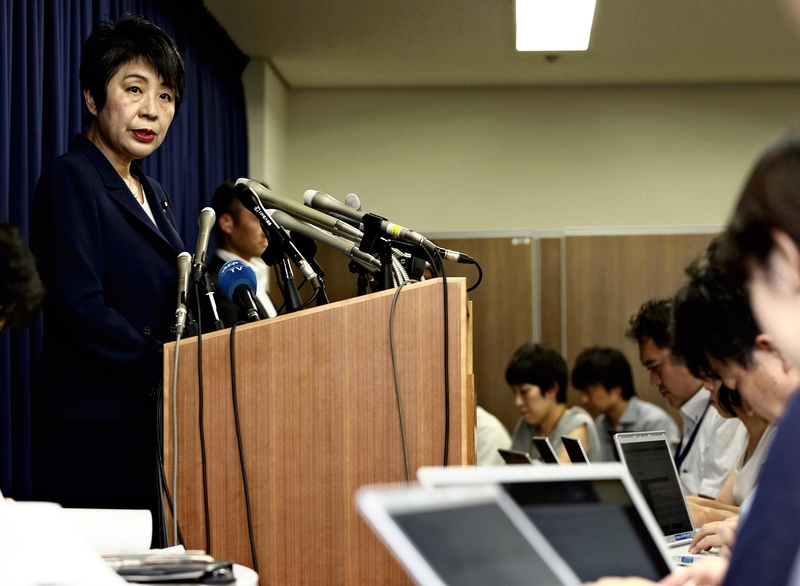
The Justice Ministry executed six former Aum Supreme Truth cult members on Thursday, less than three weeks after seven others had their death sentences carried out. The extraordinary decision to execute all 13 former Aum members whose death sentences had been finalized -- including cult leader Chizuo Matsumoto, also known as Shoko Asahara -- in such a short period was partly due to looming events that could have constrained the ministry's ability to carry out the punishments.
The 13 former Aum members' death sentences, handed down in relation to a series of cult-related incidents, had been finalized between 2005 and 2011. The Criminal Procedure Code stipulates an execution order must be given within six months of the sentence being finalized.
However, since 2012, Aum accomplices who had been on the run were arrested and went on trial, and several former members on death row appeared in court as witnesses in these trials. Consequently, the prospect of the executions going ahead was unlikely until all these trials were completely wrapped up in January this year.
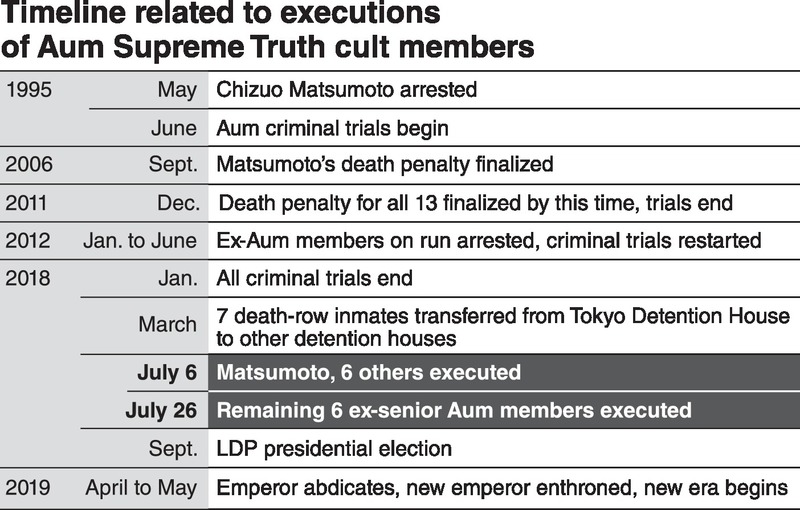
In March, the ministry started seriously considering the timing of the executions. Around this time, seven of the 13, who had all been confined at the Tokyo Detention House, were transferred to other facilities.
After much consideration, the ministry found the "time limit" for carrying out the death penalty would be May 2019 -- when a new Japanese era begins. The Aum-related incidents that brought unprecedented harm and suffering started in 1989, when the current Heisei era began.
"These incidents were defining crimes of the Heisei era," a senior Justice Ministry official said. "Many ministry officials shared a strong desire to settle these crimes before the era comes to a close."
In May, Justice Minister Yoko Kamikawa gathered court records and other materials relating to the 13 death-row inmates and started considering the feasibility of carrying out the executions.
At the time, the regular Diet session was going on and lawmakers were deliberating several important bills, including one to amend the Civil Code to lower the age of adulthood from 20 to 18.
Other considerations came into play when deciding the timing of the executions. There is a strongly held opinion that executions should be avoided in August, a month when there are several major events to mourn the nation's war dead, including the anniversaries of the atomic bombings of Hiroshima and Nagasaki and the end of World War II.
In addition, the ruling Liberal Democratic Party will have a presidential election in September, and if a justice minister opposed to capital punishment was appointed following the election, it would become unclear when the executions might be carried out. From the ministry's perspective, July was the only realistic option.
Kamikawa signed the execution orders for Matsumoto and six other death-row inmates on July 3. According to sources, the justice minister decided to go ahead with the executions on her own in late June, after an extension of the Diet session had been decided and she had confirmed all the important bills her ministry was overseeing were certain to be passed.
Hierarchy determined order
The death sentences of people involved in the same crime are, in principle, supposed to be conducted simultaneously to prevent death-row inmates from becoming psychologically unbalanced and to ensure the punishments are carried out fairly.
The ministry initially considered executing all 13 on the same day. However, this plan was shelved because each detention house can carry out a maximum of three death sentences in one day. Each detention house has only one execution site, and it takes time to prepare the area and carry out the sentence. Furthermore, all officers in attendance when an execution is conducted must be replaced for the next death-row inmate, which places considerable strain on the facilities and personnel.
Consequently, the ministry instead had to decide in which order the executions would be carried out. To determine this, Kamikawa reportedly focused on the "responsibility of their role within the religious group."
The seven executed on July 6 were involved in many of the cult's crimes and were senior figures holding positions such as "ministers" and "agency heads" under the cult's system of "ministries and agencies." Among them, Yoshihiro Inoue had been the "intelligence minister," and Kiyohide Hayakawa was the "construction minister."
"Given that these were organized crimes, I think [Kamikawa] decided it would be easier to gain the public's understanding if members who had heavy responsibilities and positions near the top of the organization's hierarchy were executed first," a senior official said.
After July 6, there were mounting concerns within the ministry about the psychological condition of the remaining six former Aum members. Even within detention houses, death-row inmates would have been able to learn, by reading newspapers and through visitors, that the other executions had been carried out. It was possible that anxiety triggered by wondering, "When will my turn come?" could have caused abnormalities in their physical or mental state.
The interval between the two execution dates was 20 days. Until now, the shortest interval between executions since November 1998, when the ministry began releasing information after carrying out death sentences, had been 47 days. It appears concern over the psychological state of the remaining group of former Aum members on death row was a factor in carrying out their executions so soon after the first group.
Read more from The Japan News at https://japannews.yomiuri.co.jp/