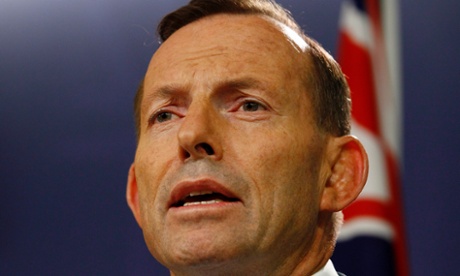
The prime minister’s pitch for survival is a plea for more time and a demand that the Liberal party not repeat the former Labor government’s chaos and dysfunction.
But his government is already chaotic and dysfunctional. And more time to do what?
This is how Abbott outlined his future agenda on Friday, before the dramatic news of the spill motion broke.
“The plan at the National Press Club on Monday, what we’re doing for childcare on Tuesday, improving national security on Wednesday, new laws to protect our people and keep them safe on Thursday and today a tax cut for small business.”
Every single one of those things is either not yet a policy, is an existing policy or is contradictory nonsense.
The “plan” at the national press club was to stick to the old talking points about the “debt and deficit disaster”, but then claim that the “hard work” had already been done by last year’s budget (which forecast bigger deficits than treasury revealed during the election campaign and included savings policies that have not passed, and almost certainly will not pass, the Senate).
This disconnect becomes even starker when you factor in slower growth and lower revenue forecasts. Avoiding big cuts makes political and economic sense, but if a return to surplus is more than a decade away, the “debt disaster” lines might need to be toned down a bit.
The “childcare plan” to deliver “more money into families’ pockets” supposedly revealed on Tuesday, has not in fact been revealed at all. It will be based on the recommendations of the Productivity Commission, but the government hasn’t released the final report which it received last October. Which seems to make all these visits to childcare centres to talk about a “new policy” a bit premature.
The recommendations of the draft report were sound, but would cost about $1bn more than the current $7bn a year spent by the commonwealth on childcare subsidies, and propose a means test that would mean better-off families receive less cash. That is fair and a good idea, but also a difficult political sell. And under the government’s new fiscal rules, which appear to be that there should be no more cuts except to offset new spending, it would also require spending to be cut from somewhere.
The national security improvements on Wednesday appear to be receiving the report on the Martin Place siege, without yet releasing it or telling us what the government would do about it.
The “new laws to protect people and keep them safe” on Thursday were the same old laws on metadata retention the government announced last year, about which we have not seen exact details, costings or a crucial parliamentary committee report.
And the small business tax cut on Thursday appears to be the Coalition’s existing tax policy packaged up a different way. Under the existing (confused) policy all businesses get a 1.5% tax cut but then big business pays a 1.5% “levy” for the now-ditched paid parental leave plan. That meant big business kept paying 30% and those small businesses that are incorporated paid 28.5%. Under what seems to be the new policy the “levy” is abolished and small business gets a 1.5% tax cut. Which means big business pays 30% and small business pays 28.5%. Yes, Tony, we see what you did there. So did the business lobby on Friday.
It’s not a very convincing vision. It’s hard to see how it would restore confidence, which means it is hard to see how it would end the current political chaos.
Those backing the prime minister are urging bold measures such as demanding that he dump his chief of staff Peta Credlin. So far Abbott has been intransigent in his belief that it is morally wrong to blame a loyal staffer for his own mistakes. It may be too late for a sidelining or sacking to make much difference anyway, since backbenchers have worked out that while Credlin’s influence has been a big issue internally, the voters are worried about what the Coalition has been actually doing.
But Abbott’s backers are pushing for a Credlin shift and a ditching of the GP co-payment and higher education reforms, as a way of brokering a reprieve. (Formally ditching those policies would of course leave the disconnect between deficit rhetoric and fiscal reality even larger.)
Those determined for leadership change kept pouring fuel on the fire, and then lit the match at 1.26pm on Friday. It came from two backbenchers from Western Australia. Luke Simpkins, the man who will move the spill motion, clearly prefers Julie Bishop. But he also revealed he’d spoken about his intentions 24 hours earlier with John Howard’s former chief of staff, Arthur Sinodinos, who is close to Malcolm Turnbull.
Then the prime minister revealed that Bishop was opposing the spill motion, and at the time of writing neither Bishop nor Turnbull had declared. But Bishop said she was opposing the spill motion only “due to cabinet solidarity and her position as deputy”, which didn’t rule out that she would stand if the motion succeeded.
Dissidents have so far focused their attacks on policy. Given climate policy brought about Malcolm Turnbull’s downfall as leader last time it is obviously the most difficult issue for him to negotiate. Publicly he is pointing to comments made last year saying Direct Action has to be given time to work. As I have written, Direct Action contains provisions that a future prime minister could choose to “dial up” to create an effective baseline and credit trading scheme, without any legislative change. Conservative climate-sceptics and the Nationals are very nervous.
Both Turnbull and Bishop would face the same problem Julia Gillard did when she overthrew Kevin Rudd – they have been part of Abbott’s cabinet and the government’s current direction.
And for its part, the opposition has already moved on and is gunning for Turnbull, presumably as an attempt to dissuade the Coalition from moving to a more formidable opponent, or to rehearse the arguments it will have to use after a change.
So as things stand, Australia is paralysed by a debate about whether it should be led by the current prime minister without a clear plan or a new Coalition leader, who, since they are not yet named, has no plan either. And our alternative is a Labor opposition that has yet to unveil any policies. And they wonder why the electorate is volatile.