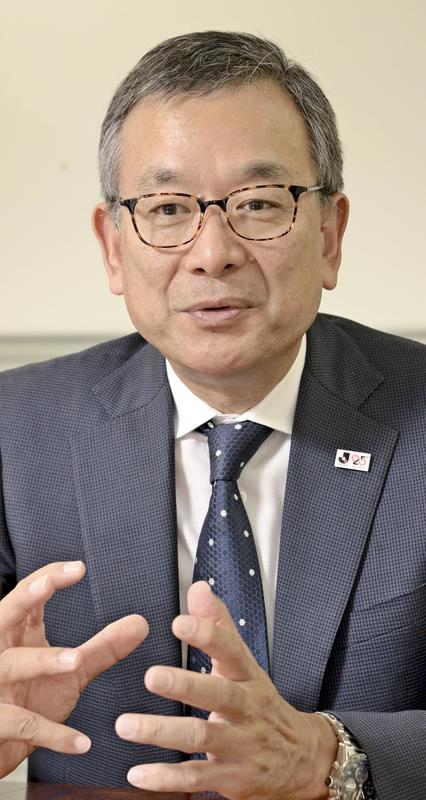
This year, the J.League celebrated the 25th anniversary of its launch on May 15, 1993. Mitsuru Murai became the league's fifth chairman in 2014, and began his third term in March. The Yomiuri Shimbun asked Murai how he will guide the professional soccer league into the future.
Linking of the 3 rings
Murai came to the league from Recruit Co. He has promoted reform since he took up his current post, leaning on his managerial perspective. However, the chairman expressed regret when he referred to the three pillars of the J.League -- competition, business and regional contributions.
"Looking back at myself, I struggled to move ahead with discussions that integrate [the three principles] as a whole," Murai said.
According to the chairman, the league will reinforce mechanisms that connect these three pillars. The more skilled players and coaches are developed, the better each J.League club will perform. That will increase the number of fans, which will bring more revenue to the clubs.
Murai envisages a cycle in which those profits will be invested into the development of young talent.
"Linking these three [philosophical] rings is important -- I call them the three dango dumplings on one stick," Murai said.
To lay the groundwork for his vision, Murai brought two key figures to the board. He appointed as executive director Masaaki Kimura, former president of the J2 club Fagiano Okayama who worked at the U.S. finance company Goldman Sachs, and certified public accountant Emi Yoneda as a full-time director. They will support Murai with Vice Chairman Hiromi Hara, who has led multiple J.League clubs. The chairman plans to draw out a 12-year plan, to run through 2030, that will be reexamined every four years.
Collaborating with local communities
Murai expressed his belief in the league, saying, "The essence of the J.League is that the clubs compete with each other while bearing the names of the local regions."
He believes that ideally, clubs will carry on their philosophies and principles, regardless of changes in coaching or club presidents.
However, only a few clubs have deeply embedded philosophies and principles at the moment. Murai said the philosophies could be simple, such as their attitude toward referees.
"For instance, a philosophy could be a statement such as, 'We will never protest [referee calls]. We will not show pain, no matter how much it hurts.' Wouldn't it be more interesting if each of the 54 clubs had their own unique flavor?"
Murai said the community-based approach of the J.League would also change. Instead of clubs doing something for local communities, it will become more important in the future for local nonprofit organizations and other groups to utilize the clubs' promotional abilities.
In April, the league opened a headquarters for "social collaboration."
"The J.League will bring together activities of each club that are highly versatile [and can be applied to others], so that many clubs and citizens can take advantage of them," Murai said about the headquarters' aim.
Import limits to be reviewed
Four J.League clubs have taken part in this season's AFC Champions League, but three of them were eliminated in the group stage. Murai is considering discussing a review on the import-player limit, which is currently at three players per team in principle, to enhance the competitiveness of J.League clubs. "The J.League also has the major purpose of improving the national team," Murai said.
"We want to discuss competition within teams such as a framework in which all players, including the Japanese, won't be guaranteed a spot on the pitch without earning it."
1st chairman pleased with league's progress
Saburo Kawabuchi, the inaugural J.League chairman, celebrated the 25th anniversary by saying: "The J.League is doing things that are far more advanced than what I had imagined. I have nothing but gratitude for everyone involved."
Kawabuchi, now serving as adviser to the Japan Football Association, pointed out that the national team is placed above [the J.League in such aspects as popularity]. "However, it is desirable for the prosperity of J.League teams to lead to the prosperity of Japan's soccer, and for the national team to be included in this line of development," Kawabuchi added.
"I hope the J.League will play a central role in Japanese soccer -- I look forward to a further push ahead."
(From The Yomiuri Shimbun, May 15, 2018)
Attendance surpasses 10 million
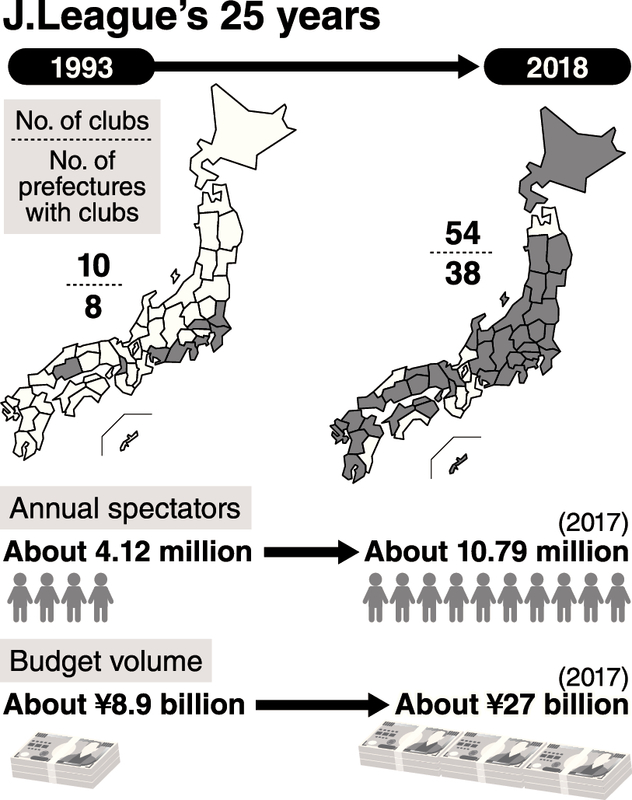
The J.League was launched in 1993 with 10 clubs from eight prefectures. It adopted a two-tier structure in 1999 with the addition of the second-division J2.
At the time, J1 comprised 16 clubs, while J2 included 10 teams. In 2014, J3 was instituted, and there are now 54 clubs (18 in J1, 22 in J2, and 14 in J3) across 38 prefectures. Total annual attendance, which was 4.12 million in 1993, surpassed 10 million for the first time in 2015.
In 2017, the league signed a 10-year, 210 billion yen broadcasting rights deal with Perform Group, a British-based major video transmission company, which dramatically expanded its fiscal scale.
Read more from The Japan News at https://japannews.yomiuri.co.jp/